Hospitality-grade floor protection · Sizing help before you order · Apply for a business account
Sizing help · Apply for a business account
Hospitality-grade floor protection · Sizing help before you order · Apply for a business account
Sizing help · Apply for a business account

On a sloped or uneven floor, a rigid foot has to be adjusted leg by leg. This base pivots up to 9° on its own, tilting to match the floor angle and holding full contact without manual fiddling at each foot.
We make this size in production runs, so there is none on the shelf today. Tell us how many you would want and you go on the list for it. When enough people ask for a size, we run it, and the people who asked hear about it first.
We stock a limited range of threads and lengths. Tell us what you need and we will confirm availability and pricing by email.
Buying in volume? See business pricing & samples ↓
Standard leveling feet have rigid bases. They adjust height but cannot compensate for the angle of the floor under each leg. On a floor that slopes, a rigid base contacts only part of its surface, concentrating weight on the edge rather than distributing it evenly. Self-leveling tilt adjustable leveling feet solve this with a pivoting base that tilts up to 9° in any direction, automatically conforming to the floor angle. The base maintains full contact with the floor surface regardless of the local slope or irregularity under each leg. Self-leveling tilt feet articulate, so the base meets the floor flat whatever its angle.
PA (polyamide) body with pivoting tilt mechanism. Zinc-plated steel threaded rod. 9° omnidirectional tilt. Self-leveling tilt adjustable leveling feet are pivoting base leveling feet for furniture on significantly uneven floors where rigid bases cannot maintain full contact. 2 base diameters: Ø 30 and 48 mm. M8 and M10 threads. Rod lengths 30 and 50 mm. Static load: 80 to 120 kg per foot. Black. Sold in packs of 4, adjustable in steps of 2 at checkout.
The tilt mechanism is built into the PA base. The base consists of two parts: an upper section that connects to the threaded rod and a lower section that contacts the floor. The lower section pivots relative to the upper section on a spherical joint, allowing up to 9° of tilt in any direction.
When the furniture is placed on an uneven floor, the weight presses each tilt base against the floor surface. The lower section of each base pivots to match the local floor angle under that specific leg.
No manual alignment needed. The pivoting mechanism tilts the floor-contact surface to match the slope. Full base contact is maintained even when the floor angle varies from leg to leg. The tilt is passive and gravity-driven.
The threaded rod still provides manual height adjustment for overall furniture leveling. Turn each foot to raise or lower that corner. The tilt mechanism continues to conform to the floor independently of the height setting.
The difference between tilt and rigid becomes most apparent on floors with localized unevenness, where the surface angle varies from one leg to the next.
A rigid base sits flat. If the floor under that leg slopes, only the downhill edge of the base contacts the floor. The uphill edge lifts off. Weight concentrates on the contacting edge instead of distributing across the full base area. This concentrated load can indent soft surfaces, create instability, and cause the furniture to rock even after height leveling. The furniture may be level overall but still unstable because the bases are not making full contact.
These feet pivot to match the floor angle. The entire base contacts the floor, distributing weight evenly. No edge loading. No concentrated pressure points. The furniture sits both level (from the threaded rod adjustment) and stable (from the full-contact tilt base). Tilt leveling feet for furniture on floors where rigid bases cannot maintain full contact. 9 degree tilt leveling feet that conform automatically.
Height adjustment plus automatic floor angle compensation. The National Wood Flooring Association (NWFA) recommends protective contact surfaces on all furniture legs, and the tilt base ensures that contact surface is fully engaged with the floor rather than balanced on an edge.
The primary advantage. On old buildings with settled floors, commercial kitchens with sloped drainage, warehouses with uneven concrete, and any space where the floor angle varies from spot to spot, self-leveling tilt adjustable leveling feet conform to whatever angle the floor presents. No manual alignment. No shimming. No repeated adjustment cycles trying to get a rigid base to sit flat on a surface that is not flat.
Because the base tilts to match the floor, the entire base area contacts the surface. Weight distributes evenly. On soft surfaces, this prevents the edge indentation that a rigid base creates on sloped surfaces. On smooth, hard flooring, full contact provides maximum stability. Unlike leaving furniture with rigid bases on uneven floors, tilt feet maintain protective full-surface contact automatically.
When furniture slides or is moved to a different spot on an uneven floor, each new position may have a different floor angle under each leg. Rigid bases need re-leveling at each new position. Self-leveling tilt adjustable leveling feet adapt automatically. The tilt mechanism re-conforms to the new floor angle without any adjustment. Self-leveling feet uneven floors present no longer require re-leveling at every new position.
Wobble happens when not all feet make solid floor contact. On an irregular floor, a rigid base may contact at one point and pivot around it, creating a rocking motion. The tilt base fills the gap by conforming to the surface, eliminating the pivot point. The furniture sits stable at every leg position because every base maintains full contact.
Same screw-in process as any leveling foot. The tilt mechanism activates automatically when the furniture is set on the floor. No manual alignment of the tilt angle is needed.
Self-leveling tilt adjustable leveling feet come in two base diameters. The choice depends on furniture weight, desired contact area, and the leg diameter.
707 mm² of tilting contact area. M8 (80 kg) and M10 (120 kg). For standard dining tables, office desks, and residential furniture where the compact base stays proportional to the leg. Three variations with 30 and 50 mm rods provide flexibility in adjustment range. Self-leveling tilt adjustable leveling feet in the Ø 30 mm diameter handle most residential and light commercial needs.
1,810 mm² of tilting contact area, more than 2.5 times the Ø 30. M10 only (120 kg). For heavy conference tables, commercial kitchen tables, and industrial workbenches where maximum tilting surface area provides better load distribution on the sloped floor. Self-leveling tilt adjustable leveling feet in the Ø 48 mm diameter handle the heaviest applications where floor unevenness and furniture weight both demand the widest possible tilt platform.
For furniture manufacturers and facility managers, self-leveling tilt adjustable leveling feet are specified when the furniture will sit on floors with known unevenness. Old buildings, renovated spaces with original floors, commercial kitchens with drainage slopes, and warehouses with rough concrete all benefit from tilt feet over rigid bases.
On projects where the floor condition varies across different rooms or areas, self-leveling tilt adjustable leveling feet provide consistent stability regardless of the specific floor angle under each leg. The 9° range covers virtually all building floor conditions except severely damaged or extremely sloped surfaces. For production quantities, visit Business Solutions.
Because all leveling feet share the same M-thread interface, you can use self-leveling tilt adjustable leveling feet on some legs and rigid-base feet on others. On a table where two legs sit on an uneven section of floor and two legs sit on a flat section, use tilt on the uneven-side legs and standard base on the flat-side legs. Both M8 or M10 feet screw into the same threaded inserts.
This selective approach can be more cost-effective than putting tilt feet on all legs when only some positions need the angle compensation. However, for furniture that moves between positions on a variably uneven floor, tilt on all legs provides consistent performance at every position without needing to assess which legs need tilt and which do not.
Standard base has a rigid flat base that does not tilt. It adjusts height only. On level or nearly level floors, rigid is sufficient. On floors with significant local unevenness, tilt provides the automatic angle compensation that rigid cannot.
Ball-joint has a spherical contact point that swivels in any direction. Tilt has a flat base that pivots up to 9°. Ball-joint makes point contact. Tilt makes full-surface contact. Choose ball-joint for extreme irregularity where a flat base cannot conform. Choose tilt for sloped but relatively smooth surfaces where full-surface contact is beneficial.
Low-profile and ultra-low profile prioritize minimal visibility with rigid bases. Tilt prioritizes floor angle compensation. Different goals. If visibility matters more than angle compensation, use low-profile. If the floor is significantly uneven, use tilt.
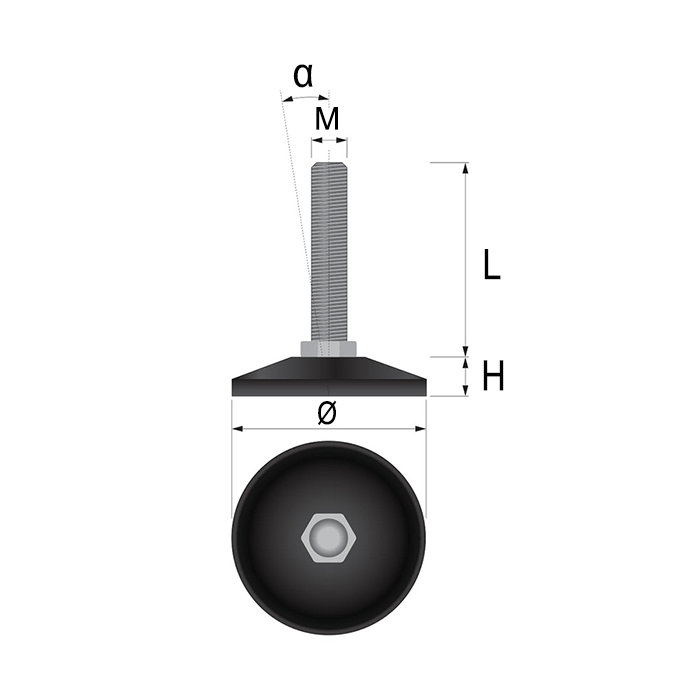
| Diameter (Ø) | Length (L) | Thread (M) | Static load (SL) |
|---|---|---|---|
| 30 mm (1.18″) | 30 mm (1.18″) | M8 | 80 kg |
| 30 mm (1.18″) | 30 mm (1.18″) | M10 | 120 kg |
| 30 mm (1.18″) | 50 mm (1.97″) | M10 | 120 kg |
| 48 mm (1.89″) | 30 mm (1.18″) | M10 | 120 kg |
| 48 mm (1.89″) | 50 mm (1.97″) | M10 | 120 kg |
Thread size must match the insert in your furniture leg.
| Specification | Detail |
|---|---|
| Material | Polyamide body with a hot-dip galvanised steel thread |
| Sizes | 5 sizes |
| Diameter (Ø) | 30 to 48 mm (1.18″ to 1.89″) |
| Length (L) | 30 to 50 mm (1.18″ to 1.97″) |
| Height (H) | 10 mm (0.39″) |
| Thread (M) | M8, M10 |
| Static load (SL) | 80 to 120 kg |
| Angle (α) | 9° |
| Mounting | Screws into a threaded insert |
| Colors | Black |
| Floor compatibility | Any floor, levels on uneven ground |
| Minimum order | Sold in a minimum of 4, then any quantity you need |
The base pivots up to 9° from horizontal in any direction. This compensates for floor slopes, surface irregularities, uneven tile, settled concrete, and any floor condition where the surface under one leg is not perfectly level. The 9° range covers the vast majority of floor unevenness found in residential and commercial buildings.
No. The tilt compensates for local floor angle under each foot. The threaded rod still provides manual height adjustment for overall furniture leveling. The two work together: turn the rod to set the overall height at each corner, and the tilt base automatically conforms to the exact floor surface under each foot.
Ø 30 mm for standard furniture where a compact base is preferred. Ø 48 mm for heavier furniture where a wider tilt platform provides more stability. The 48 mm base has more floor contact area, which distributes load better on heavy tables and provides a more stable tilt platform. Both tilt up to 9°.
Yes. The tilt mechanism allows the base to pivot in any direction, not just front-to-back or side-to-side. If the floor slopes at a diagonal, the base tilts diagonally to match. This omnidirectional tilt is what makes it self-leveling: no manual alignment is needed.
The base articulates through 9 degrees, so one tilt foot finds the floor and stays flat against it even when the floor slopes. A rigid foot on the same slope carries all the load on one edge.
The base articulates through 9 degrees, so one tilt foot finds the floor and stays flat against it even when the floor slopes. A rigid foot on the same slope carries all the load on one edge.
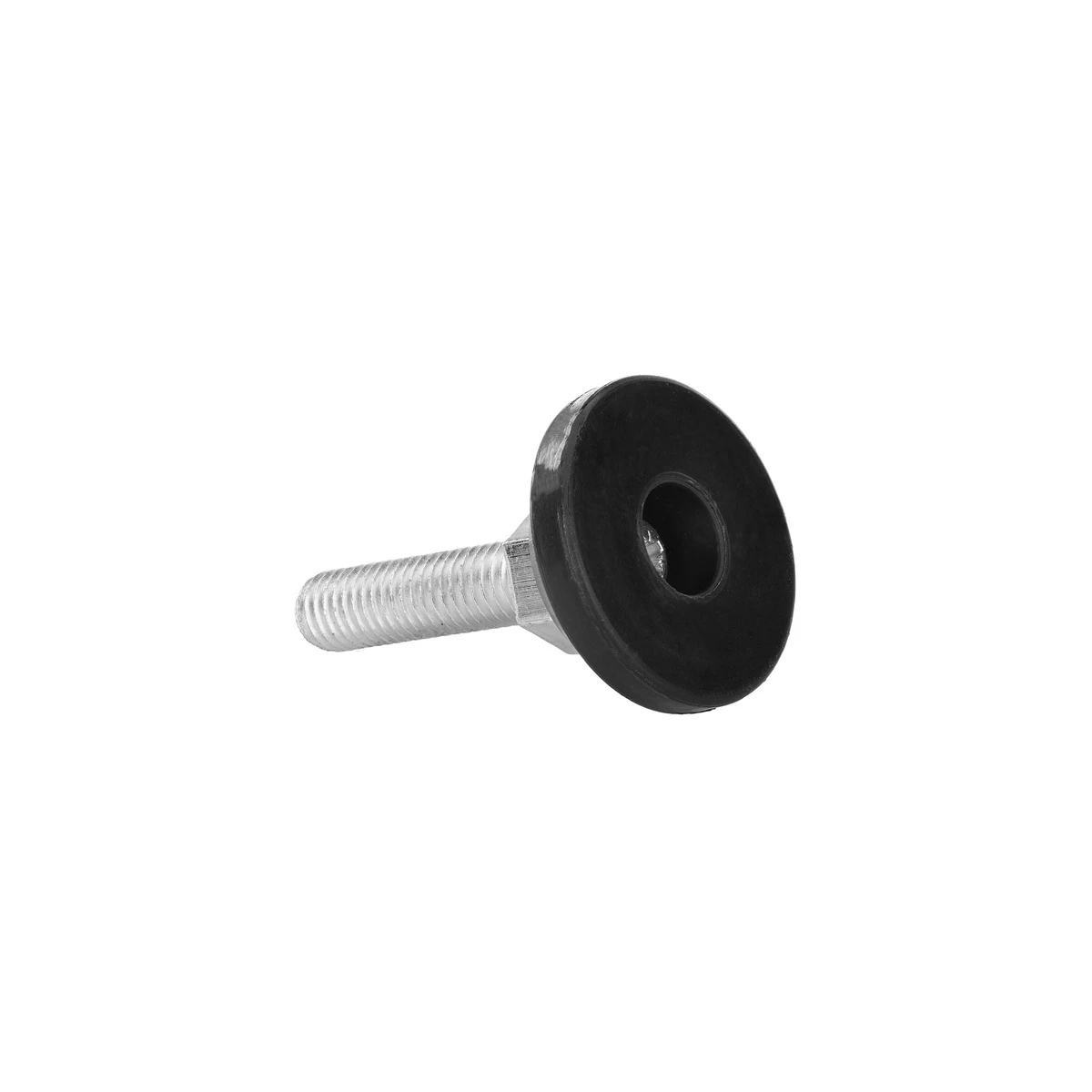 Self-Leveling Tilt Adjustable Leveling Feet
Outfitting a hotel, restaurant, school, healthcare facility, or large furniture build? Superior Glide supports volume orders with bulk pricing tiers, free physical samples, and dedicated quote pricing for accounts placing larger orders.
Bulk pricing tiers, net terms for qualified buyers, and dedicated support for facility managers and procurement teams.
Hold the product, test the fit, check the finish. We ship samples free so you can evaluate before committing to a full order.
For orders above standard volume tiers, we’ll prepare a custom quote with consolidated shipping and your account’s tier pricing.

Reviews
There are no reviews yet