Hospitality-grade floor protection · Sizing help before you order · Apply for a business account
Sizing help · Apply for a business account
Hospitality-grade floor protection · Sizing help before you order · Apply for a business account
Sizing help · Apply for a business account

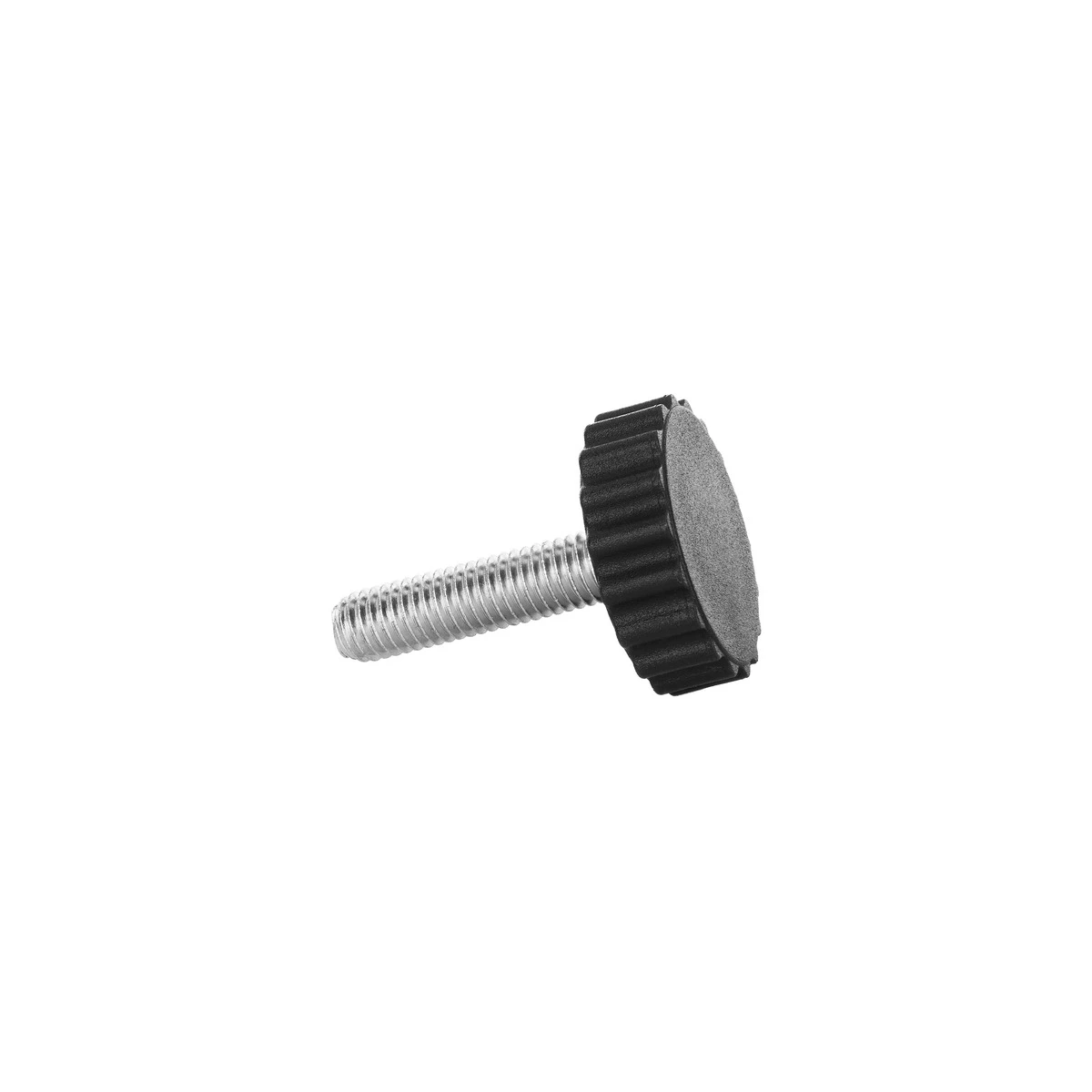
When a standard leveling foot sticks out too far below the leg, this one sits at half the height, just 9 mm, so it levels the furniture without an obvious foot poking out underneath. Same PA body and zinc-plated rod as standard. Metric M4 to M10 plus imperial 1/4″-20. Rated from 20 kg (M4) to 120 kg (M10) per foot.
We make this size in production runs, so there is none on the shelf today. Tell us how many you would want and you go on the list for it. When enough people ask for a size, we run it, and the people who asked hear about it first.
We stock a limited range of threads and lengths. Tell us what you need and we will confirm availability and pricing by email.
Buying in volume? See business pricing & samples ↓
Standard base leveling feet have an 18 to 19 mm tall base that provides maximum clearance between the floor and the tube end. But on some furniture, that tall base is too visible, too bulky, or interferes with stacking or nesting geometry. Low profile adjustable feet do the same job in a 9 mm base, so a cabinet sits close to the floor and still stops rocking. The base protrudes minimally below the furniture leg while still providing adjustable height, floor protection, and the same threaded connection to the insert. Same function. Half the visible profile.
PA (polyamide) body with zinc-plated steel threaded rod. Static load capacity from 20 kg (M4) to 120 kg (M10) per foot. Low-profile adjustable leveling feet are thin base adjustable leveling feet for furniture where minimal foot visibility matters. 3 base diameters: Ø 20, 28 and 30 mm (0.79″, 1.10″ and 1.18″). Five threads: M4, M6, M8, M10 and the imperial 1/4″-20. Rod lengths from 8 to 50 mm (0.31″ to 1.97″). Black, grey, and white. Sold in packs of 4, adjustable in steps of 2 at checkout.
The defining feature of low-profile adjustable leveling feet is the 9 mm base height. Standard base leveling feet are 18 to 19 mm. Ultra-low-profile leveling feet are 6 mm. Low-profile sits in the middle, providing a meaningful reduction in visible protrusion while maintaining enough base material for structural integrity and floor contact area.
H = 18 to 19 mm. Maximum clearance. Most visible below the leg.
H = 9 mm. Half the height. Minimal protrusion. Balanced profile.
H = 6 mm. Thinnest possible. For the absolute minimum visibility.
At 9 mm, the low-profile base is thin enough to be nearly invisible on most furniture when viewed from standing height. The base sits close to the floor and does not create a visible gap between the bottom of the leg and the floor surface. Low-profile adjustable leveling feet are the choice when the foot must do its job without being noticed.
The thread determines load capacity and must match the threaded insert. The rod length determines adjustment range. Low-profile adjustable leveling feet offer rod lengths from 8 to 50 mm, shorter than the standard base range (10 to 110 mm) because the lower base profile is typically specified on furniture that does not need extreme adjustment range.
M4: 20 kg per foot (80 kg on four legs). Lightest loads, Ø 20 base only. M6: 60 kg per foot (240 kg on four legs). Ø 20 base only. Standard lightweight furniture. M8: 80 kg per foot (320 kg on four legs). Ø 30 base. The most common choice for residential and commercial tables and desks. M10: 120 kg per foot (480 kg on four legs). Ø 30 base. Heavy commercial furniture, conference tables, and workbenches.
8 to 10 mm: minimal adjustment. Fine-tuning on nearly level floors. 14 to 19 mm: light adjustment for typical residential floors with minor unevenness. 28 to 33 mm: standard commercial range. Handles moderate floor unevenness in restaurants, offices, and retail spaces. 48 to 50 mm: maximum adjustment available in the low-profile range. For floors with significant unevenness where low-profile is still required. For longer rods, switch to standard base (up to 110 mm).
Low-profile adjustable leveling feet come in two base diameters, both at 9 mm height. The Ø 20 mm base is unique to the low-profile range and does not exist on standard base leveling feet. The Ø 30 mm base matches the smaller standard base diameter but at half the height.
For furniture legs under 25 mm in diameter. M4 (20 kg) and M6 (60 kg) threads only. Rod lengths 8 to 19 mm. The smallest possible leveling foot for the lightest furniture. Side tables, plant stands, display pedestals, and compact fixtures where a 30 mm base would extend visibly beyond the leg edge. Low-profile adjustable leveling feet in the Ø 20 mm diameter provide leveling for furniture too small and light for any other foot in the range.
For furniture legs 28 to 35 mm in diameter. M8 (80 kg) and M10 (120 kg) threads. Rod lengths 10 to 50 mm. Covers the vast majority of residential and commercial furniture that needs low-profile leveling. Dining tables, office desks, conference tables, and retail fixtures. Low-profile adjustable leveling feet in the Ø 30 mm diameter handle the same furniture weight as standard base feet at the same thread sizes, just with a shorter base.
Because all leveling feet use the same M-thread interface, you can mix different styles on the same piece of furniture. On a table where the front legs are visible but the back legs are hidden against a wall, use low-profile adjustable leveling feet on the visible front legs and standard base feet on the hidden back legs. Both screw into the same threaded inserts with identical thread engagement. Both adjust independently. The only difference is the base height at each leg.
This mixing approach also works across the full leveling foot range. You can combine low-profile feet with self-leveling tilt feet on the same furniture if some legs sit on uneven floor sections and others on flat sections. The thread compatibility across all styles provides maximum flexibility for complex floor conditions and mixed visibility requirements.
Every benefit of standard leveling feet (wobble elimination, floor protection, height adjustment, noise reduction) at half the visible base height. The National Wood Flooring Association (NWFA) recommends protective contact surfaces on all furniture legs, and low-profile adjustable leveling feet meet that recommendation with a PA base that sits nearly flush with the bottom of the furniture leg.
The primary advantage. On furniture where the design calls for clean, uninterrupted leg lines, a tall leveling foot base creates a visible bulge at the bottom. Low-profile adjustable leveling feet reduce that bulge to 9 mm. From normal viewing angles (standing or seated), the foot is nearly invisible. low-profile leveling feet for furniture where the leveling system should disappear into the design.
On stackable chairs, tables, and benches, the leveling foot protrusion affects nesting geometry. A 19 mm standard base adds nearly 2 cm at each leg. Across a stack of 10 chairs, that accumulates. The 9 mm low-profile base halves the interference. For the absolute minimum, ultra-low profile at 6 mm reduces it further. Compact adjustable feet for tables and chairs that need to stack cleanly.
Coffee tables, media consoles, low benches, and other furniture with short legs where a tall leveling foot would be disproportionately visible. The Ø 20 mm base with M4 or M6 thread serves the lightest and smallest of these applications. Unlike leaving short-legged furniture without floor protection, the low-profile foot protects the floor while staying proportional to the furniture.
The shorter base does not reduce load capacity. An M8 low-profile foot supports 80 kg per foot, the same as an M8 standard base foot. An M10 low-profile supports 120 kg, the same as standard. The base height affects visibility, not structural performance. Low-profile adjustable leveling feet threaded rod connections are identical to standard.
Low-profile is the balanced choice between maximum invisibility and practical base height. Here is how it compares.
Standard base has an 18 to 19 mm base with M6 to M12 threads and rods up to 110 mm. Choose standard when base visibility is not a concern and you need the widest thread range, longest rods, or M12 capacity (150 kg). Choose low-profile when the foot should be as invisible as possible.
Ultra-low profile has a 6 mm base (3 mm shorter than low-profile). Only in Ø 25 mm. Choose ultra-low when 9 mm is still too visible. Choose low-profile for the broader range of across 14 thread-and-length combinations.
Smooth-base leveling feet share the same 9 mm base height and Ø 30 mm diameter as low-profile but have a smooth, rib-free base surface designed for sliding contact. Choose smooth-base when the furniture needs to slide easily. Choose low-profile for standard stationary contact.
Self-leveling tilt has a pivoting base that compensates for 9° of floor unevenness automatically. Low-profile feet are rigid and require manual adjustment. Choose tilt for automatic leveling on significantly uneven floors. Choose low-profile for manual precision with minimal visibility.
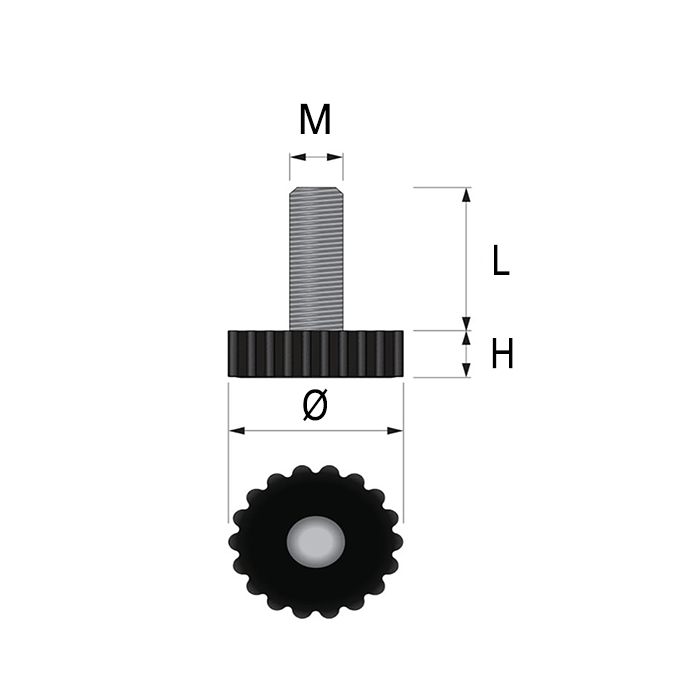
| Diameter (Ø) | Length (L) | Thread (M) | Static load (SL) |
|---|---|---|---|
| 20 mm (0.79″) | 8 mm (0.31″) | M6 | 60 kg |
| 20 kg | 10 mm (0.39″) | M4 | 20 mm (0.79″) |
| 20 mm (0.79″) | 14 mm (0.55″) | M6 | 60 kg |
| 20 mm (0.79″) | 19 mm (0.75″) | M6 | 60 kg |
| 30 mm (1.18″) | 10 mm (0.39″) | M8 | 80 kg |
| 30 mm (1.18″) | 14 mm (0.55″) | M8 | 80 kg |
| 30 mm (1.18″) | 18 mm (0.71″) | M8 | 80 kg |
| 30 mm (1.18″) | 18 mm (0.71″) | M10 | 120 kg |
| 30 mm (1.18″) | 28 mm (1.10″) | M8 | 80 kg |
| 30 mm (1.18″) | 28 mm (1.10″) | M10 | 120 kg |
| 30 mm (1.18″) | 33 mm (1.30″) | M8 | 80 kg |
| 30 mm (1.18″) | 33 mm (1.30″) | M10 | 120 kg |
| 30 mm (1.18″) | 48 mm (1.89″) | M8 | 80 kg |
| 30 mm (1.18″) | 50 mm (1.97″) | M10 | 120 kg |
Thread size must match the insert in your furniture leg.
| Specification | Detail |
|---|---|
| Material | Polyamide body with a hot-dip galvanised steel thread |
| Sizes | 14 sizes |
| Diameter (Ø) | 20 to 30 mm (0.79″ to 1.18″) |
| Length (L) | 8 to 50 mm (0.31″ to 1.97″) |
| Height (H) | 9 mm (0.35″) |
| Thread (M) | M4, M6, M8, M10 |
| Static load (SL) | 20 to 120 kg |
| Mounting | Screws into a threaded insert |
| Colors | Black, Gray, White |
| Floor compatibility | Any floor, levels on uneven ground |
| Minimum order | Sold in a minimum of 4, then any quantity you need |
Standard base leveling feet have an 18 to 19 mm tall base. Low-profile leveling feet have a 9 mm base. Choose low-profile when the foot should protrude as little as possible below the furniture leg: stackable furniture, furniture with very short legs, or designs where a visible leveling foot detracts from the aesthetic. The load capacity is the same at each thread size. Only the base height differs.
The Ø 20 mm base serves very small or lightweight furniture where even a 30 mm base would be disproportionately wide. Small side tables, display stands, and miniature fixtures use narrow tube legs where a 20 mm base fits the scale. The Ø 20 base includes M4 (20 kg) and M6 (60 kg) threads for lighter loads.
Yes. The threaded rod is the same. An M8 low-profile foot screws into an M8 round, square, or rectangular threaded insert exactly like an M8 standard base foot. You can swap between standard and low-profile on the same furniture without changing the insert.
M4 supports 20 kg per foot. On a four-legged piece, that is 80 kg total. This covers small side tables, plant stands, display fixtures, and lightweight shelving. For anything heavier, step up to M6 (60 kg per foot) or M8 (80 kg per foot). M4 is for the lightest furniture where the Ø 20 mm base size is needed.
50 mm on the M10 × 50 variant (Ø 30 base). Standard base leveling feet go up to 110 mm. If you need more adjustment range than 50 mm, use standard base adjustable leveling feet which offer longer rods at the cost of a taller base profile.
Base height. Low profile adjustable feet sit at 9 mm rather than 18 to 19 mm, so you lose less height under a plinth or a nesting frame. Thread range and load rating are unchanged.
 Low-Profile Adjustable Leveling Feet
Outfitting a hotel, restaurant, school, healthcare facility, or large furniture build? Superior Glide supports volume orders with bulk pricing tiers, free physical samples, and dedicated quote pricing for accounts placing larger orders.
Bulk pricing tiers, net terms for qualified buyers, and dedicated support for facility managers and procurement teams.
Hold the product, test the fit, check the finish. We ship samples free so you can evaluate before committing to a full order.
For orders above standard volume tiers, we’ll prepare a custom quote with consolidated shipping and your account’s tier pricing.

Reviews
There are no reviews yet