Hospitality-grade floor protection · Sizing help before you order · Apply for a business account
Sizing help · Apply for a business account
Hospitality-grade floor protection · Sizing help before you order · Apply for a business account
Sizing help · Apply for a business account
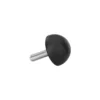
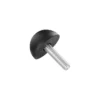
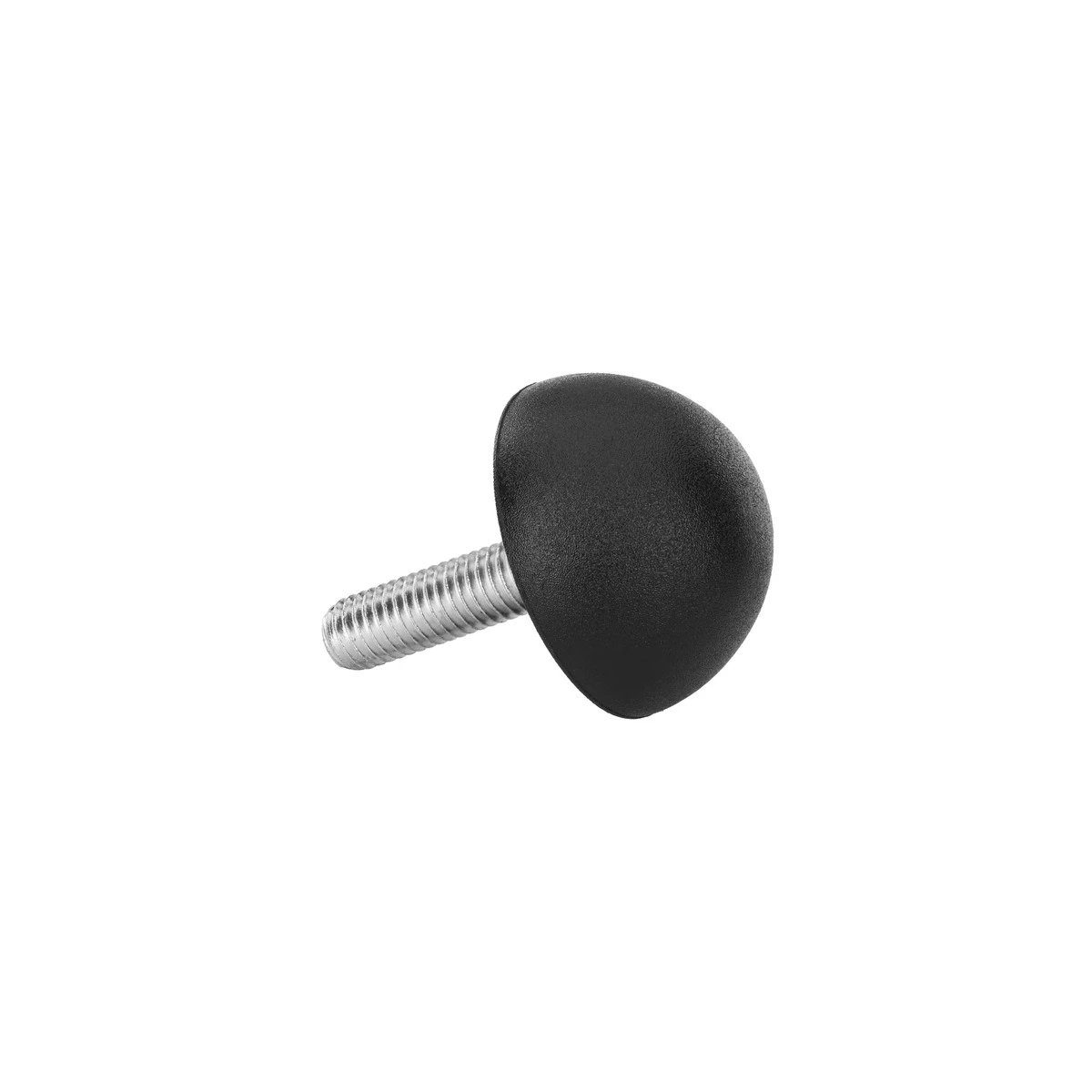
On a floor that slopes or dips, a flat-based foot can only touch on one edge. This one ends in a half-sphere that swivels in any direction and finds full contact on its own, self-centering on surfaces a rigid base can’t sit flat on. Rated from 20 kg (M4) to 80 kg (M8) per foot.
We make this size in production runs, so there is none on the shelf today. Tell us how many you would want and you go on the list for it. When enough people ask for a size, we run it, and the people who asked hear about it first.
We stock a limited range of threads and lengths. Tell us what you need and we will confirm availability and pricing by email.
Buying in volume? See business pricing & samples ↓
Every other leveling foot in the range contacts the floor with a flat base. Flat bases work on smooth, relatively even surfaces. But on highly irregular surfaces where the floor texture varies dramatically under each leg, a flat base cannot sit evenly. It balances on a high point or rocks between ridges. Ball-joint adjustable leveling feet replace the flat base with a half-sphere that makes point contact with the floor. The spherical surface swivels omnidirectionally, self-centering on whatever surface geometry exists under each leg.
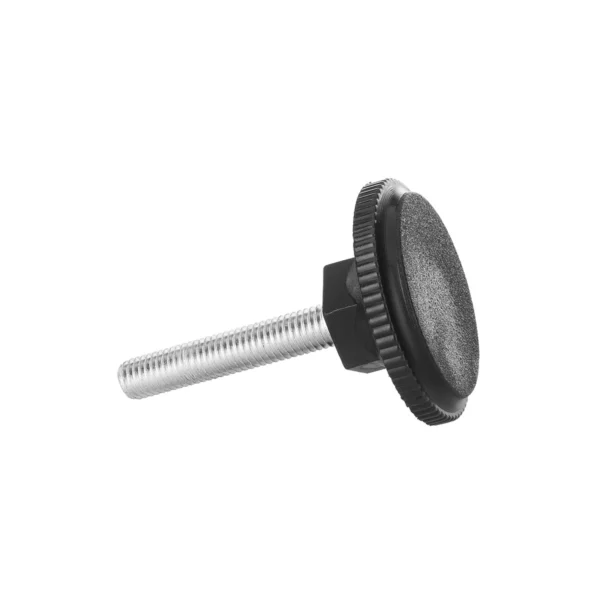
PA (polyamide) half-sphere head with zinc-plated steel threaded rod. Ball-joint adjustable leveling feet are swivel contact leveling feet for furniture and equipment on highly irregular surfaces where flat bases fail. : Ø 10 mm (M4, 20 kg) and Ø 35 mm (M8, 80 kg). Black and white. Sold in packs of 4, adjustable in steps of 2 at checkout.
The half-sphere head creates a fundamentally different floor interaction than a flat base. Understanding this difference explains when ball-joint adjustable leveling feet are the right choice and when flat bases are better.
A flat base distributes weight across its entire area (707 mm² on Ø 30, for example). A half-sphere concentrates weight at the contact point where the curve meets the floor. This concentration creates higher pressure per square millimeter but eliminates the rocking, tipping, and edge-loading that flat bases meet on uneven surfaces. The sphere self-centers: it always finds the lowest stable point under the furniture weight.
The half-sphere contacts the floor at whatever angle the surface presents. On a ridge, it sits on the ridge peak. In a groove, it settles into the groove. On a slope, it contacts at the tangent point. The swivel is passive and gravity-driven: the furniture weight keeps the sphere in contact with the surface. No locking mechanism is needed. Ball joint leveling feet for furniture that self-center on any surface geometry.
The three floor contact types in the leveling foot range serve different floor conditions. Choosing the right one depends on the surface under the furniture.
Full-surface contact. Best on smooth, relatively level floors. Distributes weight across the entire base area. The default for most furniture applications.
Pivoting flat surface. Best on sloped but smooth floors. Maintains full-surface contact at angles up to 9°. For floors that slope but are otherwise smooth.
Point contact. Best on highly irregular surfaces. Self-centering on any geometry. For surfaces too rough or irregular for flat or tilt bases.
Most furniture sits on smooth floors and uses flat bases. Some furniture sits on sloped floors and benefits from tilt. Ball-joint adjustable leveling feet serve the smallest category: furniture on surfaces so irregular that neither flat nor tilt bases can function properly. Spherical base adjustable leveling feet that work where nothing else can.
The Ø 10 mm and Ø 35 mm ball-joint adjustable leveling feet serve entirely different applications. They share the half-sphere concept but operate at different scales with different use cases.
At 2.1 g and M4 thread, this is the lightest and smallest leveling foot in the catalog. The half-sphere head at 5 mm height sits under precision instruments, electronic enclosures, laboratory equipment, and display fixtures that weigh under 20 kg. The half-sphere provides self-centering contact on workbench surfaces, optical tables, and countertops that may not be perfectly flat. Available in black and white to match equipment housings.
At 30.4 g and M8 thread, this serves standard furniture on rough floors. The half-sphere at 19 mm height provides point contact on industrial concrete, cobblestone, textured outdoor surfaces, and heavily worn floors where flat bases rock or tilt. Half sphere leveling feet at this scale handle the weight of commercial tables and workbenches at 80 kg per foot, providing stable contact on surfaces that defeat flat-base feet.
Height adjustment with self-centering point contact on surfaces where flat bases cannot sit stably. The National Wood Flooring Association (NWFA) recommends protective contact surfaces on all furniture legs. On rough surfaces, the ball-joint provides a PA contact point that is gentler than bare metal even in point-contact configuration.
The primary advantage. On cobblestone, heavily textured concrete, industrial grating, rough-sawn stone, and weathered outdoor surfaces, a flat base contacts only the high points and rocks between them. The half-sphere self-centers on whatever the surface presents. The contact point is always stable because the sphere geometry has only one stable resting position for any given surface angle. Ball-joint adjustable leveling feet provide the stability that flat bases cannot on these surfaces.
When the load on the furniture shifts (someone leans on one side, items are placed unevenly), the ball-joint re-centers automatically. A flat base on an irregular surface may tip from one contact point to another as the load shifts, creating a rocking motion. The sphere rolls smoothly to its new equilibrium. Unlike leaving furniture on unprotected irregular surfaces, the ball-joint provides controlled, self-centering contact.
The Ø 10 mm ball-joint provides three-point contact for precision leveling on three-legged instruments. Three ball-joints define a plane with zero wobble by mathematical necessity: three points always define a plane. This is why precision instruments, scales, and optical equipment often specify ball-joint feet for three-point leveling rather than four flat bases. Swivel contact leveling feet that provide mathematically stable support.
The threaded rod provides the same height adjustment as any leveling foot. Turn each foot to raise or lower that corner. The ball-joint contact works independently of the height setting. Adjust the height for overall leveling. The ball-joint handles the surface-level irregularity at each contact point automatically.
Same screw-in process as every leveling foot. The half-sphere does not change installation. The self-centering contact activates automatically when the furniture is set on the surface.
Three points define a plane. Three ball-joint adjustable leveling feet on a triangular mounting pattern create a support system with zero wobble by geometric necessity. This is why precision instruments, laboratory scales, and optical equipment specify ball-joint feet in groups of three rather than four.
On a three-point system, there is only one possible plane that passes through all three contact points. The equipment cannot rock because there is no fourth point to create an over-determined system. Four flat-base feet on an uneven surface create four contact requirements, and if the surface is not perfectly flat under all four, one foot lifts and the equipment wobbles. Three ball-joint adjustable leveling feet eliminate this possibility entirely.
For equipment that requires three-point leveling, specify the Ø 10 mm ball-joint with M4 thread. Mount three feet in a triangular pattern. Each ball-joint self-centers on the surface below it. The equipment sits on a mathematically stable plane with no adjustment needed beyond the initial height setting at each foot.
Ball-joint adjustable leveling feet work on any hard surface, but they provide the most value on surfaces where flat bases fail.
Rough concrete with aggregate exposure. Cobblestone and natural stone pavers. Industrial grating and perforated metal flooring. Flagstone and slate with natural surface variation. Heavily worn floors with divots and ridges. Any surface where the topography under each leg varies by more than a few millimeters. Ball-joint adjustable leveling feet find stable contact on all of these.
Smooth concrete, tile, hardwood, luxury vinyl, and any surface that is flat enough for a full-surface contact foot to sit evenly. On these surfaces, flat bases provide better load distribution, less floor pressure per square millimeter, and more overall stability than point contact. Use ball-joint only when flat bases cannot function on the given surface.
Self-leveling tilt pivots a flat base up to 9° to match floor slopes. It maintains full-surface contact on sloped but smooth surfaces. Ball-joint makes point contact on any surface geometry. Choose tilt for sloped smooth floors. Choose ball-joint for rough, irregular, or highly textured surfaces.
Standard base and low-profile provide flat bases that distribute load across a wide area. On smooth floors, they provide more stability and floor protection than ball-joint point contact. Choose flat bases for smooth floors. Choose ball-joint only when the surface is too irregular for flat contact.
Mini leveling feet have a Ø 13 mm flat POM base with M6 thread. Ball-joint Ø 10 has an even smaller half-sphere with M4. Choose mini for small equipment on smooth surfaces. Choose ball-joint Ø 10 for small equipment on irregular surfaces or for three-point precision leveling.
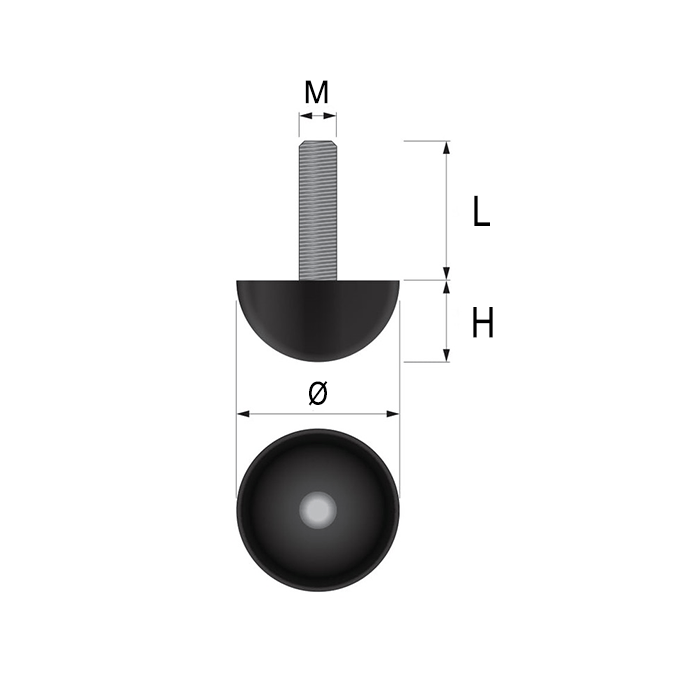
| Diameter (Ø) | Length (L) | Height (H) | Thread (M) | Static load (SL) |
|---|---|---|---|---|
| 10 mm (0.39″) | 10 mm (0.39″) | 5 mm (0.20″) | M4 | 20 kg |
| 35 mm (1.38″) | 30 mm (1.18″) | 19 mm (0.75″) | M8 | 80 kg |
Thread size must match the insert in your furniture leg.
| Specification | Detail |
|---|---|
| Material | Polyamide body with a hot-dip galvanised steel thread |
| Sizes | 2 sizes |
| Diameter (Ø) | 10 to 35 mm (0.39″ to 1.38″) |
| Length (L) | 10 to 30 mm (0.39″ to 1.18″) |
| Height (H) | 5 to 19 mm (0.20″ to 0.75″) |
| Thread (M) | M4, M8 |
| Static load (SL) | 20 to 80 kg |
| Mounting | Screws into a threaded insert |
| Colors | Black, White |
| Floor compatibility | Any floor, levels on uneven ground |
| Minimum order | Sold in a minimum of 4, then any quantity you need |
Choose ball-joint when the floor surface is so irregular that even a 9° tilt base cannot conform to it. The spherical contact point works on any surface angle because it makes point contact rather than surface contact. Cobblestone, heavily textured concrete, industrial grating, and surfaces with deep grooves or ridges are candidates. For sloped but relatively smooth floors, self-leveling tilt (9° flat tilt) is usually better because it distributes load over a larger area.
The concentrated contact of the half-sphere can create higher pressure per square millimeter than a flat base. On soft flooring (luxury vinyl, cork, softwood), this can indent the surface. Ball-joint leveling feet are designed for hard, durable surfaces like concrete, stone, metal grating, and tile where the concentrated contact does not damage the floor.
The Ø 10 mm ball-joint with M4 thread serves very small equipment and precision instruments. At 2.1 g and 20 kg static load, it is the lightest and smallest leveling foot in the entire catalog. Scales, small electronic enclosures, laboratory instruments, and miniature display fixtures use this size.
The Ø 35 mm with M8 at 80 kg per foot handles standard furniture weight. However, the point contact provides less stability than a flat base of the same diameter. On standard furniture where the floor is reasonably smooth, flat-base leveling feet provide better stability. Ball-joint is for surfaces where flat bases cannot function.
A leveling foot whose head pivots on a half sphere, so the base sits flat even when the leg meets the floor at an angle. It is the fine adjustment answer for slightly uneven floors.
A leveling foot whose head pivots on a half sphere, so the base sits flat even when the leg meets the floor at an angle. It is the fine adjustment answer for slightly uneven floors.
 Ball-Joint Adjustable Leveling Feet
Outfitting a hotel, restaurant, school, healthcare facility, or large furniture build? Superior Glide supports volume orders with bulk pricing tiers, free physical samples, and dedicated quote pricing for accounts placing larger orders.
Bulk pricing tiers, net terms for qualified buyers, and dedicated support for facility managers and procurement teams.
Hold the product, test the fit, check the finish. We ship samples free so you can evaluate before committing to a full order.
For orders above standard volume tiers, we’ll prepare a custom quote with consolidated shipping and your account’s tier pricing.

Reviews
There are no reviews yet