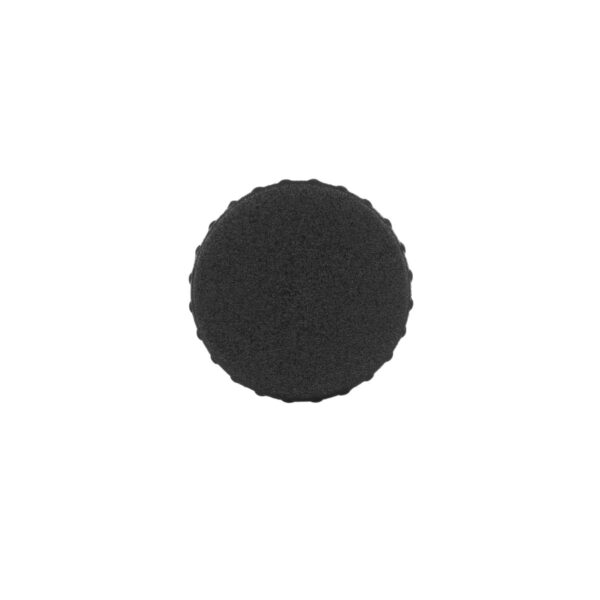
Ultra-low profile adjustable leveling feet have the thinnest base in the entire leveling foot range at just 6 mm. The foot sits nearly flush with the bottom of the furniture leg, providing height adjustment with virtually no visible protrusion. Static load capacity: 80 kg (M8) to 120 kg (M10) per foot.
Not sure what size? See the size chart ↓
📦 Sold in packs of 4 — quantity adjustable at checkout
Standard base leveling feet have an 18 to 19 mm base. Low-profile leveling feet cut that to 9 mm. Ultra-low profile adjustable leveling feet go further: 6 mm. The thinnest base in the entire leveling foot range. At 6 mm, the foot sits nearly flush with the bottom of the furniture leg. From any normal viewing angle, the foot is invisible. The furniture appears to rest directly on its legs with no visible hardware between the leg and the floor.
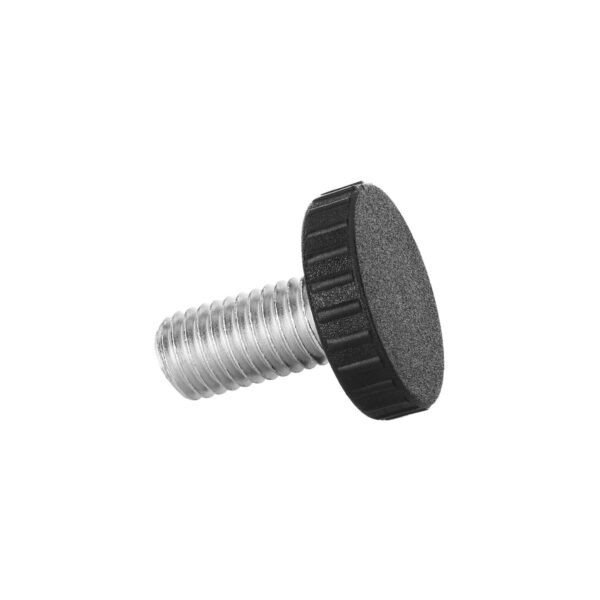
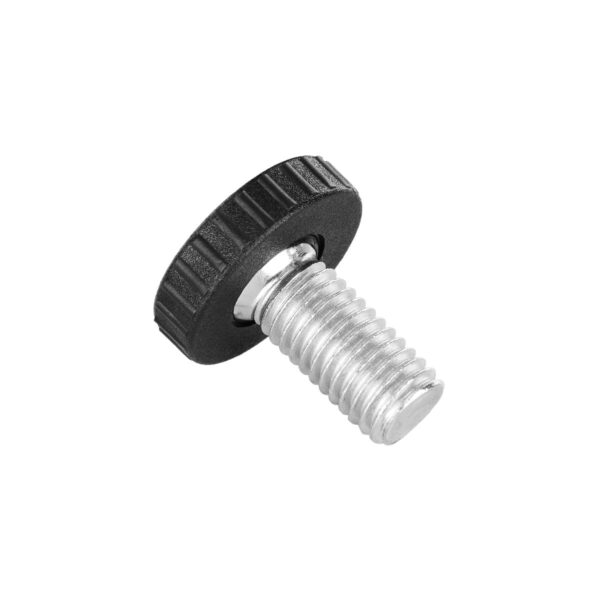
Ø 25 mm PA base at 6 mm height. Zinc-plated steel threaded rod. M8 (80 kg per foot) and M10 (120 kg per foot). Ultra-low profile adjustable leveling feet are the thinnest adjustable leveling feet in the range for furniture where visible leveling hardware is not acceptable. Rod lengths 20 to 21 mm. Black. Sold individually.
Ultra-low profile adjustable leveling feet are available in two thread sizes. Both share the same Ø 25 mm base at 6 mm height. Choose the thread that matches your threaded insert.
Static load: 80 kg per foot (320 kg on four legs). 21 mm rod for fine to moderate adjustment. Weight: 12.1 g. For standard dining tables, office desks, and commercial furniture. Compatible with M8 round, square, and rectangular threaded inserts. Black.
Static load: 120 kg per foot (480 kg on four legs). 20 mm rod for fine to moderate adjustment. Weight: 17.6 g. For heavier commercial tables, conference tables, and furniture with M10 inserts. Black.
For more thread sizes and rod lengths at 9 mm height, see low-profile adjustable leveling feet (20 variations, M4 to M10). For a taller base with the widest range, see standard base (M6 to M12, rods to 110 mm). For floor protection with a low-profile base, see low-profile with pad. For custom configurations, contact Business Solutions.
The 6 mm base height is the defining feature of ultra-low profile adjustable leveling feet. Here is how it compares to every other base height in the leveling foot range.
H = 18 to 19 mm. Maximum clearance. Most visible.
H = 9 mm. Half of standard. Minimal protrusion.
H = 6 mm. The thinnest. Nearly flush with leg bottom.
At 6 mm, the base is thinner than most floor tiles, thinner than a standard pencil diameter, and thinner than many furniture leg wall thicknesses. The foot disappears under the leg. On furniture with painted or powder-coated legs, the black PA base blends with dark leg finishes and becomes virtually undetectable. Ultra low profile leveling feet furniture designers specify when the leveling system must be completely invisible in the finished product.
Ultra-low profile adjustable leveling feet serve a specific need. Not every furniture application requires a 6 mm base. The decision depends on how critical foot invisibility is to the furniture’s design and how much adjustment range you need.
The same leveling function as every other leveling foot in the range, at the absolute minimum visible footprint. The National Wood Flooring Association (NWFA) recommends protective contact surfaces on all furniture legs, and ultra-low profile adjustable leveling feet provide a PA contact surface that is nearly invisible from any viewing angle.
The primary advantage. Furniture appears to rest directly on its legs. No bulge, no visible disc, no gap between leg and floor. 6 mm base leveling feet that provide adjustment without any visible hardware. On high-end residential furniture, designer contract furniture, and architectural installations where every detail matters, the invisible foot is a specification requirement, not a preference.
On furniture designed to stack or nest, every millimeter of protrusion at the leg base affects the geometry. Standard base adds 18 to 19 mm. Low-profile adds 9 mm. Ultra-low profile adds only 6 mm. Across a stack of 10 chairs, the difference between 6 mm and 18 mm per leg is 120 mm of total stack height saved. That translates to one or two additional chairs per stack in storage rooms with fixed shelf heights. Flush adjustable leveling feet that preserve stacking tolerances and maximize storage density.
Coffee tables, media consoles, low benches, and platform beds with legs under 50 mm. On furniture this short, even a 9 mm low-profile foot is disproportionately visible. The 6 mm ultra-low profile foot stays proportional. Unlike leaving short legs on finished floors without protection, the ultra-low profile provides floor protection at a height the furniture design can absorb.
The 6 mm base does not reduce load capacity. M8 at 80 kg per foot and M10 at 120 kg per foot are the same ratings as low-profile and standard base at those thread sizes. The load transfers through the threaded rod, not through the base height. The thinnest adjustable leveling feet in the range carry the same weight as the tallest ones at equivalent thread sizes.
Same installation as every other leveling foot in the range. The thin base does not change the process. Screw the foot into the threaded insert by hand, then adjust the height by turning.
Because all leveling feet use the same M-thread interface, you can use ultra-low profile adjustable leveling feet on some legs and a different style on others. On a desk where the front legs face visitors but the back legs sit against a wall, use ultra-low profile on the visible front and standard base on the hidden back. Both M8 feet screw into the same M8 threaded inserts. Both adjust independently.
This flexibility extends to all 15 leveling foot products in the range. Ultra-low profile adjustable leveling feet can coexist on the same piece of furniture with low-profile, self-leveling tilt, or any other style, as long as the thread sizes match the inserts at each leg. The universal thread interface makes the entire range interchangeable at the point of connection.
For furniture manufacturers and designers specifying ultra-low profile adjustable leveling feet, the simple two-SKU lineup (M8 and M10) streamlines ordering. Choose M8 for standard furniture loads up to 80 kg per foot. Choose M10 for heavier commercial and industrial furniture up to 120 kg per foot. Both use the same Ø 25 mm base and the same 6 mm height, so the visual result is identical regardless of thread size.
On contract furniture projects where the architect or interior designer specifies “no visible leveling hardware,” ultra-low profile adjustable leveling feet satisfy this requirement while still providing functional height adjustment. Include the foot specification in the furniture cutsheet alongside the threaded insert specification. For production quantities, visit Business Solutions.
Same two-material construction as all leveling feet in the range. PA body for floor contact and structural support. Zinc-plated steel rod for the threaded connection. The only physical difference is the 6 mm base height and Ø 25 mm diameter.
The Ø 25 mm PA base at 6 mm height provides the floor contact surface with adequate load distribution for M8 and M10 loads on all standard indoor flooring types. PA resists UV, chemicals, moisture, and impact. The smaller diameter and minimal height keep the foot invisible under the furniture leg while still providing a smooth, floor-safe contact surface. At 491 mm² of floor contact area, the Ø 25 base distributes weight adequately for M8 and M10 loads.
M8 x 21 mm and M10 x 20 mm. The rod lengths are closely matched at 20 to 21 mm, providing consistent fine to moderate adjustment range on both thread sizes. Zinc plating provides corrosion resistance for standard indoor use. For stainless steel rods in corrosive environments, see stainless steel rod leveling feet.
Ultra-low profile is the most specialized leveling foot in the range. Here is how it compares.
Low-profile leveling feet have a 9 mm base with 20 variations (M4 to M10, rods to 50 mm). Ultra-low profile has a 6 mm base with 2 variations (M8 and M10 only). Choose ultra-low when 9 mm is still too visible. Choose low-profile for the broader selection and longer rod options.
Standard base provides the widest range: M6 to M12, rods to 110 mm, Ø 30 and 45 mm bases. Choose standard when visibility is not a concern and you need maximum flexibility in thread, length, and base diameter.
Smooth-base leveling feet share the same height range as low-profile but have a smooth, rib-free base for sliding contact. Ultra-low profile is about minimum visibility, not sliding performance. Different specializations.
High-end restaurant furniture, boutique hotel room furniture, gallery and museum display furniture, and architect-specified contract furniture where the design intent requires clean, uninterrupted leg lines to the floor. Ultra-low profile adjustable leveling feet satisfy the “no visible hardware” specification while still providing functional leveling. In gallery and museum settings, display furniture must not distract from the artwork, and a visible leveling foot at the base of each pedestal or display case detracts from the exhibition. The 6 mm base disappears entirely under the furniture. In boutique hotels, custom furniture with visible leveling hardware feels unfinished and undercuts the premium positioning. Available for bulk orders. For commercial pricing, visit Business Solutions.
Custom and designer residential furniture, platform beds, media consoles, and low coffee tables where the homeowner or designer wants the furniture to appear to float just above the floor surface. The 6 mm foot creates a barely perceptible gap between the leg bottom and the floor. On dark legs with the black PA base, the gap vanishes entirely at normal viewing distances. For furniture with legs in lighter colors (grey, white, natural wood), the black base may show against the leg bottom. In those cases, confirm that the base sits fully under the leg with no overhang. For additional floor protection on scratch-sensitive surfaces, apply a thin self-adhesive furniture pad to the ultra-low profile base, keeping in mind the added pad thickness will slightly increase the total visible height above 6 mm.
The 6 mm base is the hardest leveling foot to inspect visually because it is designed to be invisible. Run a finger under each leg to confirm the foot is seated and tight. On furniture that gets moved or adjusted, check after each relocation. The ultra-low profile makes it easy to forget the foot is there, which is the design intent, but it still needs periodic tightness checks like every other leveling foot in the range. On stackable furniture, inspect ultra-low profile adjustable leveling feet after each stacking cycle because the compression during stacking can loosen the threaded connection over repeated cycles.
Ultra-low profile adjustable leveling feet are sold individually for single-foot replacement. The PA base does not degrade from standard cleaning chemicals, UV exposure, moisture, or normal wear. If the zinc plating on the rod shows corrosion (rare indoors), replace the foot or switch to stainless steel rod leveling feet for that environment. Keep replacement feet on hand for commercial environments where the invisible foot makes it easy to overlook a missing or damaged foot during routine inspections.
Round Threaded Inserts: Ø 28, 40, 50 mm.
Square Threaded Inserts: 20 × 20 to 50 × 50 mm.
Rectangular Threaded Inserts: 20 × 40 to 30 × 60 mm.
Low-Profile (9 mm): 20 variations, M4 to M10.
Standard Base (18-19 mm): 28 variations, M6 to M12.
Standard Base with Pad: PA6 floor protection.
| Specification | Details |
|---|---|
Product Type |
Adjustable Leveling Feet – Type E-L |
Materials |
PA (Polyamide) base + Fe HDG (Hot-Dip Galvanized Steel) stem |
Fit Style |
Threaded stem with fixed base |
Floor Compatibility |
All hard and soft flooring |
Furniture Compatibility |
Small desks, shelving units, retail displays, light equipment |
Leg Compatibility |
Metal tubing and reinforced plastic inserts |
Tube/Foot Diameters |
Ø25 mm (0.98") |
Thread Sizes |
M8–M10 |
Thread Lengths |
20–21 mm (0.79"–0.83") |
Weight Capacity |
80–120 kg (176–264 lbs) static load per foot |
Color Options |
Black |
Installation Type |
Hand screw or basic tool-fit |
Key Benefits |
Compact adjustable support, floor protection, corrosion-resistant stem |
Indoor / Outdoor |
Indoor | Covered Outdoor | Uncovered Outdoor |
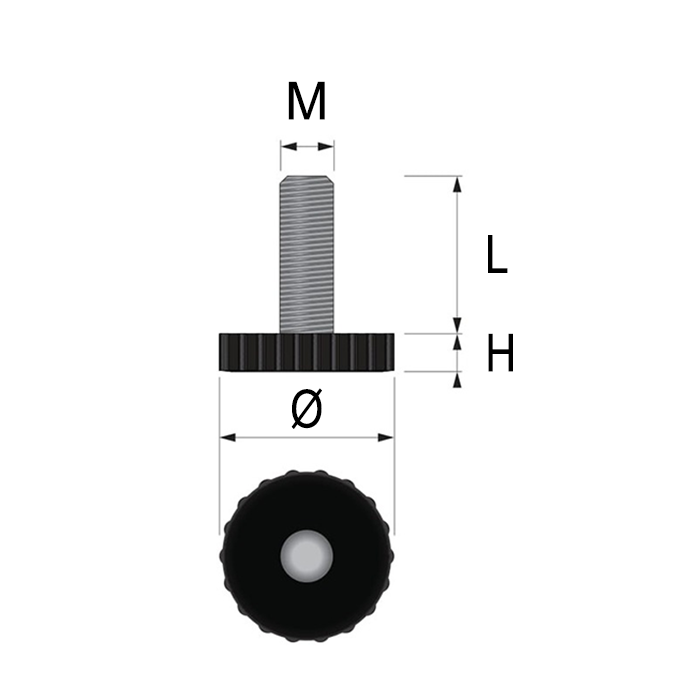
| Base Diameter (Ø) | Thread Size (M) | Threaded Stem Length (L) | Base Height (H) | Static Load Capacity (SL) |
|---|---|---|---|---|
25 mm (0.98") |
M8 (8 mm) |
21 mm (0.83") |
6 mm (0.24") |
80 kg (176 lbs) / pc |
25 mm (0.98") |
M10 (10 mm) |
20 mm (0.79") |
6 mm (0.24") |
120 kg (264 lbs) / pc |
Yes. The PA base at 6 mm handles 80 kg (M8) or 120 kg (M10) per foot, the same static load capacity as low-profile and standard base leveling feet at the same thread sizes. Load capacity is determined by the threaded connection, not the base height. The thinner base reduces visibility, not structural performance.
Ø 25 mm provides the smallest practical floor contact area for M8 and M10 threads while maintaining structural integrity at the 6 mm height. The low-profile range uses Ø 20 and Ø 30. Ultra-low profile uses Ø 25 as the optimal balance between compactness and load-bearing surface at the thinnest base height.
Yes. All leveling feet use the same M-thread interface. An M8 ultra-low profile foot screws into the same M8 threaded insert as an M8 standard or low-profile foot. You can mix profiles on the same furniture if different legs have different visibility requirements.
Ultra-low profile serves a specialized need: the absolute minimum visible protrusion. The M8 x 21 mm and M10 x 20 mm cover the two most common thread sizes for furniture in this weight range. For more thread sizes and rod lengths at a slightly taller 9 mm profile, see low-profile leveling feet (20 variations).
For floors with minor unevenness, yes. The 20 to 21 mm rod provides fine to moderate adjustment. For significant floor unevenness, the rod length becomes the limiting factor. Step up to low-profile (up to 50 mm) or standard base (up to 110 mm) for more range.
Only logged in customers who have purchased this product may leave a review.

Reviews
There are no reviews yet