
If you put felt pads under your dining chairs, you did the sensible thing. They cost a few dollars, they go on in a minute, and for the first few weeks they work.
Then you notice fine scratches around the table. You replace the pads. The scratches come back. Most people blame the chairs, or the floor, or the kids. The real answer is duller and more useful: felt furniture pads scratch hardwood floors because of what the pad itself turns into after a few weeks of being dragged.
What actually scratches a hardwood floor
Grit does. Sand and dust come in on shoes and settle where people walk, which is exactly where the chairs are. A finished wood floor shrugs off weight. What it cannot shrug off is a hard particle dragged across it under the load of somebody sitting down.
So the chair leg is rarely the culprit, and neither is the floor. The question is what sits between them, because that is what decides whether grit gets caught, held, and dragged back and forth in the same few inches.
That is the job a felt pad is bad at, and it is the whole reason felt furniture pads scratch hardwood floors.
What is inside a felt pad
Felt looks solid but it is really a stack. Thin layers of fiber are laid flat, one on top of another, and glued together into a sheet. The sheet gets punched into circles and squares, a sticky back goes on, and that is your pad.
Now think about what a chair does to it. Nobody lifts a dining chair. They drag it sideways, many times a day. That sideways shove runs along the glued seams between the layers, so the layers work loose and the pad sheds, one layer at a time.
As it sheds it opens up. A loose, shaggy surface is exactly the kind of surface that catches grit and holds on to it, and now the pad is carrying the abrasive around under the leg instead of keeping it out.
The glue has a second problem. Floors get mopped, and people walk in with wet shoes. Damp is hard on the bond between those layers, so felt gives up fastest in kitchens and entryways, which happen to be the grittiest rooms in the house.
The sticky back is the other half of it
There is a second half to why felt furniture pads scratch hardwood floors, and it is the glue on the back. The adhesive on a hardware-store felt pad is a thin pressure-sensitive film. It was not built for a chair leg that moves all day in a humid room. When it lets go, the pad slides off-center or falls off, and the bare leg sits on the floor until somebody notices, which is usually after the mark is there.
What we do differently
The reason felt furniture pads scratch hardwood floors is structural, so we build the structure the other way around. Our glides and pads use the same fiber family, PA6.
Instead of laying fibers flat and gluing them, the fibers are driven straight down into a dense pile, like the bristles of a brush, and locked in mechanically. No glue is used in the pile at all. Push the chair sideways and you are pushing against the ends of upright fibers rather than sliding one glued layer off another, so the surface stays closed as it wears instead of opening into a shag. The pile is packed to 1,450 grams of fiber per square meter.
No glue in the pile also means damp affects it far less than it affects felt. That is not the same as waterproof, and we are not going to claim it is. It means a mopped kitchen floor is a normal day for it rather than the thing that finishes it off.
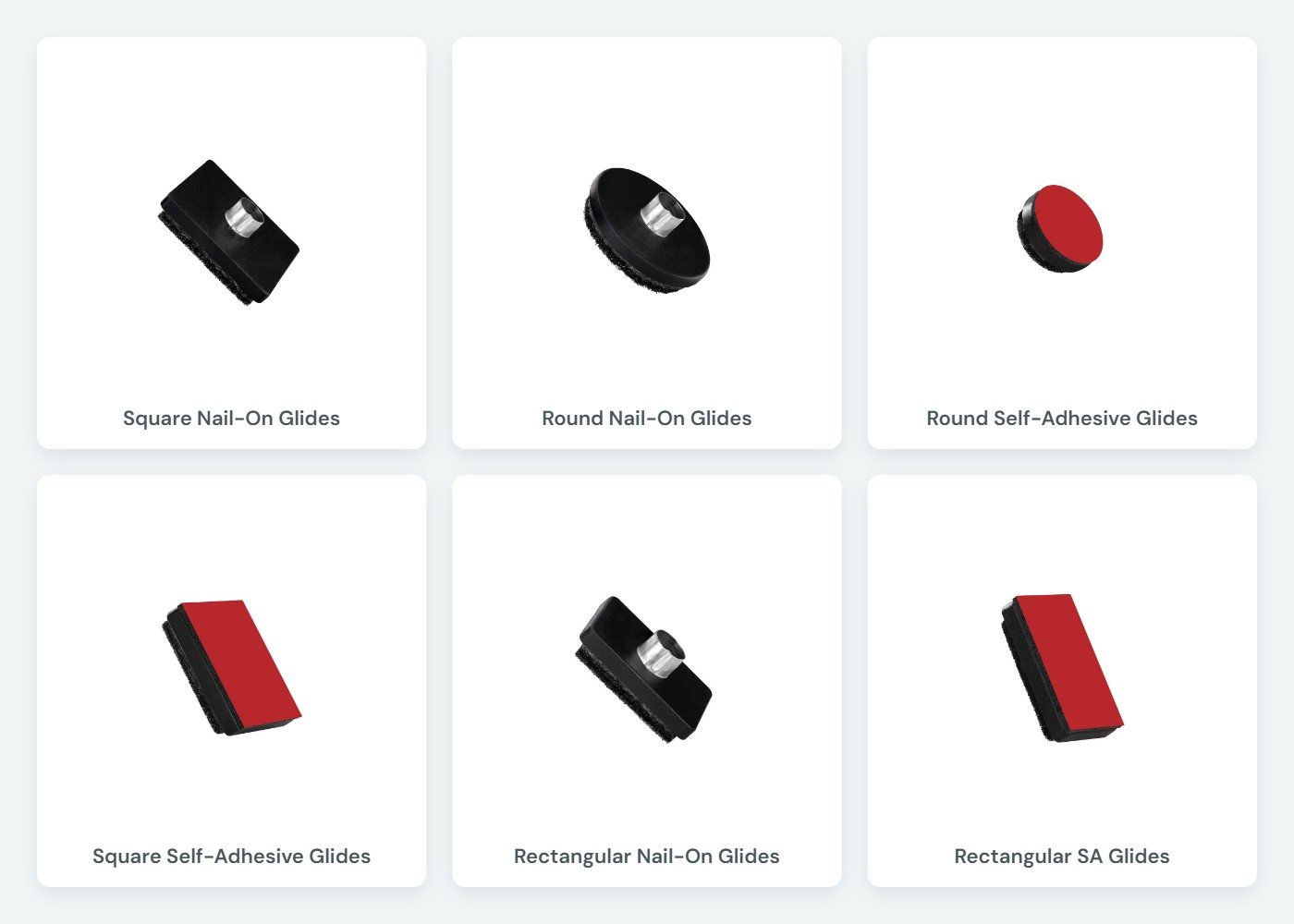
The fiber sits on a molded ABS body, the plastic used for car trim and Lego bricks. That body is what attaches to the leg, and there are three ways it does that.
Which one goes on your chair
Turn the chair over and look at the bottom of the leg.
Solid wood. Most dining chairs, kitchen chairs and older furniture. Use a nail-on glide. A hollow zinc-plated tubular rivet taps into the wood with a rubber mallet, no drilling, and a small anti-rotation notch on the rivet keeps the glide from spinning in the leg. That notch is why nail-on glides come square and rectangular as well as round: a plain nail lets a glide twist, so square shapes would never stay lined up. The rivet head is molded inside the plastic body, so metal and plastic are one part. On cheaper nail-in glides the plastic can break away and leave the nail behind in the leg, and a bare nail head is then the lowest point on the chair.
A flat, closed bottom in metal, plastic, laminate or veneer. Bar stools, office chairs, patio sets, most ready-to-assemble furniture. Use a self-adhesive glide. The backing is an acrylic foam tape, the kind used to mount trim on cars, not the film on a felt pad. Clean the bottom of the leg with 70% isopropyl alcohol, let it dry, press the glide on firmly, and give it 48 hours to reach full strength before the chair goes back into daily use. On plastic legs, fit one and test it before doing the set.
Furniture that stays put, or a leg too wide for any glide. Sideboards, bookcases, bed frames, sofa feet. Use a self-adhesive pad. Pads use the same fiber face on a thin backing and go on legs from 12 mm right up to 300 mm, far wider than the largest glide. Same alcohol wipe, same 48 hours.
An open tube you can look up into gives adhesive nothing to hold. That leg takes a push-in tube plug, which is a different product.
The 50 mm and 75 mm nail-on glides also carry an acrylic foam backing behind the rivet, so those two sizes want the alcohol wipe as well, even though they are tapped in.
Getting the size right
Measure the bottom of the leg at its widest point. Round leg, measure across. Square or rectangular, measure both sides. Then take the size that matches, or the next one down. Never bigger.
A glide that overhangs the leg catches on rug edges and thresholds and rocks under load. Slightly smaller is invisible. The full chart is in the guide on how to measure furniture legs.
When felt is fine
A side table against a wall. A lamp. A dresser that moves once a year. Furniture that never drags never grinds anything into anything, and felt under it will last. It is also a fair stopgap the week after a move. Felt furniture pads scratch hardwood floors when they get dragged, not when they sit still.
What it is not is the answer for anything that moves every day, which is the job it fails at, and it fails in a way that costs you a floor. The National Wood Flooring Association lists abrasive traffic among the leading causes of finish wear, which is the polite name for this exact problem.
Why felt furniture pads scratch hardwood floors: the short version
Grit does the scratching. Felt furniture pads scratch hardwood floors because they are bad at keeping grit out of the way: they shed sideways, open up, hold what they collect, and come unstuck.
Upright, glue-free fiber on a rigid body has none of the failure points that make felt furniture pads scratch hardwood floors. Fit the right mount for the leg, size it flush or one step down, and check the glides once in a while, before one of them checks your floor.
Browse furniture glides for hard floors, or read the Furniture Glides Guide for fitting steps and the size chart. Not sure what your legs are made of? Send a photo of the bottom of one to support@superiorglide.com, or use the chat, and we will tell you the mounting and the size.
Fitting out a restaurant, hotel, school or office? Business Solutions covers free samples, volume pricing and a quote for the whole job.