
You have decided the felt has to go and you want a fiber glide. Now you are choosing between nail-on vs self-adhesive furniture glides, two products at nearly the same price that look almost the same on the page.
Nail-on vs self-adhesive furniture glides is not a quality decision. Both have the same PA6 fiber face on the same molded ABS body, and both protect the floor equally well. The only difference is how the glide holds on to the leg, and the leg tells you which one it needs.
Turn the chair over
Nail-on vs self-adhesive furniture glides comes down to what you see here. Look at the bottom of the leg. There are four things you might see.
Solid wood. Dining chairs, kitchen chairs, most older furniture, anything you could push a thumbtack into. That leg takes a nail-on glide.
A flat, closed bottom in metal, plastic, laminate or veneer. Bar stools, office chairs, patio furniture, most ready-to-assemble pieces. That leg takes a self-adhesive glide.
An open tube you can look up into. Adhesive has nothing to grip and a rivet has nothing to bite. That leg takes a push-in tube plug, which is a separate product, so do not force a glide onto it.
A leg on furniture that stays where it is, or a base much wider than any glide. A sideboard, a bookcase, a bed frame, a sofa foot. That takes a self-adhesive pad, covered further down.
Not sure what the leg is made of? Send us a photo of the bottom of it and we will tell you.
How a nail-on glide holds
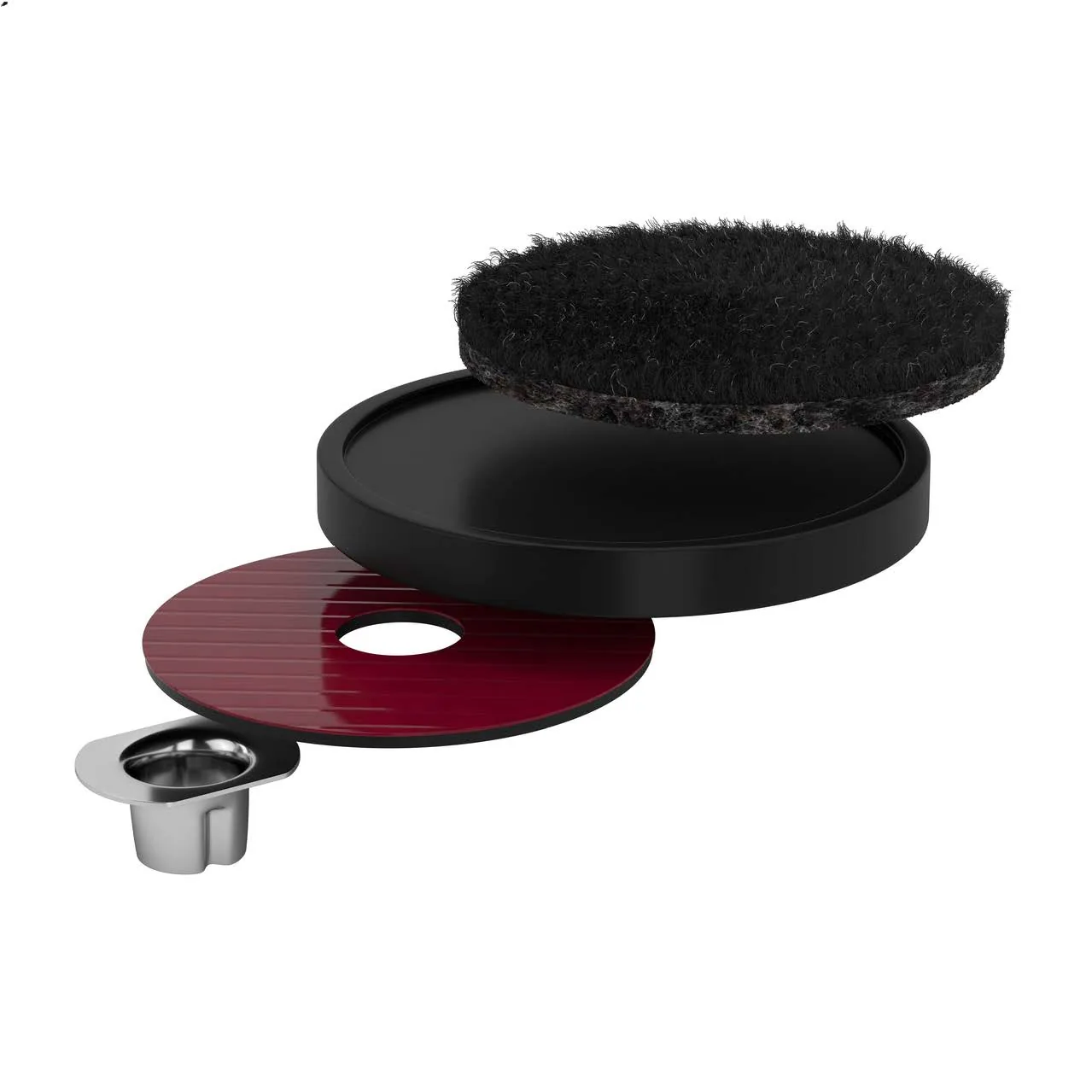
A nail-on glide has a hollow zinc-plated tubular rivet fixed into the body. You set the glide on the leg and tap it home with a rubber mallet. No pilot hole, no drill.
Because the rivet is hollow it parts the wood fibers on the way in rather than boring them out, so the wood closes around it and it sits shallower than a nail while more wood surface holds it. A small anti-rotation notch on the rivet stops the glide turning in the leg. That notch is the reason nail-on glides exist in square and rectangular shapes at all: a plain nail lets a glide spin, so square shapes would never stay lined up with the leg.
The wide head of the rivet is molded inside the plastic body, so metal and plastic are one part. That is the detail to look for on any nail-on glide, because on cheaper ones the plastic head can break away and leave the nail behind, sticking out of the leg, where it becomes the lowest point on the chair.
Nail-on suits wood legs on furniture that moves constantly, and it suits older and antique pieces, because nothing is drilled out and the rivet can be tapped into the same spot again when the glide is eventually replaced.
How a self-adhesive glide holds
A self-adhesive glide has a pad of acrylic foam tape on the back. It is the same class of adhesive used to mount trim and badges on cars, and it behaves nothing like the thin sticky film on a hardware-store felt pad.
Prepared properly it is a permanent fitting, not a temporary one. The preparation is the whole game:
- Clean the bottom of the leg with 70% isopropyl alcohol and let it dry completely. Dust, wax and factory release oils are what make adhesive fail, not the adhesive itself.
- Peel the backing and press the glide on firmly, centered on the leg.
- If you can, stand the furniture on the glides so its own weight keeps them pressed.
- Give it 48 hours to reach full strength before the chair goes back into daily use.
One extra step on plastic legs: fit one glide and test it before you do the whole set. Some plastics have a low-energy surface that any adhesive struggles with, and it is better to find that out on one leg than on twelve.
Self-adhesive is also the right answer when you would rather not pierce the leg at all: a rental, a piece you might sell on, or furniture that is not yours to alter.
Worth knowing: the 50 mm and 75 mm nail-on glides also carry an acrylic foam backing behind the rivet, which supports the larger body and takes load off the rivet. Those two sizes want the same alcohol wipe before fitting, even though they are tapped in.
And the third option, for furniture that does not move
If the piece stays where it is, neither mounting is doing anything a pad cannot do. A self-adhesive pad is the same PA6 fiber face on a thin backing, and it goes on legs from 12 mm right up to 300 mm, which is far wider than the largest glide will fit. For a sideboard, a bed frame, a bookcase or a wide sofa foot, that is the correct product and usually the cheaper one. Same alcohol wipe, same 48 hours. How to measure furniture legs for pads covers the sizing.
Which one for a chair that moves all day
With nail-on vs self-adhesive furniture glides, either works, as long as it matches the leg. A dining chair is pulled out and pushed in a few times a day, close to a thousand cycles a year. A rivet in solid wood shrugs that off. Properly prepared acrylic foam on a clean metal leg does too. The self-adhesive failures we see are almost always a leg that was not cleaned, or a chair that went back into use an hour after fitting.
Fitting time
Fitting time is the last practical difference between nail-on vs self-adhesive furniture glides. Nail-on: place, tap flush with a rubber mallet, use the chair straight away.
Self-adhesive: no tools, but respect the 48 hours.
A six-chair set takes about five minutes either way.
Slides work exactly the same way
Everything above applies unchanged to furniture slides for carpet. The face is molded ABS instead of fiber, but the mounting decision is identical: solid wood takes nail-on with the same rivet and the same anti-rotation notch, everything else takes self-adhesive with the same alcohol wipe and the same 48 hours. Pick the floor first with the glides vs slides guide, then use this page for the mounting.
Whichever you choose, get the size right
Measure the bottom of the leg at its widest point and take the glide that matches or the next size down. Never larger. An oversized glide rocks and grinds its edge into the finish on every move, and on a self-adhesive glide the overhang works the bond loose from the edges in. How to measure furniture legs for glides and slides has the chart.
Whichever fixing you land on, the job is the same: keep abrasion off the finish. The National Wood Flooring Association lists abrasive traffic among the leading causes of finish wear, and that is the wear a correctly sized glide takes instead of your floor.
Nail-on vs self-adhesive furniture glides: the short answer
Solid wood leg: nail-on.
Metal, laminate, veneer, or a leg you would rather not pierce: self-adhesive, cleaned with 70% isopropyl alcohol, 48 hours to cure.
Open tube: tube plug.
Furniture that stays put, or a leg wider than 95 mm: pad.
That is nail-on vs self-adhesive furniture glides settled. Everything is in the furniture glides collection. Questions about your legs? Send a photo of the bottom of one to support@superiorglide.com or use the chat.
Fitting out a restaurant, hotel, school or office, where the wooden chairs and the metal stools need different fixings? Business Solutions covers free samples, volume pricing and a quote for the whole job.