
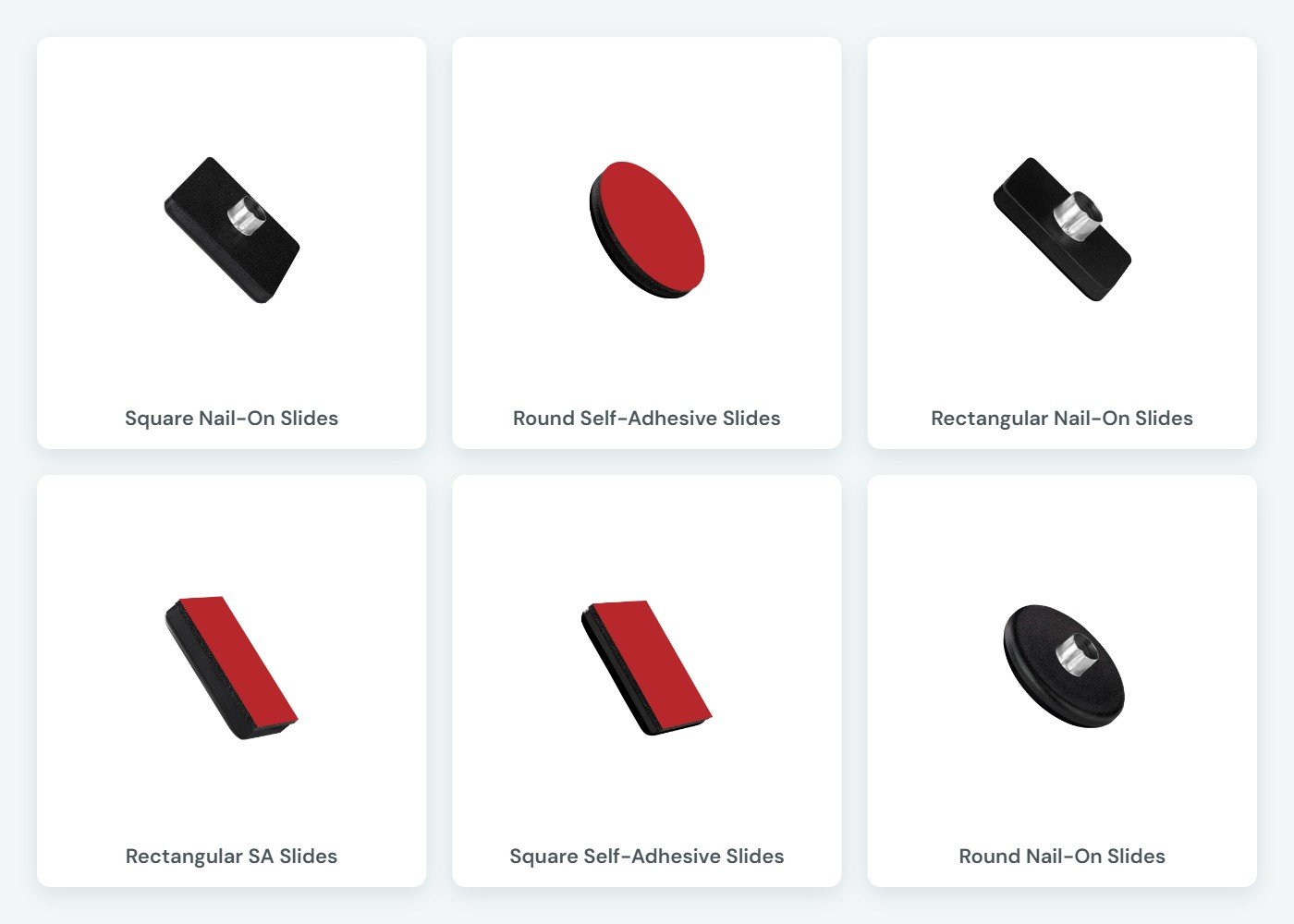
Furniture glides vs slides is a decision your floor makes, not your chair. The two look identical in a photograph and do opposite jobs. A glide has a soft fiber face and belongs on a hard floor. A slide has a hard plastic face and belongs on carpet. Put the wrong one down and it either drags or wears out.
Everything else in the furniture glides vs slides comparison is the same: same shapes, same sizes, same two ways of attaching. So this is a short decision, and the floor makes it, not the chair.
Glides have a soft face, for hard floors
A glide has a dense pile of PA6 fiber on the bottom, like the bristles of a brush cut short. It belongs on smooth hard floors: hardwood, engineered wood, laminate, luxury vinyl plank and tile, cork, bamboo, polished concrete, and smooth sealed tile.
The soft face is what protects the finish. The chair moves on fiber ends rather than on bare wood or plastic, so it slides quietly and the leg itself never touches the floor. Our fiber is needle-punched, meaning the fibers stand upright and are held mechanically with no glue, so the surface stays closed as it wears rather than shedding into a shag. If you are switching from felt, the article on why felt pads scratch hardwood floors explains why that matters.
Slides have a hard face, for carpet and rough floors
A slide has a smooth, molded ABS face with rounded edges. It belongs on carpet, carpet tile and rugs.
Fiber on carpet is a bad pairing. The pile of the glide and the pile of the carpet grab each other, so the chair drags instead of moving, and the carpet wears the fiber down. A hard, smooth face skims over the top of the pile instead. That same hard face is also the right answer on rough hard floors where a soft face would catch and tear: slate, brick, stamped concrete, and tile with deep grout lines.
Furniture glides vs slides: the whole decision
Smooth hard floor: glides. Carpet, rugs, or a rough textured floor: slides.
You do not need to think about the chair yet. Furniture glides vs slides is settled by the floor, so sort the floor first.
What if one piece of furniture is on both
This is the one place furniture glides vs slides gets fuzzy. A dining chair that lives on hardwood and gets pulled onto a rug now and then is fine on glides. Furniture that genuinely travels between a hard floor and carpet does better on slides, because a hard face copes with a smooth floor well enough while a soft face does not cope with carpet at all.
Are sliders the same thing
Mostly. In the furniture glides vs slides world, “slider,” “glider” and “furniture protector” all get used for the same parts, and if you searched for furniture sliders and landed here, slides are what you were after.
One thing worth knowing before you buy anything: a lot of what is sold as “furniture sliders” is the moving-day kind, the big soft discs you shove under a couch to walk it across a room and then throw away. We do not make those. Ours are the permanent kind that fits to the leg and stays there. If you are moving house next Saturday, buy the disposable discs. If you want the chair to stop wearing the floor from now on, you want a glide or a slide.
Then the leg decides how it attaches
Once you know glide or slide, turn the chair over.
Solid wood legs take the nail-on version. A hollow zinc-plated tubular rivet taps into the wood with a rubber mallet, and an anti-rotation notch on the rivet keeps it from spinning in the leg.
Metal, plastic, laminate or veneer legs with a flat closed bottom take the self-adhesive version. Clean the bottom of the leg with 70% isopropyl alcohol, let it dry, press firmly, and leave it 48 hours to reach full strength.
An open tube you can look up into takes a push-in tube plug instead.
And furniture that stays in one place, or a leg wider than any glide, takes a self-adhesive pad: the same fiber face on a thin backing, in sizes from 12 mm up to 300 mm. The nail-on vs self-adhesive article walks through that choice in more detail.
Sizing is the same rule, with one difference on carpet
Measure the bottom of the leg at its widest point, then take the size that matches or the next one down. Never larger. Anything that overhangs the leg rocks under weight and catches on thresholds.
Carpet adds a second consideration. A slide has to float on the pile, so coverage matters more than it does on a hard floor: a slide much smaller than the leg sinks in. Aim to sit flush.
Sizes also differ between the two lines. Glides run 23 mm, 28 mm, 38 mm, 50 mm and 75 mm, plus a 33 x 19 mm rectangle. Slides stop at 50 mm, so a leg wider than about 65 mm is past the slide range. How to measure furniture legs for glides and slides has the full chart and the printable version.
Furniture glides vs slides: quick answer
Hardwood, laminate, vinyl plank, cork, bamboo, smooth tile, polished concrete: glides.
Carpet, carpet tile, rugs, slate, brick, stamped concrete, deep grout lines: slides.
Furniture that lives on both: slides.
Furniture that never moves, or a leg too wide for a glide: pads.
The National Wood Flooring Association lists abrasive traffic among the leading causes of finish wear on wood floors. Matching the face to the floor is the most direct way to take that wear out of the picture.
Browse furniture glides for hard floors or furniture slides for carpet. Not sure which floor you have, or have both in the same room? Send a photo to support@superiorglide.com or use the chat and we will point you the right way.
Fitting out a restaurant, hotel, school or office, where half the rooms are carpeted and half are not? Business Solutions covers free samples, volume pricing and a quote for the whole job.