Low-profile leveling feet with pad combine the 9 mm low-profile base with an integrated PA6 floor protection pad on the contact surface. Minimal visible protrusion plus dedicated scratch prevention in one component. Static load capacity: 80 kg per foot.
Not sure what size? See the size chart ↓
📦 Sold in packs of 4 — quantity adjustable at checkout
Low-profile leveling feet reduce the visible base to 9 mm. Standard leveling feet with pad add a PA6 scratch-protection layer. Low-profile leveling feet with pad combine both: the 9 mm base height for minimal visibility and the integrated PA6 pad for dedicated floor protection. On furniture that sits on hardwood, engineered wood, or luxury vinyl where the design calls for clean leg lines and the floor demands scratch prevention, this is the product that handles both requirements in a single component.
Ø 30 mm PA base at 9 mm height with permanently bonded PA6 floor protection pad. Zinc-plated steel M8 threaded rod at 14 mm length. Static load capacity: 80 kg per foot. Low-profile leveling feet with pad for furniture where minimal protrusion and floor protection both matter. Black. Sold individually.
Low-profile leveling feet with pad are currently available in one configuration that covers the most common specification for furniture needing both low-profile leveling and floor protection.
Base height: 9 mm. M8 thread. Rod length: 14 mm. Static load: 80 kg per foot (320 kg on four legs). PA body + Fe HDG rod + PA6 pad. Weight: 17.1 g. Black. Compatible with M8 round, square, and rectangular threaded inserts.
For a taller base with pad, see standard base with pad (Ø 38 mm, M6/5/16″-18/1/4″-20). For low-profile without pad in more sizes and threads, see low-profile adjustable leveling feet (20 variations, M4 to M10). For custom low-profile with pad configurations, contact Business Solutions.
Low-profile leveling feet with pad solve two problems simultaneously. Understanding each feature independently explains why combining them matters.
The base protrudes only 9 mm below the furniture leg, compared to 18 to 19 mm on standard base leveling feet. From standing or seated viewing angles, the foot is nearly invisible. On design-focused furniture, stackable seating, and short-legged pieces, this minimal protrusion preserves the intended leg aesthetic. The low-profile base provides the same structural support and floor contact as a taller base at the same diameter.
The PA6 floor protection pad is permanently bonded to the bottom of the PA base during manufacturing. PA6 has a lower coefficient of friction, higher wear resistance, and a smoother micro-surface than plain PA. On hardwood, engineered wood, luxury vinyl, and other scratch-sensitive floors, the PA6 pad prevents the micro-scratching that a plain PA base can cause under sustained compressive load. The same PA6 compound used in furniture glides and furniture pads across the catalog.
Without this product, achieving both features requires a low-profile leveling foot plus a separate self-adhesive pad applied to the base. That adhesive can shift or peel under the rotational force of leveling adjustment. Low-profile leveling feet with pad eliminate the separate adhesive pad entirely. One component, permanently bonded, no maintenance.
The PA6 pad adds minimal additional thickness to the 9 mm base. The pad is a thin layer bonded to the base bottom, not a separate disc stacked underneath. The total base-plus-pad height remains close to the low-profile specification. PA6 pad low-profile leveling feet maintain the visual benefits of the low-profile design while adding floor protection that the standard low-profile version does not include.
Every benefit of low-profile leveling feet (minimal visibility, wobble elimination, height adjustment, noise reduction) plus dedicated PA6 scratch protection. The National Wood Flooring Association (NWFA) recommends protective contact surfaces on all furniture legs, and low-profile leveling feet with pad meet that recommendation at the lowest possible visible profile.
The primary advantage of the pad version. On hardwood, engineered wood, luxury vinyl, polished concrete, and sealed stone, the PA6 pad prevents micro-scratching that accumulates under sustained static load. Every leveling foot carries the weight of one furniture corner continuously. Over weeks and months, a plain PA base can leave marks. The PA6 pad does not. Leveling feet with pad low profile that protect finished floors from day one without adding visible bulk.
The combination that no other single product provides. Standard base with pad provides floor protection but at a taller profile. Standard low-profile provides minimal visibility but without the PA6 pad. Low-profile leveling feet with pad provide both. Unlike leaving furniture on unprotected leveling feet, the integrated pad ensures the floor stays scratch-free while the foot stays invisible. Low profile leveling feet floor protection in a single component.
A separate self-adhesive pad on a low-profile leveling foot faces two challenges: the adhesive can peel under rotational force during adjustment, and the pad adds visible thickness to a foot that was chosen specifically for minimal visibility. The integrated PA6 pad eliminates both issues. It is permanently bonded (no peeling) and adds minimal thickness (preserving the low profile). Thin base leveling feet with pad that stay thin and stay protected.
The PA6 pad adds a softer contact layer between the foot and the floor. On hard surfaces, this reduces contact noise when furniture shifts or vibrates. The noise reduction supplements the PA body’s own dampening. In restaurants, offices, and conference rooms where dozens of tables sit on hard floors, every quieter contact point contributes to a more comfortable acoustic environment.
Three materials in one component, same as standard base with pad. The PA body provides structural support. The zinc-plated steel rod provides the threaded connection. The PA6 pad provides floor protection.
The Ø 30 mm PA base at 9 mm height carries the compressive load. The PA6 pad bonded to the bottom provides the floor contact surface. PA handles the structural load. PA6 handles the floor interaction. Two materials working together at the contact point.
M8 thread, 14 mm rod length. Zinc-plated steel. Provides fine height adjustment for floors with minor unevenness. The 14 mm length is adequate for most residential and standard commercial floor conditions. For environments requiring corrosion-resistant rods, see stainless steel rod leveling feet.
When do you need this specific combination, and when is another option better?
Standard base with pad provides the same PA6 floor protection but on a taller base (Ø 38 mm). Choose standard base with pad when visibility is not a concern. Choose low-profile with pad when the foot must be as invisible as possible while still protecting the floor.
Low-profile without pad offers 20 variations across M4 to M10 and rod lengths up to 50 mm, but no PA6 floor protection. Choose low-profile without pad on concrete, carpet, or surfaces where scratching is not a concern. Choose low-profile with pad on hardwood, engineered wood, and luxury vinyl.
You can apply a self-adhesive pad to a standard low-profile foot. But the adhesive can peel under rotational force, and the pad adds visible thickness to a foot chosen for minimal profile. The integrated PA6 pad on low-profile leveling feet with pad solves both issues permanently.
Low-profile leveling feet with pad cost more per unit than standard low-profile feet without pad. But the total cost comparison should include the separate adhesive pad, the labor to apply it, and the labor to replace it when the adhesive fails. In commercial environments with dozens or hundreds of tables, the adhesive pad replacement cycle creates recurring maintenance labor that the integrated pad eliminates entirely.
For a single residential table, the cost difference per foot is minimal and the convenience of not needing a separate pad justifies the small premium. For commercial projects with 50 or more tables, the elimination of pad-related maintenance across the fleet represents meaningful operational savings over the furniture’s service life. Low-profile leveling feet with pad pay for themselves by removing the adhesive pad from the maintenance schedule permanently.
Any furniture with M8 threaded inserts that sits on a scratch-sensitive floor and requires minimal foot visibility below the leg.
The PA6 pad adds the most value on smooth, finished hard floors. On other floor types, the benefit varies. This guide helps determine whether low-profile leveling feet with pad are the right specification for your floor.
Solid hardwood (oak, maple, walnut, cherry). Engineered hardwood with finished veneer. Luxury vinyl plank (LVP) and luxury vinyl tile (LVT). Polished concrete with sealed finish. Sealed natural stone (marble, granite, travertine). Laminate flooring. Cork and bamboo flooring. All of these surfaces can micro-scratch under sustained load from a plain PA base. Low-profile leveling feet with pad prevent this on every contact point while keeping the foot nearly invisible.
Raw concrete and unfinished surfaces. Textured ceramic tile (the texture dominates wear). Carpet and soft flooring (no hard surface to scratch). Industrial epoxy flooring. Outdoor pavers and decking. Rubber gym flooring. For these floors, standard low-profile leveling feet without pad provide adequate floor contact without the PA6 layer.
For furniture manufacturers and facility managers specifying low-profile leveling feet with pad, the single M8 x 14 mm configuration simplifies ordering and inventory. Every foot in the order is identical. No size selection confusion. No mismatched threads on the production floor.
Specify low-profile leveling feet with pad at the design stage alongside M8 threaded inserts. The 14 mm rod length provides standard fine adjustment for typical floor conditions. The integrated PA6 pad means no additional floor protection components are needed in the bill of materials. One leveling foot SKU per leg, ready to install at the end of the assembly line. For production quantities, visit Business Solutions.
If existing furniture has M8 threaded inserts, low-profile leveling feet with pad can replace the current leveling feet without modification. Unscrew the old foot, screw in the new foot with pad. This is particularly valuable when furniture moves from a non-sensitive floor (warehouse, staging area) to a scratch-sensitive floor (showroom, dining room). The pad adds floor protection to furniture that was not originally specified with it.
Low-profile leveling feet with pad are sold individually. Order the quantity that matches your furniture leg count. A four-legged table needs 4 feet and 4 M8 threaded inserts. A six-legged conference table needs 6 of each. If only some legs sit on scratch-sensitive flooring, you can mix low-profile leveling feet with pad on the sensitive-floor legs and standard low-profile without pad on the others. Both use the same M8 thread and the same Ø 30 mm base diameter, so they are visually consistent from leg to leg.
Anywhere M8-threaded furniture needs both invisible leveling and guaranteed floor protection on scratch-sensitive surfaces.
Upscale restaurant dining tables, hotel lobby tables, boutique cafe tables, and high-end retail display fixtures on hardwood or luxury vinyl floors. These environments demand both design-quality furniture appearance and floor protection. Low-profile leveling feet with pad deliver both without compromise. At 80 kg per foot, a four-legged table supports 320 kg total, which covers the table weight plus any foreseeable dining load from dishes, drinks, and leaning guests. In restaurant chains that specify consistent furniture across all locations, low-profile leveling feet with pad ensure every table arrives ready for scratch-sensitive floors without additional accessories or assembly steps at each location. Available for bulk orders. For commercial pricing, visit Business Solutions.
Home dining tables on hardwood floors, executive desks on luxury vinyl, and home office furniture where the homeowner has invested in premium flooring and wants both leveling and protection. The 14 mm rod provides enough adjustment for the minor unevenness typical of residential floors. For offices with raised access flooring (common in modern commercial buildings), the fine adjustment range handles the slight unevenness at floor panel joints. Low-profile leveling feet with pad are also specified for showroom and model home furniture where the furniture must look perfect on the display floor and the display floor must remain unmarked through constant foot traffic around the furniture.
Check periodically that the foot is tight in the threaded insert and the furniture remains level. Inspect the PA6 pad surface for wear. The PA6 material is highly wear-resistant, but on furniture that gets moved or adjusted frequently, the pad should be checked every 6 to 12 months. The low-profile base makes the foot harder to see during visual inspections, so run a finger under each leg to confirm the foot is still seated and the pad surface is intact. If the PA6 shows visible wear-through to the PA body beneath, replace the leveling foot.
When relocating furniture from one floor to another, wipe the pad surface clean before setting the furniture in its new position. Grit trapped between the pad and a new floor surface can scratch the floor that the pad is designed to protect. On commercial furniture that gets relocated between rooms or buildings regularly, make pad cleaning part of the relocation checklist. Low-profile leveling feet with pad are sold individually for convenient single-foot replacement without disrupting the other legs on the same furniture.
Low-Profile Adjustable Leveling Feet: 20 variations, M4 to M10, rods 8 to 50 mm. No pad.
Standard Base with Pad: taller base, Ø 38 mm, M6/5/16″-18/1/4″-20.
| Specification | Details |
|---|---|
Product Type |
Adjustable Leveling Feet – Type E (with Pad) |
Materials |
PA (Polyamide) base + PA6 (Polyamide 6) pad + Fe HDG steel stem |
Fit Style |
Threaded stem with fixed base |
Floor Compatibility |
Tile, hardwood, laminate, concrete, LVT, etc |
Furniture Compatibility |
Storage units, shelving, desks, tables, compact fixtures |
Leg Compatibility |
Metal threaded inserts |
Tube/Foot Diameters |
Ø30 mm (1.18") |
Thread Sizes |
M8 (8 mm) |
Thread Lengths |
14 mm (0.55") |
Weight Capacity |
80 kg (176 lbs) static load per foot |
Color Options |
Black |
Installation Type |
Screw-in by hand or wrench |
Key Benefits |
Compact design, floor-safe pad, adjustable support, quick install |
Indoor/Outdoor Use |
Indoor | Covered Outdoor | Uncovered Outdoor |
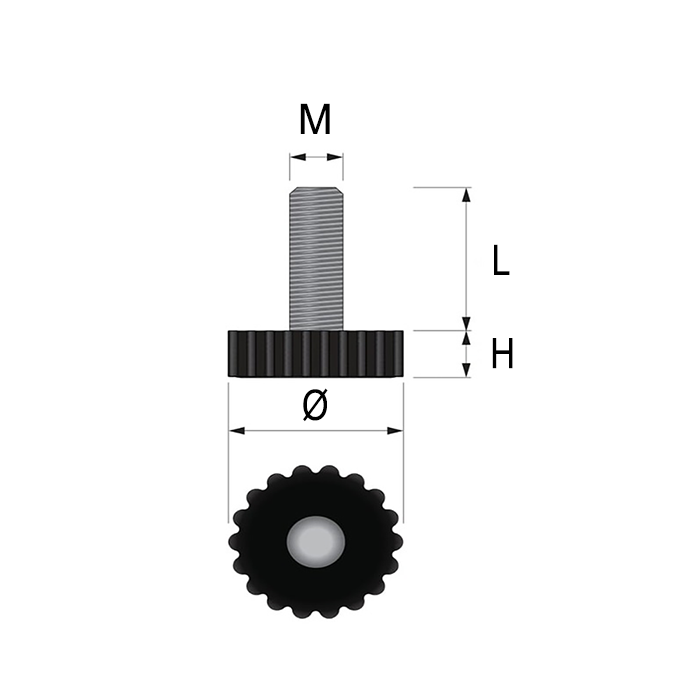
| Base Diameter (Ø) | Thread Size (M) | Threaded Stem Length (L) | Base Height (H) | Static Load Capacity (SL) |
|---|---|---|---|---|
30 mm (1.18") |
M8 (8 mm) |
14 mm (0.39") |
9 mm (0.39") |
80 kg (176 lbs) / pc |
Both have an integrated PA6 pad. The difference is the base height. Standard base with pad has a taller base (Ø 38 mm). Low-profile leveling feet with pad have a 9 mm base that protrudes minimally below the furniture leg. Choose low-profile with pad when you need both scratch protection and minimal foot visibility.
The Ø 30/M8 x 14 mm combination covers the most common specification for furniture that needs both low-profile leveling and floor protection: standard dining tables, office desks, and commercial furniture on hardwood or luxury vinyl. For other sizes with a pad, see standard base with pad. For custom low-profile with pad configurations, contact Business Solutions.
Yes. The same PA6 compound, permanently bonded during manufacturing. The pad covers the full Ø 30 mm base diameter. Same scratch resistance, same low coefficient of friction, same protection for hardwood, engineered wood, and luxury vinyl floors.
Yes. Both use the same M8 thread and screw into the same round, square, or rectangular threaded inserts. You could use low-profile with pad on the legs that sit on hardwood and standard low-profile without pad on legs that sit on carpet or concrete.
14 mm provides fine adjustment for floors with minor unevenness. For most residential and commercial floors, 14 mm is adequate. If your floor has moderate to significant unevenness, use a standard low-profile leveling foot (up to 50 mm rod) with a separate self-adhesive pad applied to the base.
Only logged in customers who have purchased this product may leave a review.


Reviews
There are no reviews yet