Hospitality-grade floor protection · Free shipping over $50 · 90-day limited warranty
Hospitality-grade floor protection · Free shipping over $50 · 90-day limited warranty
The little discs that go under furniture legs so they don’t scratch your floors. This guide covers how to choose, measure, and install glides for any smooth hard floor.
Specified by hotels, restaurants, and universities · NWFA-recommended protective glides for hardwood
Every furniture glide is one mounting method (nail-on or self-adhesive) and one surface (Smooth Glide PA6 or Anti-Slip rubber). Answer two questions and you know which one is yours.
1 Mounting method
If solid wood legs
Strongest mechanical hold. A zinc-plated steel tubular rivet drives into the wood with a rubber mallet, no glue, no curing.
If metal, plastic, or no rivet holes
For metal, plastic, hollow tube, antiques, and rentals. EHBF acrylic foam tape bonds in 30 seconds, no holes.
2 Surface material
Got both answers? You know exactly what to buy. Next, make sure glides suit your floor type, then measure your legs for the right size. Or skip ahead and browse the full lineup.
Furniture glides are made for smooth, hard floors. If your floor is polished or sealed, glides protect it. If your floor is carpet, rough, or unsealed, glides are not the right product.
NWFA approved: our PA6 Smooth Glide surface meets National Wood Flooring Association recommendations for furniture contact on hardwood floors.
For carpet, area rugs, AND rough hard floors: use Furniture Slides instead. The hard ABS surface on slides handles textured tile, slate, stamped concrete, and other abrasive floors that would wear through a glide’s PA6 fiber.
Nail-on glides install with a zinc-plated steel tubular rivet that drives into the wood with a rubber mallet. An anti-rotation notch keeps the glide from spinning. No drilling, no glue, no curing time.
Best for: any solid wood furniture you own that moves frequently. Dining chairs are the classic case.
Use nail-on glides when
Nail-on specifications
Self-adhesive glides use EHBF acrylic foam tape that bonds to any clean smooth surface in 30 seconds and reaches full cure in 48 hours. No tools, no holes, no prep beyond a wipe with isopropyl alcohol.
Best for: any leg that isn’t solid wood you own. Metal, plastic, hollow tube, antiques, and rentals all use self-adhesive.
Use self-adhesive glides when
Self-adhesive specifications
Both surfaces work on the same smooth, hard floors. The difference is what they do once they are there: Smooth Glide lets furniture move silently, Anti-Slip locks it in place. Your use case decides.
For furniture that moves
Needle-punched polyamide fiber at 1,450 g/m² pile density. Glides silently across smooth, hard floors. NWFA approved for hardwood contact. The right choice for 90% of customers.
Best for
Floors: hardwood, tile, vinyl, laminate, polished concrete, sealed cork.
For furniture that stays in place
Natural and chloroprene rubber compound that grips smooth, hard floors. Locks furniture in place when motion is the enemy: rolling boats, fixed restaurant seating, polished concrete venues.
Best for
Floors: smooth, hard floors only. Same as Smooth Glide.
In short: if you want furniture to glide smoothly across the floor, choose Smooth Glide. If you want furniture to stay exactly where you put it, choose Anti-Slip. Both come in nail-on and self-adhesive mounting, in every shape and size.
Sizes are stated in millimeters with imperial conversions. The right size sits just inside the edge of the leg, fully hidden when viewed from the side.
Lay the furniture on its side or upside down. The flat face at the very bottom of the leg is where the glide will sit. That’s the surface you measure.
Use a ruler, tape measure, or calipers. Round legs: measure the diameter across the widest point. Square legs: measure one side. Rectangular legs: measure both width and length.
Many modern and mid-century legs taper, meaning the bottom is narrower than the top. Always measure at the bottom, not the top. The glide must fit the actual base it’s attaching to.
If your measurement falls between two sizes, choose the smaller one so the glide sits flush or just under the leg edge. A glide that overhangs the leg edge catches on things and lifts at the corner. A slightly tucked-under glide stays hidden and bonded.
Sizing tip: a glide that sits flush with the leg base or slightly smaller stays hidden under the leg edge. A glide that’s larger overhangs and catches on things. At a size boundary, choose flush or smaller — never larger.
Round glides
| Glide size | Fits leg base |
|---|---|
| Ø 23 mm | Ø 23–27 mm (0.91″–1.06″) |
| Ø 28 mm | Ø 28–37 mm (1.10″–1.46″) |
| Ø 38 mm | Ø 38–49 mm (1.50″–1.93″) |
| Ø 50 mm | Ø 50–74 mm (1.97″–2.91″) |
| Ø 75 mm | Ø 75–100 mm (2.95″–3.94″) |
Square & rectangular glides
| Glide size | Fits leg base |
|---|---|
| 23 × 23 mm | 23×23–27×27 mm (0.91″–1.06″) |
| 28 × 28 mm | 28×28–37×37 mm (1.10″–1.46″) |
| 38 × 38 mm | 38×38–49×49 mm (1.50″–1.93″) |
| 50 × 50 mm | 50×50–74×74 mm (1.97″–2.91″) |
| 75 × 75 mm | 75×75–100×100 mm (2.95″–3.94″) |
| 33 × 19 mm | 33×19–40×25 mm (1.30″×0.75″–1.57″×0.98″) |
Prefer to measure against the real thing?
Print our size guide at 100% and hold your leg against the true-scale shapes. Works for glides and slides, nail-on or self-adhesive.
Both methods are quick. Nail-on or self-adhesive, most people finish all four legs in under five minutes, whether that is four dining chairs or four hundred restaurant chairs.
Center the furniture glide on the bottom of the leg. The anti-rotation notch molded into the rivet on the tubular rivet is designed to key into the wood grain, preventing the glide from spinning later. For square and rectangular glides, align the edges with the leg edges.
Tap with a rubber mallet until the furniture glide sits flush against the wood. No pre-drilling needed. The zinc-iron plated rivet separates wood fibers rather than cutting them, so the hole stays tight even after multiple replacements over the years.
Try to rotate the furniture glide with your fingers. If it spins, the anti-rotation notch molded into the rivet hasn’t fully seated into the wood grain. Give it another firm tap with your mallet until it locks in place and holds.
Set the furniture back down and push it across the floor. You should feel smooth, quiet movement with no catching or dragging. If it glides silently, you’re done.
Wipe the bottom of every furniture leg with isopropyl alcohol (70% or higher). This single step is the difference between a furniture glide that holds up and one that falls off within a week. Dust, oil, and finish residue all weaken the adhesive bond.
Peel the protective backing film off the furniture glide. Discard it immediately if the exposed EHBF adhesive touches anything other than the clean leg surface, contamination weakens the bond.
Center the furniture glide on the leg base and press firmly for a full 30 seconds. You want full contact with no air pockets and no gaps at the corners. Align square and rectangular glide edges with the leg edges.
Set the furniture back down gently. The weight of the furniture actually helps the EHBF adhesive cure. Wait 48 hours before heavy use or dragging. Moving furniture before the adhesive fully bonds is the number one reason self-adhesive furniture glides fail prematurely.
Most floor pads still use a twenty-year-old design: adhesive-backed felt pressed onto a cheap plastic disc with a drop of hotmelt glue. They hold for a few weeks, then the felt peels, the glue fails, and your floors are exposed again. Here is what is different.
Surface: PA6 needle-punched polyamide fiber, 1,450 g/m² pile density, vertically interlocked. Resists lateral shearing without delaminating. No glues in manufacturing.
Platform: Automotive-grade ABS plastic. Shock-resistant, dimensionally stable, and resistant to brittleness.
Bonding: Superglue applied to all edges and corners. Manual application, manual quality check. Resists peeling at the edges where lateral stress concentrates.
Fastener: Zinc-iron plated tubular rivet. Shallow penetration and broader grip than a standard nail. Wide head molded into ABS. Anti-rotation notch molded into the rivet prevents spinning. Available in round, square, and rectangular.
Surface: Horizontal nylon felt layers pressed together with adhesive. Layers separate under lateral force. Humidity accelerates failure because glue holds the layers together.
Platform: PE (polyethylene) plastic. Brittle, prone to cracking, ages quickly.
Bonding: A single drop of hotmelt in the center of the platform. Felt peels from corners first, exactly where stress concentrates.
Fastener: Standard nail. Narrow head not molded into plastic. Only available in round (other shapes would need 2+ nails). Plastic can break loose, leaving the nail to gouge your floor.
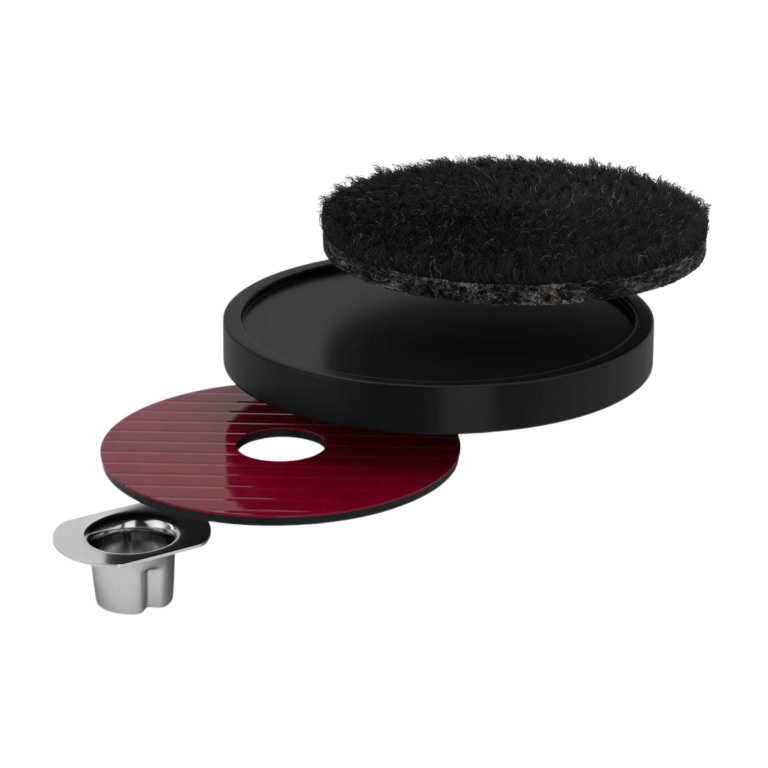
Every furniture glide is a complete floor protection unit. Here is what each part does, and how the materials work together for silent gliding, durability, and floor protection.
Four components work together to deliver reliable, wobble-free floor protection. The tubular rivet locks into solid wood without pre-drilling. The PA6 fiber surface glides silently across hardwood, tile, and all other smooth, hard floors.
PA6 (Polyamide 6) needle-punched fiber at 1,450 g/m² pile density and 5.5 mm thickness. Vertically interlocked fibers resist lateral shear and won’t delaminate, even under heavy daily use on hard floors.
Automotive-grade ABS (Acrylonitrile Butadiene Styrene) platform, the same material used in car dashboards. The PA6 fiber surface is superglue-bonded to all edges of the ABS platform for maximum durability.
EHBF (Extra High Bond Foam) double-sided acrylic foam pad distributes load across the full ABS platform, dampens vibration, and absorbs sound. The result: silent, scratch-free gliding on every smooth, hard floor. The EHBF foam layer is available on nail-on glides in Ø 50 mm and Ø 75 mm round, and 50 × 50 mm and 75 × 75 mm square sizes only.
Zinc-iron plated steel tubular rivet with a razor-sharp edge that separates wood fibers without pre-drilling. The precision-formed head is molded directly into the ABS platform, creating a single fused unit that can’t loosen or rattle.
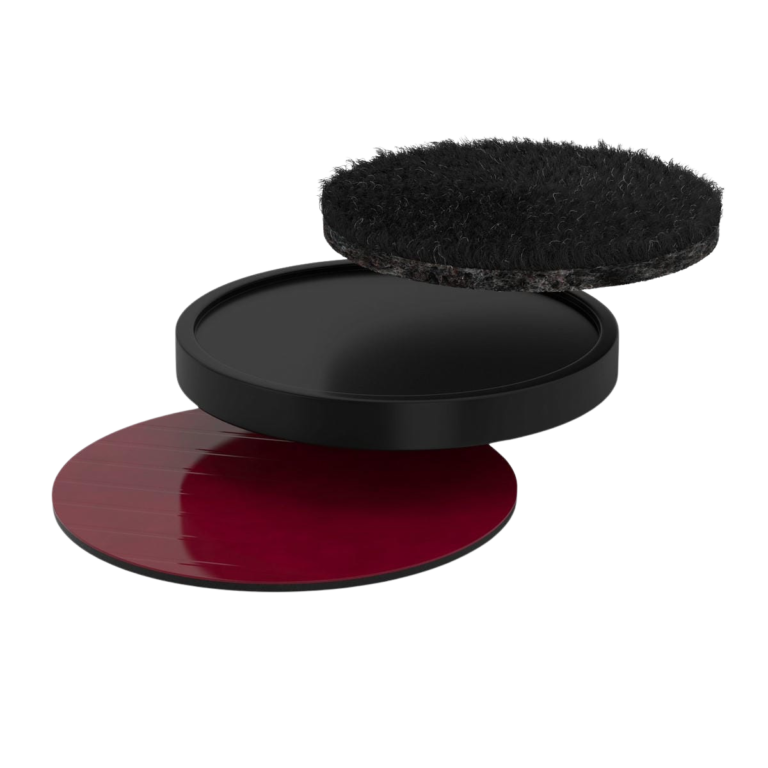
Three components bond securely to metal. No tools, no rivet holes. The EHBF acrylic foam adhesive reaches full bond strength after 48 hours. The PA6 gliding surface is identical to the nail-on range.
Same PA6 (Polyamide 6) needle-punched fiber used in our nail-on furniture glides: 1,450 g/m² pile density, 5.5 mm thickness, vertically interlocked fibers. Superglue-bonded to the ABS platform for maximum durability. Glides silently across hardwood, tile, laminate, vinyl, and every other smooth, hard floor.
Same automotive-grade ABS platform as our nail-on line. High surface tension ensures secure superglue bonding to the PA6 fiber surface on all edges. The underside bonds to the EHBF adhesive backing with full contact. No air gaps, no weak points.
EHBF (Extra High Bond Foam) double-sided acrylic tape bonds securely to any clean, smooth surface: chrome, powder-coated steel, anodized aluminum, finished wood, and most rigid plastics. Reaches full bond strength after 48 hours under furniture weight. No tools required.
The questions people ask most about furniture glides, answered in plain English.
Furniture glides are protective pads that attach to the bottom of furniture legs. Sometimes called chair glides for smooth, hard floors, they prevent scratches, scuffs, and noise while allowing smooth movement on hardwood, tile, laminate, and vinyl floors.
Yes. Properly sized furniture glides with Smooth Glide (PA6) or Anti-Slip (NR+CR) surfaces prevent scratches, scuffs, and wear on all smooth, hard floors.
Any furniture on smooth, hard floors benefits from glides: chairs, tables, bar stools, sofas, beds, and more. Anything that moves or could shift over time.
Yes. Smooth Glide (PA6) glides dramatically reduce scraping and squeaking on tile, hardwood, laminate, and other hard surfaces.
Measure your furniture leg at the base, right where the glide will sit. If your measurement falls between sizes, choose the size that sits flush or just smaller — never larger. See the sizing steps in the How to Measure section. See How to Measure above.
Nail-on glides for solid wood legs. Self-adhesive for metal, plastic, or wood when you prefer no rivet holes. See Quick Decision above.
Smooth Glide for furniture that moves regularly. Anti-Slip for furniture that must stay put. See Surface Choice above.
Yes. Worn glides expose abrasive materials directly to your floor. Replace them as soon as you notice wear. Waiting risks serious floor damage that costs far more than new glides.
How long they hold up depends on use. Dining chairs pushed and pulled daily wear their glides faster than bedroom furniture that rarely moves. The PA6 surface is built to take repeated sliding; when a glide wears thin enough to expose the leg or backing, replace it.
No. Furniture glides are engineered for smooth, hard floors only. On carpet, the PA6 fiber grips instead of gliding. For carpet, rugs, and mats, use furniture slides with an ABS surface.
No. Rough hard surfaces like unpolished slate, raw concrete, and textured tile are abrasive enough to wear through PA6 fiber quickly. Use furniture slides instead.
Whether you’re outfitting one dining room or a full restaurant floor, the right glide is in the catalog.
Browse other furniture guides: Slides Guide · Pads Guide · Tube Plugs Guide · Leveling Feet Guide · Sled Base Guide
Product categories: Furniture Glides · Furniture Slides · Furniture Pads · Tube Plugs & End Caps · Leveling Feet · Sled Base Glides
Business accounts: Business Solutions for volume pricing, B2B accounts, and commercial orders.