
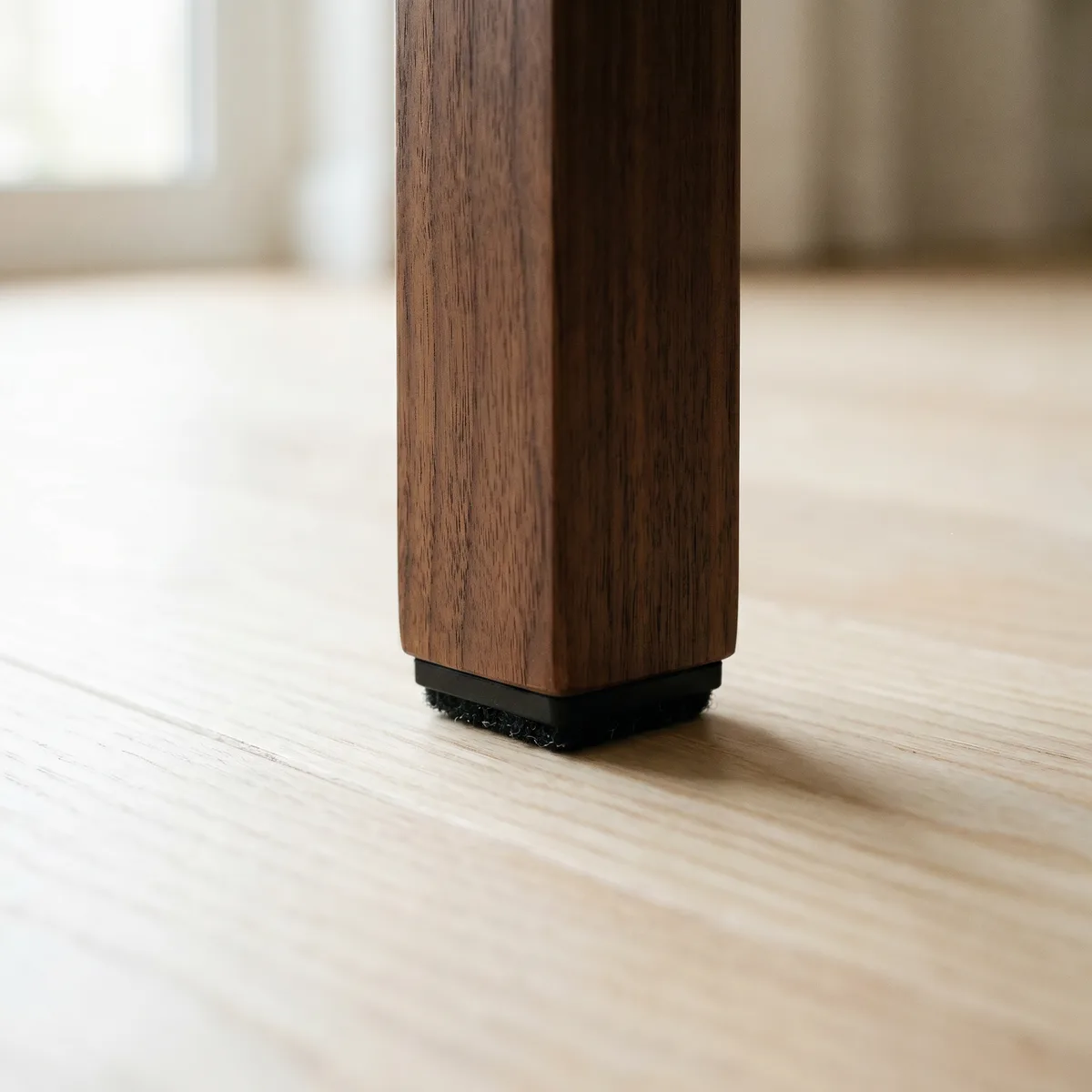
You put felt pads under your chairs to avoid scratching the floor. Six months later, there are scratches anyway.
This happens to a lot of people. And the felt pads are usually why.
It isn’t that felt is a bad idea. It’s what happens to felt after a few weeks of real use, and why PA6, the engineered material used in commercial furniture hardware, behaves differently on hardwood.
Here’s the full comparison of felt pads vs glides on hardwood.
What felt pads are made of, and why that matters
Standard furniture felt pads are made of compressed wool or synthetic fiber. The material is soft, which is why it works on day one. A soft pad between a hard chair leg and the floor cushions the contact and absorbs pressure without marking the surface.
The problem isn’t the felt itself. It’s what the felt collects.
Floors aren’t clean surfaces. Even in a well-kept home, hardwood collects fine grit: dust, tracked-in particles, sand off shoes, and microscopic debris from daily life. Most of it is invisible. But it’s there.
When a felt pad sits on hardwood, it traps that grit. The fibers catch particles and hold them. Within weeks, the underside of a typical felt pad has grit worked into its contact surface.
At that point, every time you push a chair across the floor, you drag that embedded grit with it.
That’s not a felt pad anymore. That’s sandpaper.
The scratches you find under furniture are rarely from the leg. They’re from the grit that they felt collected.
What PA6 is, and how it works differently
PA6 is polyamide 6, also called nylon 6. It’s an engineered polymer used wherever low friction, durability, and dimensional stability matter: automotive components, precision mechanical parts, and, in the furniture hardware industry, engineered glides for commercial seating.
The properties that make it work for furniture on hardwood are specific.
Low surface energy. PA6 has a naturally low coefficient of friction against hard floors. It slides cleanly, without the resistance that causes marking.
Non-porous surface. Unlike felt fiber, PA6 doesn’t collect and hold grit. Particles that land on it don’t embed. They stay on the surface where they can be wiped away, or they get displaced by the chair’s motion before they can mark the floor.
Dimensional stability. PA6 holds its shape under load. Felt compresses over time and eventually flattens to the point where the leg meets the floor directly. PA6 keeps its profile and its function.
Moisture resistance. In humid climates, and Florida in particular, felt absorbs moisture and can pass it to the hardwood, contributing to micro-warping at the contact points. PA6 isn’t affected by humidity.
These aren’t marketing claims. They’re the documented material properties of PA6, listed in the manufacturer’s engineering data sheets.
Felt pads vs glides: what fails first
Here’s the honest comparison of what happens over time.
Felt pads: the typical failure sequence
- Weeks 1 to 2: pads work as intended. No marking.
- Weeks 3 to 6: grit begins working into the fiber. Faint scratching starts.
- Months 2 to 4: the adhesive loosens, especially in humid conditions. Pads shift off-center or fall off.
- Replacement, and the cycle starts again.
A lot of people go through this several times a year on a single piece of furniture. They assume it’s normal. It’s really just the limit of the material in everyday use.
PA6 nail-on glides: how they behave
A properly installed PA6 glide on a chair pulled in and out from a dining table daily shows very little wear. The mechanical fastener, a tubular zinc rivet that expands inside the leg, holds without relying on a stick-on backing at all. The contact surface stays clean and keeps doing its job.
There’s no regular replacement cycle to manage.
The cost comparison
Here’s the part that surprises people. Engineered glides aren’t the expensive option.
Felt pads from a hardware store run roughly $0.25 to $0.50 each. A six-chair dining set needs 24 pads. At $0.35 average, that’s about $8 to outfit the set. Then you replace them a few times a year, which is common, plus the work each time: noticing they’ve fallen off, finding replacements, cleaning the old adhesive residue, pressing new ones on.
Superior Glide PA6 glides for the most common chair-leg sizes run a little over a dollar each. The same six-chair set runs around $26 to outfit, once.
So the comparison isn’t cheap felt versus expensive glides. It’s $8 a few times a year versus about $26 one time, for a glide that doesn’t trap grit and doesn’t fall off. Buy felt pads two or three times, and you’ve spent what the engineered set costs, with a scratched floor to show for it.
And the scratches are the cost that actually matters. Refinishing hardwood runs a few dollars per square foot, when done professionally, and a single room adds up fast.
When felt pads are actually the right choice
This isn’t a case against felt everywhere.
Felt pads work well on light furniture that rarely moves: a side table against a wall, a lamp base, a decorative piece. The grit problem barely shows up when the pad isn’t being dragged across the floor.
They also work as a stopgap. If you’ve just moved in and need protection while you figure out what furniture you’re keeping, felt pads are a reasonable short-term choice.
What they’re not is a long-term answer for dining chairs, desk chairs, or anything that moves every day.
What to look for in a PA6 glide
Not everything sold as “nylon” or “polymer” is PA6. The material designation matters because different polyamides have different friction and wear characteristics.
When you’re buying engineered glides for hardwood, look for:
- PA6 is listed explicitly, not just “nylon” or “plastic.”
- The right attachment for your leg. A nail-on or screw-on glide holds mechanically and suits legs that can take a fastener. A self-adhesive glide suits legs you’d rather not pierce, as long as it uses a proper engineered adhesive, not the weak backing on a hardware-store felt pad.
- An anti-rotation feature, a notch or flat that keeps the glide from spinning in the leg socket and wearing unevenly
- The right size. The glide should sit slightly smaller than the leg, never larger. An oversized glide rocks and marks the floor at its rim.
Sizing is the most common point of confusion. If you’re not sure how to measure your furniture legs, the guide on the furniture glides page walks through it.
The short version
In the end, felt pads vs glides comes down to what the surface does over time. Felt pads work on day one. They collect grit, they scratch floors, and they fall off. You replace them, and it happens again.
PA6 glides don’t collect grit. The contact face is engineered, not felt. There’s no regular replacement cycle.
If your floors matter to you, what goes between the chair leg and the wood matters too. Felt and PA6 aren’t the same kind of product. They just get sold in the same aisle.
Looking for the right glide for your furniture? The Superior Glide furniture glides collection covers nail-on and self-adhesive options across common leg sizes, with a sizing guide to help you get the fit right.
Questions? Email support@superiorglide.com or use the chat, and we’ll help you find the right fit.