Hospitality-grade floor protection · Sizing help before you order · Apply for a business account
Sizing help · Apply for a business account
Hospitality-grade floor protection · Sizing help before you order · Apply for a business account
Sizing help · Apply for a business account
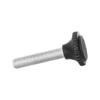
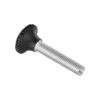
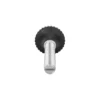
Leveling a heavy commercial table usually means crawling underneath to turn each foot. This standard-height foot puts a screwdriver slot in the rod end so you adjust from above with a flathead. The M10 option holds 120 kg per foot for workbenches and big tables.
We make this size in production runs, so there is none on the shelf today. Tell us how many you would want and you go on the list for it. When enough people ask for a size, we run it, and the people who asked hear about it first.
We stock a limited range of threads and lengths. Tell us what you need and we will confirm availability and pricing by email.
Buying in volume? See business pricing & samples ↓
Heavy commercial furniture often sits in positions where hand access to the leveling feet is restricted: conference tables against walls, industrial workbenches in tight layouts, kitchen prep tables loaded with equipment. On furniture this heavy, tipping the piece to access the feet is impractical. Notched thread standard base adjustable leveling feet solve this with a screwdriver slot in the threaded rod end. Insert a flathead screwdriver from above through the furniture tube leg, engage the slot, and turn the rod to adjust the height. M10 at 120 kg per foot handles the heaviest commercial applications.
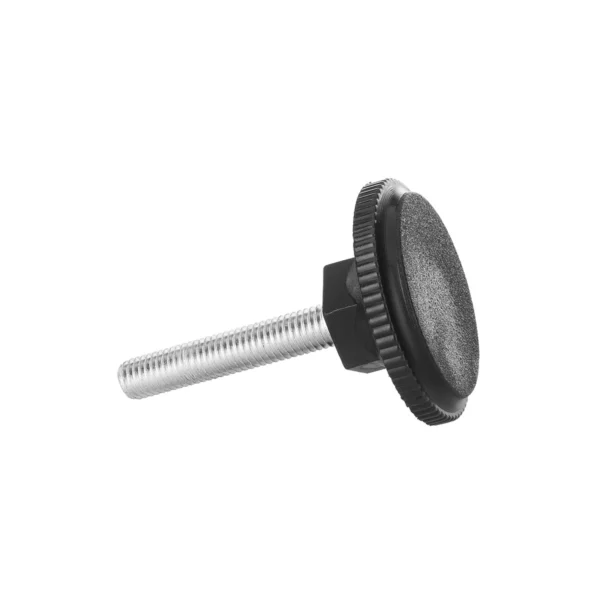
PA (polyamide) standard base with zinc-plated steel M10 threaded rod featuring a screwdriver notch. Notched thread standard base adjustable leveling feet are from-above standard base leveling feet for heavy furniture where hand access below is limited. Ø 30 mm (H = 18 mm) and Ø 45 mm (H = 19 mm). M10 × 50 mm. Static load: 120 kg per foot. Black. Sold in packs of 4, adjustable in steps of 2 at checkout.
The notch is a straight slot machined into the top end of the M10 threaded rod. When installed, the slot faces upward, accessible through the hollow tube leg from above. The adjustment process is the same as the notched thread low-profile version, but at a heavier load capacity.
If the tube top has a tube plug or square plug, remove it. Insert a flathead screwdriver down through the tube to reach the rod end. Seat the blade in the straight slot.
Clockwise extends the foot (raises). Counterclockwise retracts (lowers). The M10 thread pitch provides precise height adjustment per turn. The 50 mm rod gives significant total adjustment range for uneven floors.
Check the furniture level after each foot adjustment. Move to the next leg. Replace any tube plugs removed for access. The standard base sits at 18-19 mm under the leg throughout.
Both notched thread standard base adjustable leveling feet carry the same M10 load (120 kg per foot) with the same 50 mm rod. The difference is the floor contact area and the visual proportion relative to the furniture leg.
707 mm² of floor contact. 18 mm base height. For furniture with legs in the 25 to 35 mm range where the Ø 30 base sits proportionally under the leg. The compact base stays closer to the leg diameter, reducing visible overhang. On conference tables and office desks with standard round tube legs, the Ø 30 base matches the typical leg proportion.
1,590 mm² of floor contact, 2.25 times the Ø 30 area. 19 mm base height. For heavier furniture where broader contact provides better load distribution and stability. Industrial workbenches, heavy conference tables, and commercial kitchen prep tables benefit from the wider base. Notched thread leveling feet M10 on the Ø 45 base provide the highest stability with from-above adjustment.
Notched thread standard base adjustable leveling feet serve heavy furniture that needs from-above adjustment access on a standard-height base. The M10 thread at 120 kg per foot and 50 mm rod handle the weight and floor conditions found in commercial and industrial environments.
Same screw-in process as any standard base leveling foot. The notch does not change installation. It only adds from-above adjustment after the foot is installed.
For furniture manufacturers, notched thread standard base adjustable leveling feet add from-above adjustment to the standard base without changing any other specification. Two part numbers: Ø 30/M10 × 50 and Ø 45/M10 × 50. Choose the base diameter based on the furniture leg size and desired floor contact area.
On commercial projects where heavy furniture will be serviced by maintenance teams, specifying notched thread standard base adjustable leveling feet ensures every heavy table and workbench can be leveled with one common flathead screwdriver. No hex keys, no specialty wrenches. The same screwdriver that levels the notched thread low-profile desks also levels the notched thread standard base conference tables and workbenches. One tool for the entire furniture fleet. For production quantities, visit Business Solutions.
Notched thread standard base adjustable leveling feet use the same PA base as non-notched standard base feet. Floor compatibility is identical: hardwood, engineered wood, luxury vinyl, tile, polished concrete, laminate, sealed stone, and any other standard smooth, hard floor surface. The PA base provides non-scratching, non-marking contact.
In industrial environments where the floor is rough concrete with aggregate exposure, the standard base at 18-19 mm provides clearance between the floor surface and the tube end. This clearance keeps debris from packing between the tube and the floor. The 50 mm rod handles the unevenness typical of industrial concrete floors where settling, repairs, and expansion joints create height variations across the floor surface.
All leveling feet share the same M-thread interface. On heavy furniture where two legs sit against a wall and two face the room, use notched thread standard base adjustable leveling feet on the wall-side legs (from-above access needed) and standard non-notched feet on the room-side legs (hand access easy). Both use M10, both carry 120 kg, and the base dimensions can match if you select the same diameter.
This selective approach uses notched thread feet only where from-above access provides practical value. On commercial orders, this can reduce the notched thread quantity while maintaining from-above access where it matters most. For furniture that moves between positions where different legs face the wall at different times, notched thread on all legs provides consistent access regardless of orientation.
Height adjustment on heavy furniture with from-above screwdriver access on a standard base. The National Wood Flooring Association (NWFA) recommends protective contact surfaces on all furniture legs, and the standard PA base provides the same non-scratching floor contact at Ø 30 or Ø 45 as non-notched versions.
The primary advantage. A 200 kg conference table loaded with monitors and documents cannot be tipped for hand access to the feet. A flathead screwdriver through the tube from above reaches the notch and adjusts the foot while the table stays in place with everything on it. Flathead adjustable leveling feet standard base that solve the access problem on the heaviest commercial furniture.
The low-profile notched version handles 80 kg per foot on M8. The smooth-base hex-key also handles 80 kg on M8. Notched thread standard base adjustable leveling feet are the only from-above adjustable feet in the range at 120 kg per foot. Unlike leaving heavy furniture improperly leveled due to access difficulty, the notch makes re-leveling practical on furniture that would otherwise go un-adjusted.
Commercial and industrial floors are often more uneven than residential floors. Settled concrete, expansion joints, drainage slopes, and floor patch repairs create height variations that shorter rods cannot compensate for. The 50 mm rod on notched thread standard base adjustable leveling feet provides the adjustment range these floors demand. Combined with from-above screwdriver access, re-leveling after floor repairs or furniture relocation is quick.
Same advantage as the low-profile version: a flathead screwdriver is the most universally available hand tool. In commercial facilities where maintenance teams service large furniture fleets, one screwdriver handles every notched thread foot in the building. Screwdriver standard base leveling feet that require no specialty tools for from-above adjustment on the heaviest furniture in the range.
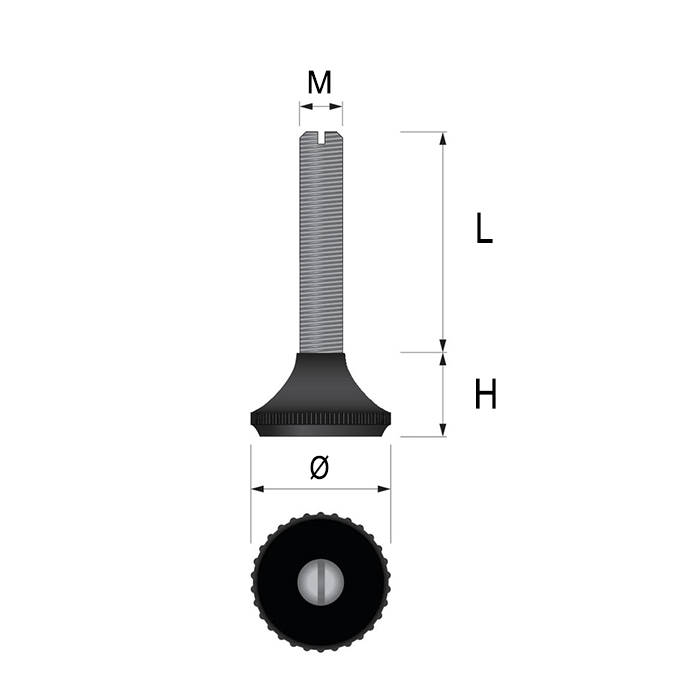
| Diameter (Ø) | Height (H) |
|---|---|
| 30 mm (1.18″) | 18 mm (0.71″) |
| 45 mm (1.77″) | 19 mm (0.75″) |
Thread size must match the insert in your furniture leg.
| Specification | Detail |
|---|---|
| Material | Polyamide body with a hot-dip galvanised steel thread |
| Sizes | 2 sizes |
| Diameter (Ø) | 30 to 45 mm (1.18″ to 1.77″) |
| Length (L) | 50 mm (1.97″) |
| Height (H) | 18 to 19 mm (0.71″ to 0.75″) |
| Thread (M) | M10 |
| Static load (SL) | 120 kg |
| Mounting | Screws into a threaded insert |
| Colors | Black |
| Floor compatibility | Any floor, levels on uneven ground |
| Minimum order | Sold in a minimum of 4, then any quantity you need |
Notched thread low-profile has a 9 mm base with M8 at 80 kg. This product has a standard 18-19 mm base with M10 at 120 kg. Choose low-profile for minimal foot visibility at lighter loads. Choose standard base for heavier furniture where the taller base clearance and M10 load capacity are needed.
M10 at 120 kg per foot serves the heavy furniture category where standard base notched thread is most commonly specified. The 50 mm rod provides significant adjustment range for uneven commercial and industrial floors. The two base diameters (Ø 30 and Ø 45) allow matching the foot proportion to the furniture leg diameter.
Choose Ø 30 (707 mm² contact) for furniture with legs under 40 mm where the foot should stay proportional. Choose Ø 45 (1,590 mm² contact) for heavier furniture where broader floor contact improves stability and load distribution. Both carry 120 kg per foot with the same M10 × 50 mm rod.
A manual flathead screwdriver is recommended. Power drivers can deliver excessive torque that strips the slot. If using a powered driver, set it to the lowest torque setting and stop as soon as resistance increases. The notch is designed for hand-tool torque, not power-tool torque.
From above, with a flat screwdriver in the notch at the end of the rod. You level the furniture where it stands instead of tipping it to reach the foot underneath.
From above, with a flat screwdriver in the notch at the end of the rod. You level the furniture where it stands instead of tipping it to reach the foot underneath.
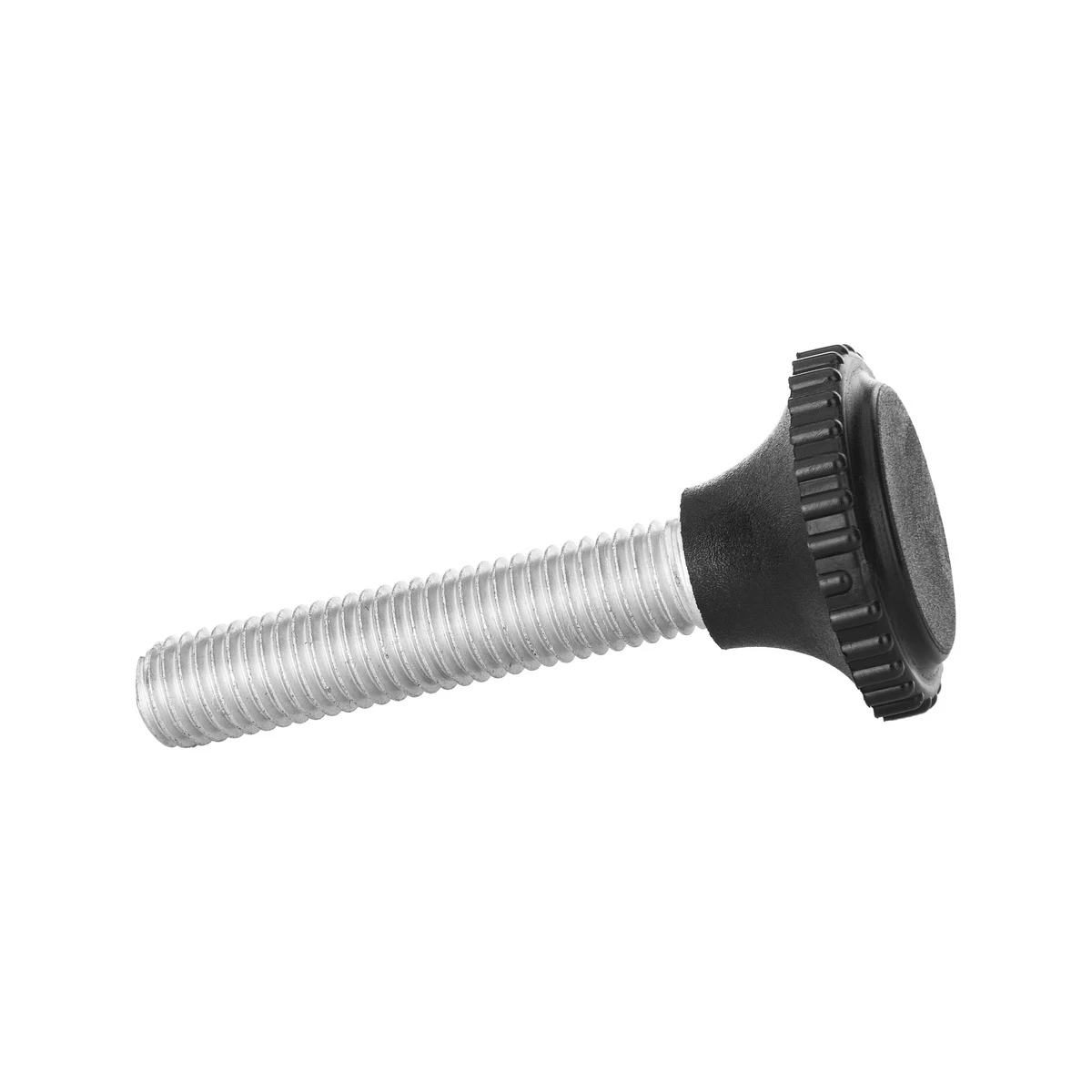 Notched Thread Standard Base Adjustable Leveling Feet
Outfitting a hotel, restaurant, school, healthcare facility, or large furniture build? Superior Glide supports volume orders with bulk pricing tiers, free physical samples, and dedicated quote pricing for accounts placing larger orders.
Bulk pricing tiers, net terms for qualified buyers, and dedicated support for facility managers and procurement teams.
Hold the product, test the fit, check the finish. We ship samples free so you can evaluate before committing to a full order.
For orders above standard volume tiers, we’ll prepare a custom quote with consolidated shipping and your account’s tier pricing.

Reviews
There are no reviews yet