Standard base adjustable leveling feet screw into threaded inserts inside hollow furniture legs to provide precise height adjustment on uneven floors. The tallest base profile in the range (18 to 19 mm) provides maximum clearance between the floor and the tube end. PA body with zinc-plated steel threaded rod. Static load capacity from 60 kg (M6) to 150 kg (M12) per foot. Adjustable leveling feet for furniture with round, square, or rectangular tube legs fitted with threaded inserts.
Not sure what size? See the size chart ↓
📦 Sold in packs of 4 — quantity adjustable at checkout
Tables wobble. Desks rock. Workbenches tilt. The floor is never perfectly level, and furniture with fixed-height legs cannot compensate. Standard base adjustable leveling feet solve this by screwing into a threaded insert inside the hollow furniture leg and providing a height-adjustable floor contact point. Turn the foot clockwise to extend it and raise that corner. Turn counterclockwise to retract it and lower that corner. Each leg adjusts independently until the furniture sits level and stable on any floor.
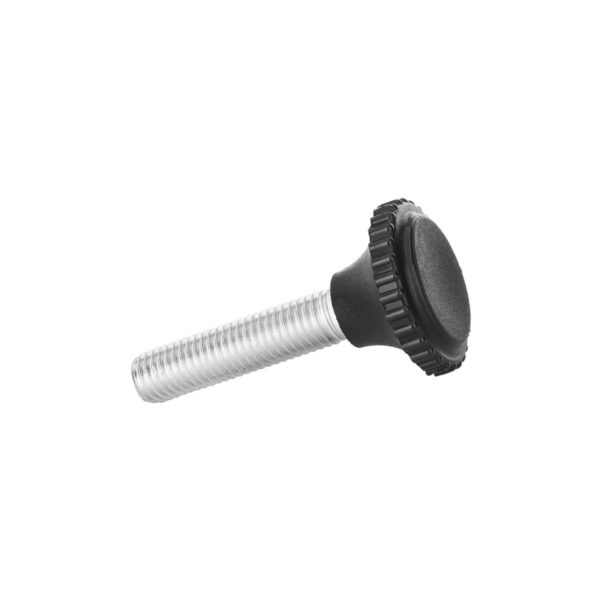
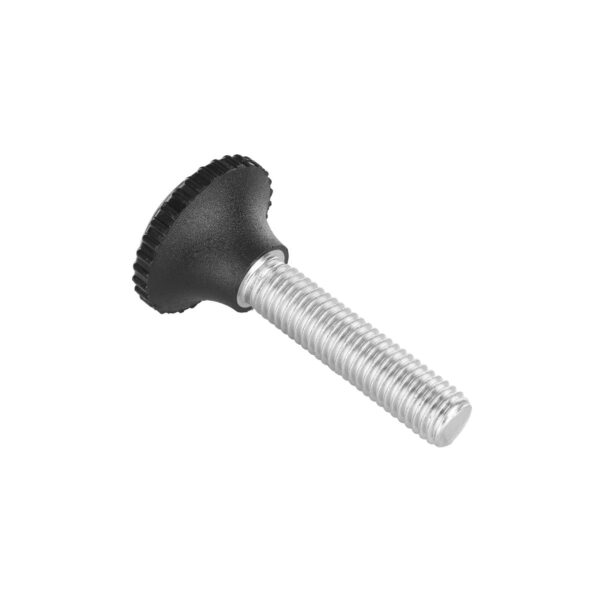
The tallest base profile in the leveling foot range. PA (polyamide) body with zinc-plated steel threaded rod. Standard base adjustable leveling feet are adjustable leveling feet for furniture with threaded inserts in round, square, or rectangular tube legs. 2 base diameters: Ø 30 and 45 mm. M6, M8, M10, and M12 threads. Rod lengths from 10 to 110 mm. 28 variations. Black, grey, and white. Sold individually.
Standard base adjustable leveling feet are organized by base diameter, thread size, and rod length. The base diameter determines the floor contact area. The thread must match the threaded insert in your furniture leg. The rod length determines the maximum height adjustment range.
The compact base for light to medium furniture. M6 threads in 10, 20, and 25 mm rod lengths. M8 threads in 10, 28, and 43 mm. M10 threads in 28, 43, and 63 mm. 9 thread-and-length combinations. Black, grey, and white on select sizes. The Ø 30 mm base fits neatly under furniture legs in the 28 to 35 mm diameter range.
The wide base for heavy commercial and industrial furniture. M8 threads in 28, 43, 70, and 110 mm rod lengths. M10 in 28, 35, 43, and 60 mm. M12 in 25 and 45 mm. 10 combinations. Black, grey on select sizes. The Ø 45 mm base provides broader floor contact and better load distribution on heavy tables and workbenches.
For a shorter base profile (9 mm instead of 18 mm), see low-profile adjustable leveling feet. For the shortest profile (6 mm), see ultra-low profile. For a wider base (Ø 50 mm), see wide-base. For stainless steel rods in corrosive environments, see stainless steel rod leveling feet. For self-leveling on uneven floors, see self-leveling tilt.
Two components work together. A threaded insert press-fits inside the hollow furniture leg and provides an M-threaded nut. The leveling foot screws into that nut. Turning the foot adjusts the height. The system converts fixed-height furniture into adjustable-height furniture without modifying the leg itself.
Press a round, square, or rectangular threaded insert into the hollow tube leg. The insert seals the tube and provides the M-threaded nut that the leveling foot screws into.
Thread the standard base leveling foot into the insert nut by hand. Turn clockwise. The threaded rod engages the nut and the PA base extends below the furniture leg.
Turn each foot independently until the furniture sits level. On a four-legged table, adjust each corner until all four feet contact the floor evenly and the tabletop is level.
The thread size must match your threaded insert. The rod length determines how much height adjustment is available. Longer rods provide more adjustment range but extend further below the leg when fully deployed.
M6: 60 kg per foot. For small side tables, display fixtures, and lightweight furniture. Smallest inserts (Ø 28 mm round). M8: 80 kg per foot. The most common thread across the furniture industry. Handles standard dining tables, office desks, and commercial tables. M10: 120 kg per foot. Heavy conference tables, library tables, and substantial commercial furniture. M12: 150 kg per foot. Heaviest applications including industrial workbenches, laboratory tables, and furniture supporting heavy equipment. On a four-legged table, multiply the per-foot capacity by 4 for the total supported load.
10 mm: minimal adjustment for nearly level floors. Fine-tuning only. 20 to 28 mm: the standard range for most residential and commercial furniture on typical floors. 35 to 43 mm: moderate unevenness. Old buildings, uneven tile, slightly sloped floors. 50 to 63 mm: significant unevenness or applications where the furniture needs to be raised above standard height. 70 to 110 mm: maximum adjustment for severely uneven floors or intentional height increase.
Standard base adjustable leveling feet come in two base diameters. The choice depends on the furniture leg size, the load, and the visual proportion you want between the foot and the leg.
Fits under furniture legs in the 28 to 35 mm range without the base extending significantly beyond the leg edge. The base is wider than the leg but not dramatically so. M6, M8, and M10 threads. Rod lengths from 10 to 63 mm. For residential dining tables, office desks, side tables, and light commercial furniture. Standard base adjustable leveling feet in the Ø 30 mm diameter handle the majority of residential and light commercial leveling needs.
Provides 2.25 times the floor contact area of the Ø 30 base. The wider footprint distributes load more evenly, which matters on heavy furniture where a narrow base would concentrate pressure and potentially indent soft flooring. M8, M10, and M12 threads. Rod lengths from 25 to 110 mm. For heavy commercial tables, conference tables, industrial workbenches, and any furniture where maximum stability and load distribution matter. Standard base adjustable leveling feet in the Ø 45 mm diameter handle the heaviest applications in the range.
The fundamental problem of furniture on uneven floors. The National Wood Flooring Association (NWFA) recommends protective contact surfaces on all furniture legs, and standard base adjustable leveling feet provide both height adjustment and a PA floor contact surface that protects finished floors.
The primary function. A table with four fixed-height legs wobbles when the floor is not perfectly level. Standard base adjustable leveling feet let each leg adjust independently until all four contact the floor evenly. No more folded napkins under table legs. No more cardboard shims. No more rocking that spills drinks and frustrates customers. Adjustable feet for table legs that eliminate wobble on any floor.
The PA base contacts the floor instead of bare metal. PA is smoother, softer, and quieter than steel on smooth, hard floors. The Ø 30 or 45 mm base distributes weight across a broader area than the bare tube end. Unlike leaving metal legs on finished floors, the PA base prevents scratching. Standard base leveling feet M8 M10 that protect floors while providing adjustment.
Beyond leveling, standard base adjustable leveling feet can raise or lower the overall furniture height. A table designed for 720 mm can be raised to 740 mm with longer rod lengths, or fine-tuned to exact working height. On workbenches where tool accuracy depends on precise height, the threaded adjustment provides millimeter-level control that fixed legs cannot. In manufacturing environments where different operators prefer different working heights on the same bench, longer rods allow the height to be adjusted between shifts without replacing any components.
The PA base absorbs contact noise between the furniture and the floor. Metal-on-floor contact creates scraping and rattling every time the furniture moves or shifts. The PA base cushions this contact. In restaurants, offices, and conference rooms where dozens of tables sit on smooth, hard floors, the collective noise reduction from PA-based leveling feet is significant. Furniture leveling feet threaded rod that quiet every contact point.
Two materials engineered for different functions. The PA base handles floor contact and load distribution. The zinc-plated steel rod handles the threaded connection and height adjustment.
The PA base is the widest part of the foot. At 18 mm (Ø 30) or 19 mm (Ø 45) tall, the standard base provides the most clearance between floor and tube end of any leveling foot in the range. PA resists UV, chemicals, moisture, and impact. The base surface is smooth for quiet floor contact on hard surfaces.
The threaded rod screws into the M-threaded nut inside the threaded insert. Zinc plating provides corrosion resistance for standard indoor use. Rod lengths from 10 to 110 mm determine the adjustment range. The rod is permanently molded into the PA base during manufacturing.
Standard base is the default choice for most furniture. Here is how it compares to the other profiles in the range and when to choose something different.
Low-profile leveling feet have a 9 mm base (half the height of standard). Choose low-profile when the foot must protrude as little as possible below the leg. Choose standard when the taller base provides better stability and you do not mind the additional 9 mm of visible foot below the furniture.
Wide-base leveling feet have a Ø 50 mm base for maximum floor contact on heavy furniture. Standard base at Ø 45 mm is close in width but has a taller profile (19 mm vs. 11 mm). Choose wide-base for the broadest footprint. Choose standard for the tallest profile.
Self-leveling tilt feet have a pivoting base that compensates for 9° of floor unevenness automatically. Standard base feet are rigid and require manual adjustment at each leg. Choose tilt for furniture on significantly uneven floors where manual adjustment is impractical. Choose standard for precise, manual control.
Ball-joint feet have a spherical contact point that swivels in any direction. Standard base feet have a flat, broad contact area. Choose ball-joint for point-contact leveling on very irregular surfaces. Choose standard for the broadest, most stable floor contact.
Standard base adjustable leveling feet are the right choice for most furniture leveling applications. The tall base, broad diameter options, and full thread range make them the most versatile leveling foot in the range.
Anywhere furniture with hollow tube legs needs adjustable height or floor leveling. Standard base adjustable leveling feet are the most widely specified leveling foot across residential, commercial, and industrial furniture.
Restaurant dining tables, hotel lobby tables, conference room tables, and office desks. In commercial environments, uneven floors cause wobble that spills drinks, frustrates customers, and damages floor finishes through concentrated rocking pressure at two diagonal leg corners. Standard base adjustable leveling feet paired with threaded inserts eliminate wobble across an entire dining room or office floor. The Ø 45 mm base with M10 or M12 threads handles the heaviest commercial tables. In restaurant chains with hundreds of tables across multiple locations, specifying standard base adjustable leveling feet at the manufacturing stage means every table arrives ready for leveling on any floor condition. Available in bulk. For commercial pricing, visit Business Solutions.
Workbenches, assembly tables, and laboratory tables where precise leveling affects work quality. Residential dining tables and home office desks on uneven floors. The Ø 30 mm base with M8 handles the majority of residential furniture. For industrial applications, the M8 x 110 mm rod on the Ø 45 base provides the maximum adjustment range for severely uneven workshop floors. Standard base adjustable leveling feet are the right starting point for any new furniture project where leveling is specified. The PA base provides adequate floor contact on smooth, hard floors. On floors where additional scratch protection is needed, the PA surface itself serves as the protector without supplemental pads.
Check periodically that each leveling foot is tight in the threaded insert and the furniture remains level. Vibration, repeated adjustment, and furniture relocation can loosen the foot over time. Re-tighten by hand. After relocating furniture to a new position, readjust all four feet because the new floor surface will have different levelness characteristics. On furniture that staff move frequently, such as restaurant tables rearranged for different group sizes, checking leveling feet should be part of the regular setup routine.
On commercial furniture, inspect every 3 to 6 months. On residential furniture, check when wobble returns. Standard base adjustable leveling feet are sold individually, so you can replace a single worn foot without replacing all four. The PA base does not degrade from standard cleaning chemicals, UV exposure, or normal wear. If the zinc plating on the rod shows corrosion (rare indoors), replace the foot or switch to stainless steel rod leveling feet for that environment. Standard base adjustable leveling feet with damaged or visibly worn PA bases should be replaced rather than repaired, as the base integrity directly affects floor contact and stability.
Round Threaded Inserts: Ø 28, 40, 50 mm.
Square Threaded Inserts: 20 × 20 to 50 × 50 mm.
Rectangular Threaded Inserts: 20 × 40 to 30 × 60 mm.
Low-Profile: 9 mm base height.
Wide-Base: Ø 50 mm.
Self-Leveling Tilt: 9° pivot.
Ball-Joint: spherical contact. Sold in multiples of 4.
| Specification | Details |
|---|---|
Product Type |
Adjustable Leveling Feet – Type A |
Materials |
PA (Polyamide) base + Fe HDG (Hot-Dip Galvanized Steel) stem |
Fit Style |
Threaded stem with fixed base |
Floor Compatibility |
All hard and soft floors |
Furniture Compatibility |
Furniture frames, workbenches, racks, display units |
Leg Compatibility |
Metal threaded inserts |
Tube/Foot Diameters |
Ø30 mm (1.18"), Ø45 mm (1.77") |
Thread Sizes |
M6-M12 |
Thread Lengths |
10–110 mm (0.39"–4.33") |
Weight Capacity |
60–150 kg (132–330 lbs) static load per foot |
Color Options |
Black (all), Grey (select sizes), White (M10 / Ø30 mm only) |
Installation Type |
Press-fit thread-in, tool-compatible |
Key Benefits |
Height adjustable, vibration reducing, corrosion-resistant |
Indoor / Outdoor |
Indoor | Covered Outdoor |
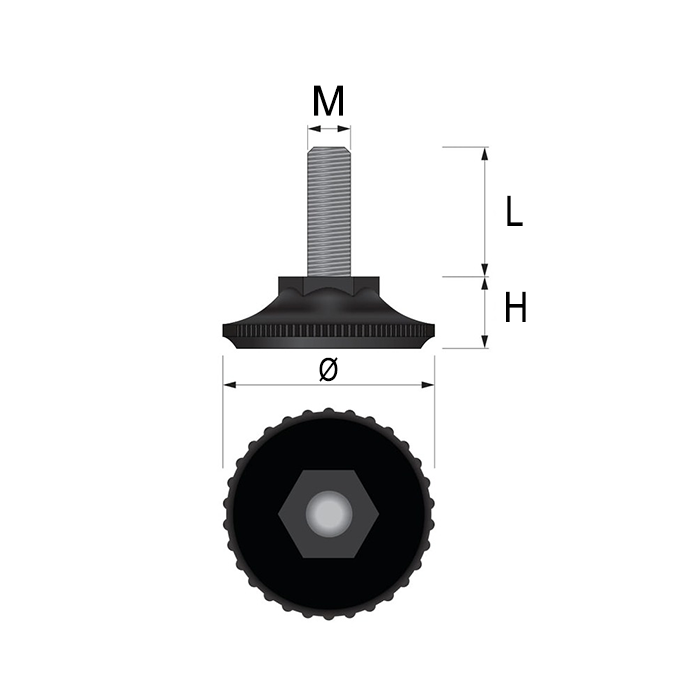
| Base Diameter (Ø) | Thread Size (M) | Threaded Stem Length (L) | Base Height (H) | Static Load Capacity (SL) |
|---|---|---|---|---|
Ø 30 mm (Ø 1.18") |
M6 (6 mm) |
10 mm (0.39") |
18 mm (0.71") |
60 kg (132 lbs) / pc |
Ø 30 mm (Ø 1.18") |
M6 (6 mm) |
20 mm (0.79") |
18 mm (0.71") |
60 kg (132 lbs) / pc |
Ø 30 mm (Ø 1.18") |
M6 (6 mm) |
25 mm (0.98") |
18 mm (0.71") |
60 kg (132 lbs) / pc |
Ø 30 mm (Ø 1.18") |
M8 (8 mm) |
10 mm (0.39") |
18 mm (0.71") |
80 kg (176 lbs) / pc |
Ø 30 mm (Ø 1.18") |
M8 (8 mm) |
28 mm (1.10") |
18 mm (0.71") |
80 kg (176 lbs) / pc |
Ø 30 mm (Ø 1.18") |
M8 (8 mm) |
43 mm (1.69") |
18 mm (0.71") |
80 kg (176 lbs) / pc |
Ø 30 mm (Ø 1.18") |
M10 (10 mm) |
63 mm (2.48") |
18 mm (0.71") |
120 kg (264 lbs) / pc |
Ø 30 mm (Ø 1.18") |
M10 (10 mm) |
28 mm (1.10") |
18 mm (0.71") |
120 kg (264 lbs) / pc |
Ø 30 mm (Ø 1.18") |
M10 (10 mm) |
43 mm (1.69") |
18 mm (0.71") |
120 kg (264 lbs) / pc |
Ø 45 mm (Ø 1.77") |
M8 (8 mm) |
28 mm (1.10") |
19 mm (0.75") |
120 kg (264 lbs) / pc |
Ø 45 mm (Ø 1.77") |
M8 (8 mm) |
43 mm (1.69") |
19 mm (0.75") |
80 kg (176 lbs) / pc |
Ø 45 mm (Ø 1.77") |
M8 (8 mm) |
70 mm (2.76") |
19 mm (0.75") |
80 kg (176 lbs) / pc |
Ø 45 mm (Ø 1.77") |
M8 (8 mm) |
110 mm (4.33") |
19 mm (0.75") |
80 kg (176 lbs) / pc |
Ø 45 mm (Ø 1.77") |
M10 (10 mm) |
28 mm (1.10") |
19 mm (0.75") |
120 kg (264 lbs) / pc |
Ø 45 mm (Ø 1.77") |
M10 (10 mm) |
35 mm (1.38") |
19 mm (0.75") |
120 kg (264 lbs) / pc |
Ø 45 mm (Ø 1.77") |
M10 (10 mm) |
43 mm (1.69") |
19 mm (0.75") |
120 kg (264 lbs) / pc |
Ø 45 mm (Ø 1.77") |
M10 (10 mm) |
60 mm (2.36") |
19 mm (0.75") |
120 kg (264 lbs) / pc |
Ø 45 mm (Ø 1.77") |
M12 (12 mm) |
25 mm (0.98") |
19 mm (0.75") |
150 kg (330 lbs) / pc |
Ø 45 mm (Ø 1.77") |
M12 (12 mm) |
45 mm (1.77") |
19 mm (0.75") |
150 kg (330 lbs) / pc |
The Ø 30 mm base fits furniture where the leg diameter is 28 to 35 mm and a compact footprint matters. M6 (60 kg), M8 (80 kg), and M10 (120 kg) threads. The Ø 45 mm base provides a wider, more stable floor contact area for heavier furniture with larger legs (40 to 50 mm tubes). M8 (80 kg), M10 (120 kg), and M12 (150 kg) threads. For light to medium tables and desks, Ø 30 is standard. For heavy commercial tables, workbenches, and conference tables, Ø 45 provides better load distribution.
Rod length determines the maximum height adjustment range. A 10 mm rod provides minimal adjustment for nearly level floors. A 28 mm rod is the most common for standard furniture. A 43 mm rod handles moderate floor unevenness. Rods of 60 mm and above handle significant unevenness or applications where the furniture needs to be raised noticeably above standard height.
No. Standard base adjustable leveling feet screw into round, square, or rectangular threaded inserts that are already press-fit inside the hollow tube leg. The threaded insert provides the M-threaded nut. The leveling foot screws into that nut. Two components work together.
Standard base leveling feet have a taller base (18 to 19 mm high) that provides more clearance between the floor and the bottom of the furniture leg. Low-profile leveling feet have a shorter base (9 mm) for furniture where minimal protrusion below the leg matters. Choose based on how much visible foot you want below the furniture.
Yes. On a table that sits on a floor sloping from one side to the other, the high-side legs need shorter rods and the low-side legs need longer rods. Each leg adjusts independently. You can also mix thread sizes if the threaded inserts in different legs have different M threads, though this is uncommon.
Only logged in customers who have purchased this product may leave a review.

Reviews
There are no reviews yet