Ball-joint adjustable leveling feet have a half-sphere contact point instead of a flat base. The spherical surface makes point contact with the floor and swivels omnidirectionally, self-centering on irregular and uneven surfaces where flat bases cannot sit evenly. Static load capacity: 20 kg (M4) to 80 kg (M8) per foot.
Not sure what size? See the size chart ↓
📦 Sold in packs of 4 — quantity adjustable at checkout
Every other leveling foot in the range contacts the floor with a flat base. Flat bases work on smooth, relatively even surfaces. But on highly irregular surfaces where the floor texture varies dramatically under each leg, a flat base cannot sit evenly. It balances on a high point or rocks between ridges. Ball-joint adjustable leveling feet replace the flat base with a half-sphere that makes point contact with the floor. The spherical surface swivels omnidirectionally, self-centering on whatever surface geometry exists under each leg.
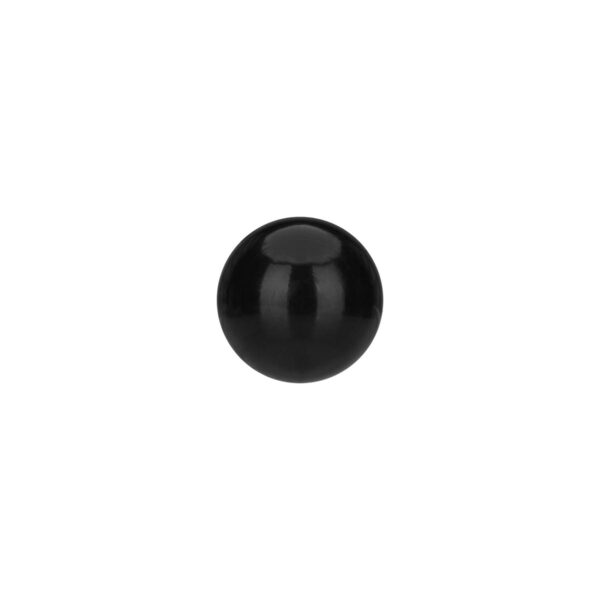
PA (polyamide) half-sphere head with zinc-plated steel threaded rod. Ball-joint adjustable leveling feet are swivel contact leveling feet for furniture and equipment on highly irregular surfaces where flat bases fail. 2 sizes: Ø 10 mm (M4, 20 kg) and Ø 35 mm (M8, 80 kg). Black and white. Sold individually.
Ball-joint adjustable leveling feet come in two dramatically different sizes. The Ø 10 mm serves precision instruments and miniature fixtures. The Ø 35 mm serves standard furniture on rough surfaces.
The smallest leveling foot in the entire catalog. Half-sphere head at 5 mm height. Static load: 20 kg per foot. Weight: 2.1 g. Black and white. For precision instruments, small electronic enclosures, laboratory equipment, and miniature fixtures. The half-sphere at this scale is barely larger than the M4 rod itself.
Standard furniture scale. Half-sphere head at 19 mm height. Static load: 80 kg per foot (320 kg on four legs). Weight: 30.4 g. Black. For tables, workbenches, and fixtures on rough or irregular floor surfaces. Compatible with M8 round, square, and rectangular threaded inserts.
For flat-base leveling on smooth floors, see standard base (M6 to M12) or low-profile (M4 to M10). For flat-base tilt on sloped smooth floors, see self-leveling tilt (9° pivot). For the smallest flat-base foot, see mini (Ø 13 mm). For custom ball-joint configurations, contact Business Solutions.
The half-sphere head creates a fundamentally different floor interaction than a flat base. Understanding this difference explains when ball-joint adjustable leveling feet are the right choice and when flat bases are better.
A flat base distributes weight across its entire area (707 mm² on Ø 30, for example). A half-sphere concentrates weight at the contact point where the curve meets the floor. This concentration creates higher pressure per square millimeter but eliminates the rocking, tipping, and edge-loading that flat bases experience on uneven surfaces. The sphere self-centers: it always finds the lowest stable point under the furniture weight.
The half-sphere contacts the floor at whatever angle the surface presents. On a ridge, it sits on the ridge peak. In a groove, it settles into the groove. On a slope, it contacts at the tangent point. The swivel is passive and gravity-driven: the furniture weight keeps the sphere in contact with the surface. No locking mechanism is needed. Ball joint leveling feet for furniture that self-center on any surface geometry.
The three floor contact types in the leveling foot range serve different floor conditions. Choosing the right one depends on the surface under the furniture.
Full-surface contact. Best on smooth, relatively level floors. Distributes weight across the entire base area. The default for most furniture applications.
Pivoting flat surface. Best on sloped but smooth floors. Maintains full-surface contact at angles up to 9°. For floors that slope but are otherwise smooth.
Point contact. Best on highly irregular surfaces. Self-centering on any geometry. For surfaces too rough or irregular for flat or tilt bases.
Most furniture sits on smooth floors and uses flat bases. Some furniture sits on sloped floors and benefits from tilt. Ball-joint adjustable leveling feet serve the smallest category: furniture on surfaces so irregular that neither flat nor tilt bases can function properly. Spherical base adjustable leveling feet that work where nothing else can.
The Ø 10 mm and Ø 35 mm ball-joint adjustable leveling feet serve entirely different applications. They share the half-sphere concept but operate at different scales with different use cases.
At 2.1 g and M4 thread, this is the lightest and smallest leveling foot in the catalog. The half-sphere head at 5 mm height sits under precision instruments, electronic enclosures, laboratory equipment, and display fixtures that weigh under 20 kg. The half-sphere provides self-centering contact on workbench surfaces, optical tables, and countertops that may not be perfectly flat. Available in black and white to match equipment housings.
At 30.4 g and M8 thread, this serves standard furniture on rough floors. The half-sphere at 19 mm height provides point contact on industrial concrete, cobblestone, textured outdoor surfaces, and heavily worn floors where flat bases rock or tilt. Half sphere leveling feet at this scale handle the weight of commercial tables and workbenches at 80 kg per foot, providing stable contact on surfaces that defeat flat-base feet.
Height adjustment with self-centering point contact on surfaces where flat bases cannot sit stably. The National Wood Flooring Association (NWFA) recommends protective contact surfaces on all furniture legs. On rough surfaces, the ball-joint provides a PA contact point that is gentler than bare metal even in point-contact configuration.
The primary advantage. On cobblestone, heavily textured concrete, industrial grating, rough-sawn stone, and weathered outdoor surfaces, a flat base contacts only the high points and rocks between them. The half-sphere self-centers on whatever the surface presents. The contact point is always stable because the sphere geometry has only one stable resting position for any given surface angle. Ball-joint adjustable leveling feet provide the stability that flat bases cannot on these surfaces.
When the load on the furniture shifts (someone leans on one side, items are placed unevenly), the ball-joint re-centers automatically. A flat base on an irregular surface may tip from one contact point to another as the load shifts, creating a rocking motion. The sphere rolls smoothly to its new equilibrium. Unlike leaving furniture on unprotected irregular surfaces, the ball-joint provides controlled, self-centering contact.
The Ø 10 mm ball-joint provides three-point contact for precision leveling on three-legged instruments. Three ball-joints define a plane with zero wobble by mathematical necessity: three points always define a plane. This is why precision instruments, scales, and optical equipment often specify ball-joint feet for three-point leveling rather than four flat bases. Swivel contact leveling feet that provide mathematically stable support.
The threaded rod provides the same height adjustment as any leveling foot. Turn each foot to raise or lower that corner. The ball-joint contact works independently of the height setting. Adjust the height for overall leveling. The ball-joint handles the surface-level irregularity at each contact point automatically.
Same screw-in process as every leveling foot. The half-sphere does not change installation. The self-centering contact activates automatically when the furniture is set on the surface.
Three points define a plane. Three ball-joint adjustable leveling feet on a triangular mounting pattern create a support system with zero wobble by geometric necessity. This is why precision instruments, laboratory scales, and optical equipment specify ball-joint feet in groups of three rather than four.
On a three-point system, there is only one possible plane that passes through all three contact points. The equipment cannot rock because there is no fourth point to create an over-determined system. Four flat-base feet on an uneven surface create four contact requirements, and if the surface is not perfectly flat under all four, one foot lifts and the equipment wobbles. Three ball-joint adjustable leveling feet eliminate this possibility entirely.
For equipment that requires three-point leveling, specify the Ø 10 mm ball-joint with M4 thread. Mount three feet in a triangular pattern. Each ball-joint self-centers on the surface below it. The equipment sits on a mathematically stable plane with no adjustment needed beyond the initial height setting at each foot.
Ball-joint adjustable leveling feet work on any hard surface, but they provide the most value on surfaces where flat bases fail.
Rough concrete with aggregate exposure. Cobblestone and natural stone pavers. Industrial grating and perforated metal flooring. Flagstone and slate with natural surface variation. Heavily worn floors with divots and ridges. Any surface where the topography under each leg varies by more than a few millimeters. Ball-joint adjustable leveling feet find stable contact on all of these.
Smooth concrete, tile, hardwood, luxury vinyl, and any surface that is flat enough for a full-surface contact foot to sit evenly. On these surfaces, flat bases provide better load distribution, less floor pressure per square millimeter, and more overall stability than point contact. Use ball-joint only when flat bases cannot function on the given surface.
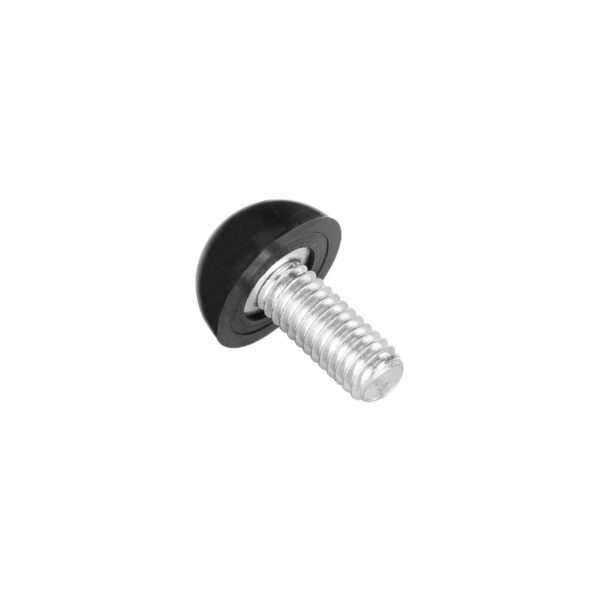
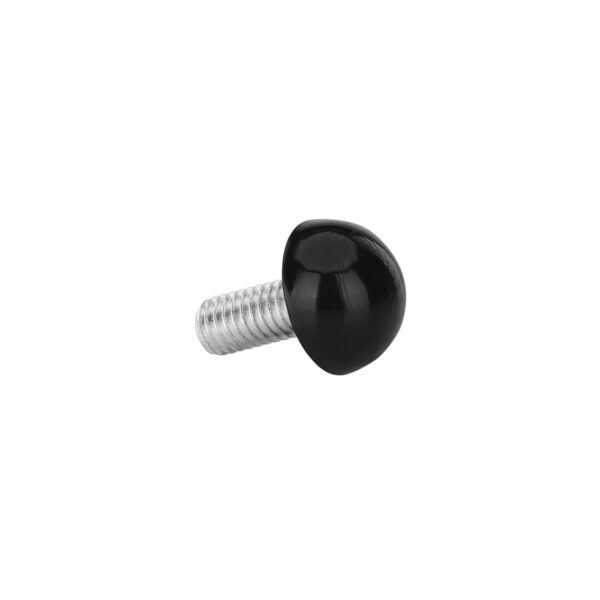
PA half-sphere head with zinc-plated steel threaded rod. The half-sphere is molded as part of the PA body, creating a smooth, seamless curved contact surface.
The half-sphere provides the curved contact surface. PA resists UV, chemicals, moisture, and impact. The smooth curved surface slides over floor irregularities without catching or snagging. On the Ø 10 mm version, the sphere is proportional to the M4 rod. On the Ø 35 mm version, the sphere provides a larger radius curve for more gradual contact on rough surfaces.
M4 x 10 mm on the Ø 10 version. M8 x 30 mm on the Ø 35 version. Zinc plating provides corrosion resistance for standard indoor use. For stainless steel rods in corrosive environments, see stainless steel rod leveling feet.
Self-leveling tilt pivots a flat base up to 9° to match floor slopes. It maintains full-surface contact on sloped but smooth surfaces. Ball-joint makes point contact on any surface geometry. Choose tilt for sloped smooth floors. Choose ball-joint for rough, irregular, or highly textured surfaces.
Standard base and low-profile provide flat bases that distribute load across a wide area. On smooth floors, they provide more stability and floor protection than ball-joint point contact. Choose flat bases for smooth floors. Choose ball-joint only when the surface is too irregular for flat contact.
Mini leveling feet have a Ø 13 mm flat POM base with M6 thread. Ball-joint Ø 10 has an even smaller half-sphere with M4. Choose mini for small equipment on smooth surfaces. Choose ball-joint Ø 10 for small equipment on irregular surfaces or for three-point precision leveling.
Workshop tables on rough concrete, industrial equipment on factory floors with expansion joints and surface irregularities, outdoor covered furniture on flagstone patios and textured pavers. The Ø 35 mm ball-joint with M8 at 80 kg per foot handles standard commercial and industrial furniture weight. The half-sphere contacts the rough surface at a single stable point, eliminating the rocking that flat bases create on these surfaces. In workshops where equipment needs to be repositioned on rough concrete, ball-joint adjustable leveling feet allow the equipment to sit stably at any position without shimming or extensive re-leveling. Available for bulk orders. For commercial pricing, visit Business Solutions.
Precision scales, optical instruments, electronic test equipment, and laboratory devices that need three-point leveling for zero-wobble support. The Ø 10 mm ball-joint with M4 provides the lightest, smallest self-centering leveling point in the catalog. Three ball-joint feet on a triangular mounting pattern create mathematically perfect planar support with no possibility of wobble. For OEM equipment manufacturers, ball-joint adjustable leveling feet in the Ø 10 mm size integrate directly into precision equipment designs at the component level. For furniture with round or square threaded inserts, ball-joint adjustable leveling feet provide specialized contact for surfaces where flat bases fail.
Check periodically that the foot is tight in the threaded insert and the furniture remains stable. Inspect the half-sphere surface for flat spots caused by sustained static load on hard surfaces. Over extended periods, a PA sphere under heavy load on a hard surface can develop a minor flat spot at the contact point. This flat spot slightly reduces the self-centering ability but typically does not affect stability for most applications. On precision instruments where self-centering accuracy is critical, inspect the half-sphere annually and replace if any visible flat spot has developed.
Ball-joint adjustable leveling feet are sold individually for single-foot replacement. The PA half-sphere does not degrade from standard cleaning chemicals, UV exposure, or moisture under normal indoor conditions. On outdoor covered applications, inspect more frequently for UV-related surface changes that can affect the PA surface finish. If the half-sphere develops a significant flat spot, cracks from impact, or shows visible surface degradation, replace the foot. The ball-joint design means that a damaged foot can be replaced independently without affecting the other feet on the same piece of furniture or equipment.
Self-Leveling Tilt: 9° flat pivot for sloped smooth floors.
| Specification | Details |
|---|---|
Product Type |
Adjustable Leveling Feet – Nylon Tilt Feet With Half Sphere Head |
Materials |
PA (Polyamide) base + Fe HDG (Hot-Dip Galvanized Steel) stem |
Fit Style |
Screw-in with tilt adjustment |
Floor Compatibility |
Hard floors (tile, wood, concrete, laminate, etc) |
Furniture Compatibility |
Compact furniture, stands, adjustable frames |
Leg Compatibility |
Metal or plastic threaded inserts |
Base Diameter |
Ø 10 mm, Ø 35 mm |
Thread Sizes |
M4 and M8 |
Thread Lengths |
10 mm, 30 mm |
Weight Capacity |
20 kg (44 lbs) or 80 kg (176 lbs) static load per foot (depending on size) |
Color Options |
Black |
Installation Type |
Hand or tool installation, self-adjusting tilt head |
Key Benefits |
Self-leveling, quiet stability, non-marking |
Indoor / Outdoor |
Indoor | Covered Outdoor | Uncovered Outdoor |
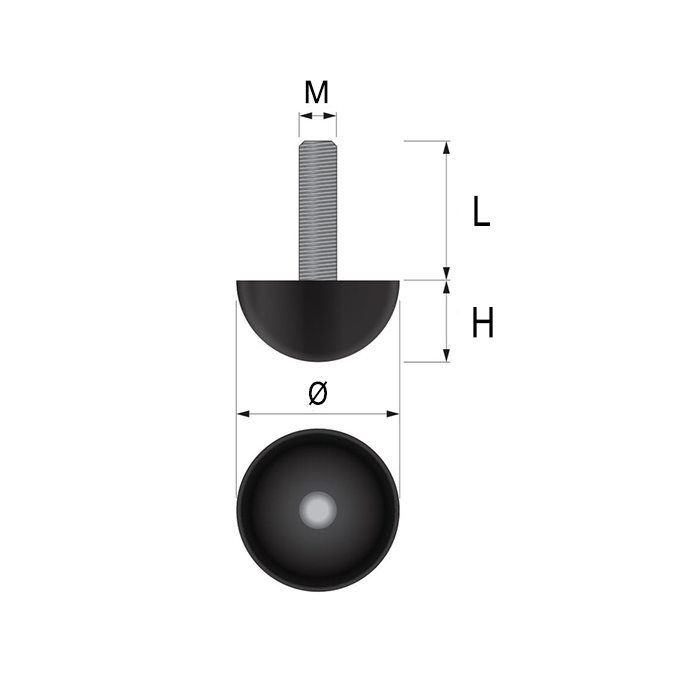
| Base Diameter (Ø) | Thread Size (M) | Threaded Stem Length (L) | Base Height (H) | Static Load Capacity (SL) |
|---|---|---|---|---|
10 mm (0.39") |
M4 (4 mm) |
10 mm (0.39") |
5 mm (0.20") |
20 kg (44 lbs) / pc |
35 mm (1.34") |
M8 (8 mm) |
30 mm (1.18") |
19 mm (0.75") |
80 kg (176 lbs) / pc |
Choose ball-joint when the floor surface is so irregular that even a 9° tilt base cannot conform to it. The spherical contact point works on any surface angle because it makes point contact rather than surface contact. Cobblestone, heavily textured concrete, industrial grating, and surfaces with deep grooves or ridges are candidates. For sloped but relatively smooth floors, self-leveling tilt (9° flat tilt) is usually better because it distributes load over a larger area.
The concentrated contact of the half-sphere can create higher pressure per square millimeter than a flat base. On soft flooring (luxury vinyl, cork, softwood), this can indent the surface. Ball-joint leveling feet are designed for hard, durable surfaces like concrete, stone, metal grating, and tile where the concentrated contact does not damage the floor.
The Ø 10 mm ball-joint with M4 thread serves very small equipment and precision instruments. At 2.1 g and 20 kg static load, it is the lightest and smallest leveling foot in the entire catalog. Scales, small electronic enclosures, laboratory instruments, and miniature display fixtures use this size.
The Ø 35 mm with M8 at 80 kg per foot handles standard furniture weight. However, the point contact provides less stability than a flat base of the same diameter. On standard furniture where the floor is reasonably smooth, flat-base leveling feet provide better stability. Ball-joint is for surfaces where flat bases cannot function.
No. The half-sphere swivels freely. It does not lock at a specific angle. This is by design: the contact point continuously self-centers under load. If the furniture shifts or the load distribution changes, the ball-joint re-centers automatically. On surfaces where a locked angle is needed, use self-leveling tilt instead.
Only logged in customers who have purchased this product may leave a review.

Reviews
There are no reviews yet