Hospitality-grade floor protection · Sizing help before you order · Apply for a business account
Sizing help · Apply for a business account
Hospitality-grade floor protection · Sizing help before you order · Apply for a business account
Sizing help · Apply for a business account



Where a tube plug pushes inside the leg, this cap slides over the outside to finish and seal the end. The friction-fit PE interior holds it on lightweight furniture, wire shelving, and display fixtures with Ø 10 or Ø 12 mm tube or rod. Black.
We make this size in production runs, so there is none on the shelf today. Tell us how many you would want and you go on the list for it. When enough people ask for a size, we run it, and the people who asked hear about it first.
We stock a limited range of tube sizes and wall thicknesses. Tell us the size you need and we will confirm availability and pricing by email.
Buying in volume? See business pricing & samples ↓
Tube plugs press inside the tube. Round end caps slide over the outside. When you need to finish a round tube or solid rod end and there is no hollow interior to press into, or when you want external coverage that wraps around the tube end instead of sitting flush inside it, these plugs are the answer. The cap slides over the outside of the tube or rod, grips through friction, and creates a clean, finished endpoint. Simple, external, and effective on both hollow tubes and solid rods.
PE construction with a friction-fit interior that grips the outer wall of the tube or rod. Round end caps are external tube end caps for Ø 10 and Ø 12 mm round tubing and solid rods. End caps for round tube legs on lightweight furniture, wire shelving, display fixtures, racks, and any application with small-diameter round profiles. 35 mm insertion depth. Black.
One measurement: the outside diameter (OD) of the tube or rod. Round end caps slide over the outside, so the OD is all that matters. Wall thickness is irrelevant because the cap does not enter the tube interior. This makes these plugs simpler to size than internal tube plugs.
Use calipers or a ruler across the widest point of the tube or rod. Outside edge to outside edge. Round end caps are available for Ø 10 and Ø 12 mm.
The cap adds 15.5 mm to the outer profile at the endpoint. Make sure the wider cap diameter does not interfere with adjacent legs, mounting hardware, or stacking geometry.
Both these plugs have 35 mm insertion depth. The tube or rod must extend at least 35 mm beyond any obstruction (bracket, weld, bend) for the cap to seat fully.
Push on. That is the entire process. Round end caps slide over the outside of the tube or rod with a friction fit. No ribs to compress, no internal alignment needed. The cap grips the outer wall through friction along the full 35 mm depth.
The same problems as tube plugs, but from the outside. The National Wood Flooring Association (NWFA) recommends protective measures on all furniture legs, and these plugs provide that protection on small-diameter tubes and rods where internal plugs are impractical or unavailable.
An open tube end looks unfinished. A bare rod end looks industrial. These plugs cover both with a smooth PE cap that signals a complete, intentional design. On wire shelving, display fixtures, lightweight furniture, and retail racks, the cap turns an exposed metal end into a clean, safe endpoint. Push-on furniture leg caps that finish the look without any tools.
A bare metal tube or rod end on the floor concentrates all the furniture weight on a tiny circle of sharp metal. Round end caps spread that contact across the full 15.5 mm cap diameter and replace the sharp metal edge with smooth PE. Unlike leaving metal ends unprotected, the PE cap prevents scratching, gouging, and marking on smooth, hard floors. For additional PA6 scratch protection, apply a round self-adhesive furniture pad to the cap base.
Exposed metal tube and rod ends are sharp. On wire shelving at knee height, on display fixtures at eye level, on furniture frames at hand level, an uncapped metal end is a cut or puncture hazard. Round end caps cover the sharp end with a smooth, rounded PE cap. In retail environments, schools, healthcare facilities, and homes with children, capping every exposed end is basic safety practice.
On hollow tubing, these plugs cover the open end and prevent moisture, debris, and insects from entering. The cap wraps around the outside of the tube rather than sealing from inside like a plug. On steel tubing, this external coverage still protects against internal corrosion. On solid rods, moisture sealing is not relevant, but the finished appearance and safety benefits still apply.
The fundamental choice: external or internal. Here is how round end caps compare to round tube plugs and other options.
Round tube plugs press inside the tube. They sit flush and are invisible from the side. Round end caps slide over the outside and are visible from the side. Tube plugs do not change the outer profile. Round end caps add 15.5 mm to the endpoint diameter. Choose tube plugs for a clean, flush finish on larger hollow tubing. Choose these plugs for small-diameter tubes and solid rods where internal insertion is not practical.
Generic rubber tips stretch over leg ends and provide grip. They come in limited sizes, stretch out over time, and often fall off under normal use. The rubber degrades with UV exposure and cleaning chemicals. Round end caps are precision-molded for Ø 10 and Ø 12 mm with a specific friction fit engineered for long-term retention. The PE material does not stretch out, crack, or degrade under UV or chemical exposure. For grip instead of sliding, apply an anti-slip pad to the cap base.
Heat-shrink tubing wraps around the end and seals with heat. It provides a thin covering but no structural cap, no flat floor-contact surface, and requires a heat gun. Round end caps push on by hand in seconds and provide a rigid, flat-bottomed cap that doubles as floor contact.
Vinyl dip coating covers the end with a thin layer of flexible plastic. It works well on hooks and handles but creates a soft, flexible endpoint with no rigid structure. These plugs provide a rigid PE shell with a defined flat base. Dip coating is not replaceable. These plugs are removable and replaceable.
When used on floor-contact legs, the PE base of the end cap contacts the floor directly. PE is smoother and softer than bare metal, which makes it adequate for basic floor protection on most surfaces. The round tube end caps PE base works on hardwood, laminate, vinyl, tile, polished concrete, and cork without scratching under normal use. However, PE is harder than PA6 fiber. On scratch-sensitive floors like engineered hardwood or luxury vinyl, apply a round self-adhesive furniture pad to the cap base for dedicated PA6 protection.
On textured surfaces like slate, stamped concrete, or rough tile, the PE base may catch on surface irregularities. For those floors, furniture slides with ABS surfaces handle the texture better. On carpet, end caps provide adequate contact without any additional treatment.
Round end caps are designed for small-diameter round tubes and solid rods that need a finished, safe, protected endpoint. The external fit means they work on both hollow and solid profiles.
Two mounting methods for the same goal: finishing, sealing, and protecting round tube ends.
Press inside the tube. Flush, invisible from the side. Requires hollow tube. 26+ sizes, Ø 10 to 80 mm. Multiple head styles: flat, conical, domed, half-sphere, anti-slip, pad slot, angled.
Slide over the outside. Visible from the side. Works on hollow tubes and solid rods. Ø 10 and 12 mm. Black.
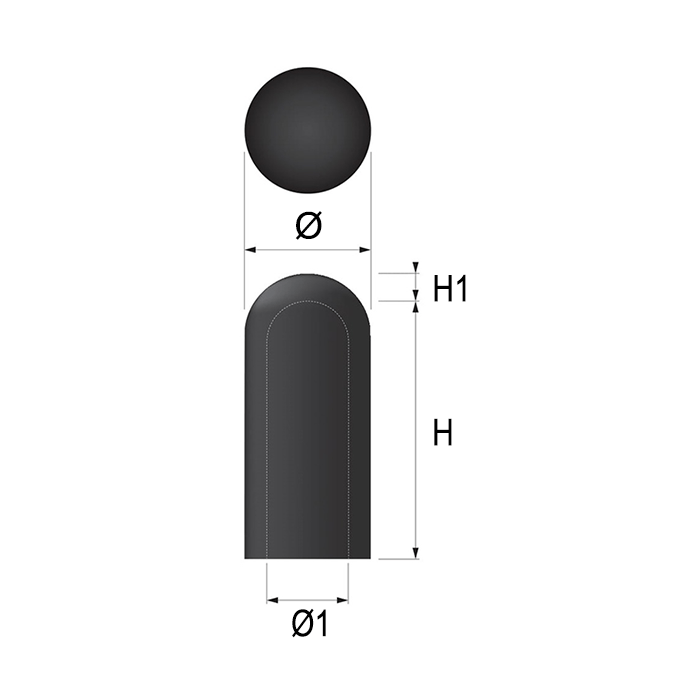
| Fits Tube (Ø1) |
|---|
| 10 mm (0.39″) |
| 12 mm (0.47″) |
Tube wall thickness is a fit requirement, not a tolerance.
| Specification | Detail |
|---|---|
| Material | Polyethylene, a tough low-friction plastic |
| Sizes | 2 sizes |
| Diameter (Ø) | 15.5 mm (0.61″) |
| Diameter 1 (Ø1) | 10 to 12 mm (0.39″ to 0.47″) |
| Height (H) | 35 mm (1.38″) |
| Head height (H1) | 5 mm (0.20″) |
| Mounting | Pushes into the tube, held by ribs |
| Colors | Black |
| Floor compatibility | Hollow tube legs |
| Minimum order | Sold in a minimum of 4, then any quantity you need |
Round end caps slide over the outside of the tube or rod. Round tube plugs press inside the tube. End caps are visible from the side and add slightly to the outer diameter. Tube plugs are flush with the tube end and invisible from the side. Choose based on appearance preference and whether the tube interior is accessible. End caps also work on solid rods, which tube plugs cannot.
Yes. Because round end caps slide over the outside, they work on both hollow tubes and solid rods. The cap grips the outer surface regardless of whether the rod is solid or hollow. This is a key advantage over tube plugs, which require a hollow interior to press into.
Friction fit. The cap’s inner diameter is slightly smaller than the rod or tube outer diameter, so it grips the outside wall. The 35 mm insertion depth provides substantial contact area for a secure hold. For additional security on high-traffic furniture, a small drop of adhesive inside the cap before installation provides a bond.
These sizes cover the most common small-diameter tubing used in lightweight furniture, wire shelving, and display fixtures. For larger diameters, internal round tube plugs provide a cleaner finish because they do not add to the outer profile. For custom end cap sizes, contact Business Solutions.
Yes. The cap slides over the tube or rod end and creates a PE floor-contact surface. For small-diameter tubes like Ø 10 and Ø 12 mm, round end caps provide a simple, effective floor protector. For dedicated scratch protection on smooth, hard floors, apply a round self-adhesive furniture pad to the cap base.
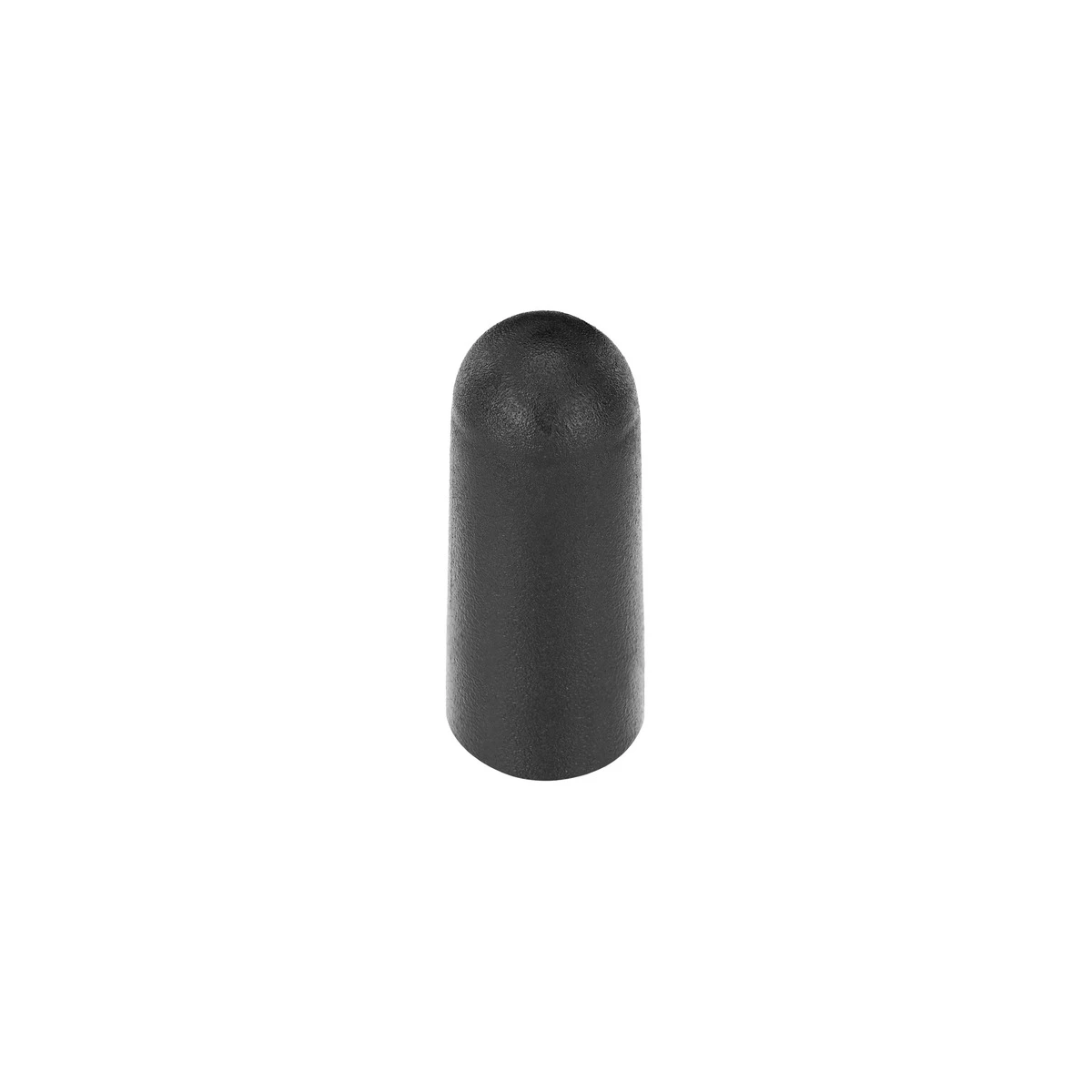 Round End Caps
Outfitting a hotel, restaurant, school, healthcare facility, or large furniture build? Superior Glide supports volume orders with bulk pricing tiers, free physical samples, and dedicated quote pricing for accounts placing larger orders.
Bulk pricing tiers, net terms for qualified buyers, and dedicated support for facility managers and procurement teams.
Hold the product, test the fit, check the finish. We ship samples free so you can evaluate before committing to a full order.
For orders above standard volume tiers, we’ll prepare a custom quote with consolidated shipping and your account’s tier pricing.

Reviews
There are no reviews yet