Hospitality-grade floor protection · Sizing help before you order · Apply for a business account
Sizing help · Apply for a business account
Hospitality-grade floor protection · Sizing help before you order · Apply for a business account
Sizing help · Apply for a business account
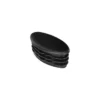
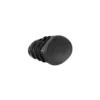
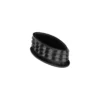
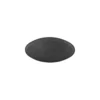
Where a standard plug leaves a head sticking up, this thin-head ellipse plug sits nearly flush with the tube end. It seals and protects without adding any noticeable bump, which matters on stackable furniture and tight-clearance fits. Black, grey, and white.
We make this size in production runs, so there is none on the shelf today. Tell us how many you would want and you go on the list for it. When enough people ask for a size, we run it, and the people who asked hear about it first.
We stock a limited range of tube sizes and wall thicknesses. Tell us the size you need and we will confirm availability and pricing by email.
Buying in volume? See business pricing & samples ↓
Three head profiles. Three purposes. Flat head provides a standard flush finish. Domed head adds a decorative raised profile. Thin head does the opposite of domed: it reduces the head to the thinnest possible profile that still seals and protects the tube end. On stackable furniture where every millimeter of protrusion affects nesting geometry, on tight-clearance assemblies where the tube end sits close to another surface, and on designs where the plug should disappear rather than draw attention, thin head ellipse tube plugs are the right choice.
Same PE construction and flexible body as standard ellipse tube plugs. Same press-fit installation. The only difference is the head thickness: reduced to the structural minimum. Thin head ellipse tube plugs are low-profile ellipse tube plugs for applications where the plug must be as unnoticeable as possible. : 15 × 30 mm and 20 × 40 mm. Wall thickness 1 to 2 mm. Black, grey, and white.
Same three measurements as all ellipse tube plugs: short axis (width), long axis (length), and wall thickness. Thin head ellipse tube plugs fit the same tubes as the flat head variant. If you already know your tube fits a 15 × 30 or 20 × 40 mm flat head ellipse plug, the thin head version fits the same tube.
Use calipers across the narrowest point of the ellipse opening, outside edge to outside edge. The short axis must be 15 or 20 mm.
Use calipers across the widest point, through the pointed ends. The long axis must be 30 mm (for 15 mm short axis) or 40 mm (for 20 mm short axis).
Use calipers at the tube end. Both sizes accept 1 to 2 mm wall thickness across the full range. This is the same wall range as the flat head variant.
Identical to flat head installation. Align the pointed ends of the plug with the pointed ends of the tube, then press in. The thinner head requires slightly less insertion force because there is less material at the head to compress during the final seating. Otherwise the process is the same.
Every benefit of a standard ellipse tube plug with the additional advantage of minimal protrusion. The National Wood Flooring Association (NWFA) recommends protective measures on all furniture legs, and thin head ellipse tube plugs provide that protection with the lowest possible visual and physical profile.
The primary application. Stackable chairs are designed with precise nesting tolerances. A standard flat head plug adds a few millimeters of protrusion at each tube end. A domed plug adds even more. Across a stack of 10 or 15 chairs, those millimeters accumulate and can prevent the top chairs from seating properly in the stack. Thin head ellipse tube plugs reduce the protrusion to the structural minimum, preserving the nesting geometry that the furniture designer intended. For commercial environments where chairs stack daily, stacking reliability directly affects staff efficiency and furniture condition. Minimal profile ellipse plugs that protect without interfering with the stack.
When an ellipse tube end sits close to another surface (an adjacent leg, a crossbar, a seat pan, a wall), standard head thickness can create contact or interference. Thin head ellipse tube plugs reduce the head to a near-flush profile that avoids these clearance problems. Flush ellipse tube plugs thin enough to fit where standard heads do not.
Some furniture designs call for the tube end to look as close to unfinished as possible while still being sealed and protected. Thin head ellipse tube plugs achieve this: the tube end appears to simply stop, with almost no visible cap or head. This is the opposite of the domed ellipse plug, which deliberately draws attention. Thin head plugs for ellipse legs that disappear into the design.
Floor protection, tube sealing, noise dampening, and moisture barrier. The thinner head does not compromise any of these functions. The PE surface still contacts the floor smoothly. The body still seals the tube opening completely. Unlike leaving tube ends open and unprotected, thin head plugs provide full protection at the thinnest possible profile.
All three ellipse plug head profiles fit the same PE body. The choice is purely about the head: how much it protrudes, how it looks, and whether protrusion matters for stacking or clearance.
Flat head ellipse tube plugs have a standard-thickness head that sits flush with the tube end. Thin head reduces the head further. On non-stackable furniture where clearance is not a concern, flat head is the standard choice. On stackable furniture and tight-clearance assemblies, thin head provides the lower profile that prevents interference.
Domed ellipse tube plugs add a raised, rounded profile above the tube edge. Thin head does the opposite: it minimizes the profile. Domed is for decorative visible ends. Thin is for invisible, functional ends. The two are at opposite ends of the visibility spectrum. Note that domed uses 20 × 35 mm (not 20 × 40) for its larger size.
Open tubes on stackable furniture expose sharp metal edges that scrape against the next chair in the stack, damaging the finish. Open tube ends also collect debris during storage. Thin head ellipse tube plugs seal the end with minimal protrusion. The plug protects during stacking without affecting nesting geometry.
Thin head is currently available only on ellipse tube plugs. For round tubes, round tube plugs come in flat head only. The thin head option addresses the specific need for minimal-profile plugs on ellipse stackable seating, which is where the combination of stacking requirements and ellipse tubing is most common.
The thin PE head provides the same basic floor protection as standard flat head plugs. PE is smoother and softer than bare metal, adequate for most surfaces without scratching. The thinner head means a slightly smaller contact area, but the full ellipse footprint is still covered.
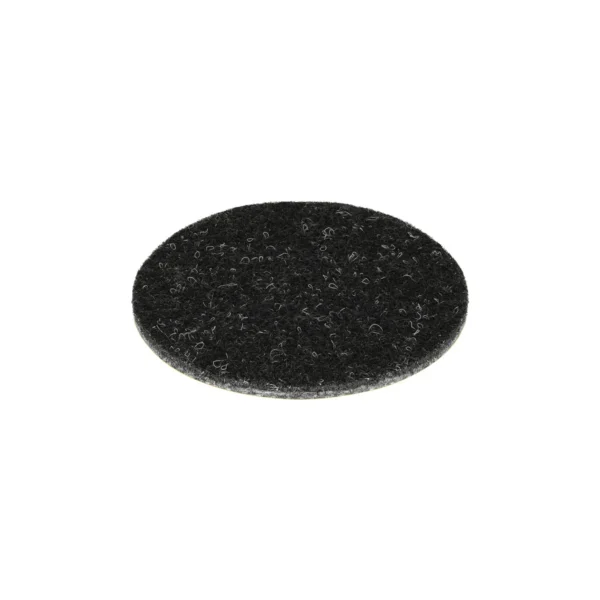
On scratch-sensitive floors like engineered hardwood or luxury vinyl, apply a round self-adhesive furniture pad to the thin head for dedicated PA6 protection. On rough hard surfaces like textured tile or stamped concrete, furniture slides with ABS surfaces handle the texture better than PE. On carpet, the thin PE head provides adequate contact without additional treatment. The key advantage of the thin head across floor surfaces is that the nearly flush profile does not catch on carpet fibers or floor transitions the way a thicker head might when furniture is dragged across surfaces.
Same ellipse cross-section, different head profiles. Choose the variant that matches your application.
15 × 30 and 20 × 40 mm. Minimal profile. Black, grey, white.
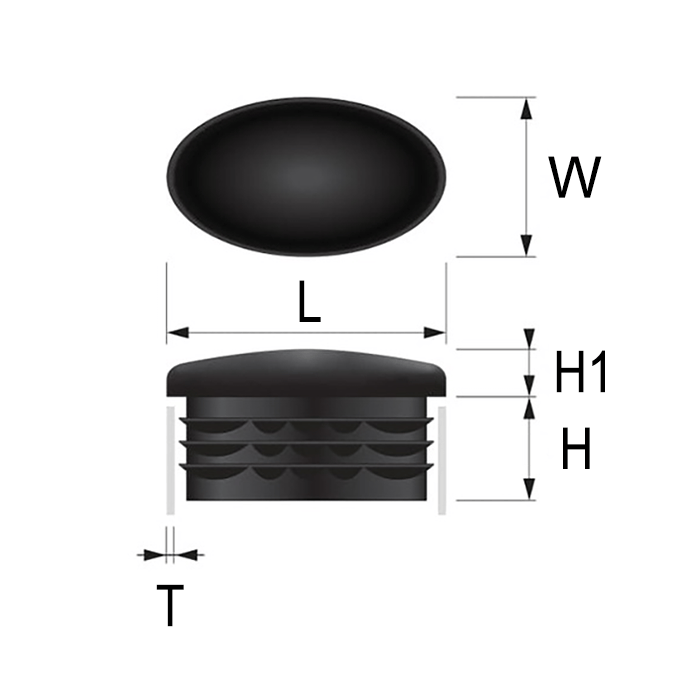
| Fits Tube (W) | Fits Tube (L) |
|---|---|
| 15 mm (0.59″) | 30 mm (1.18″) |
| 20 mm (0.79″) | 40 mm (1.57″) |
Tube wall thickness is a fit requirement, not a tolerance.
| Specification | Detail |
|---|---|
| Material | Polyethylene, a tough low-friction plastic |
| Sizes | 2 sizes |
| Width (W) | 15 to 20 mm (0.59″ to 0.79″) |
| Length (L) | 30 to 40 mm (1.18″ to 1.57″) |
| Height (H) | 12 mm (0.47″) |
| Head height (H1) | 3 mm (0.12″) |
| Tube wall thickness (T) | 1 to 2 mm (0.04″ to 0.08″) |
| Mounting | Pushes into the tube, held by ribs |
| Colors | Black, Gray, White |
| Floor compatibility | Hollow tube legs |
| Minimum order | Sold in a minimum of 4, then any quantity you need |
The thin head has a reduced head thickness compared to the standard flat head ellipse plug. Both sit close to the tube end, but the thin head reduces the visible protrusion to the minimum that still provides structural integrity. The difference is subtle but matters on stackable furniture and in tight-clearance applications where even a few millimeters of head thickness affect fit.
Yes. Stackable chairs need plugs that do not interfere with the nesting geometry. Thin head ellipse tube plugs add the least protrusion of any ellipse plug variant, which preserves the tight tolerances that stacking designs require. Standard flat head and especially domed head plugs can prevent clean stacking.
The PE surface is the same material, so the scratch resistance is identical. However, the thinner head distributes weight across a slightly smaller contact area. For dedicated floor protection, apply a round self-adhesive furniture pad to the thin head for PA6 coverage.
Yes. Both thin head and flat head use 15 × 30 and 20 × 40 mm. The domed variant uses 20 × 35 mm instead of 20 × 40 for its larger size. Thin head and flat head are interchangeable on the same tube; only the head profile differs.
Choose thin head when the plug must be as invisible as possible: stackable furniture, components that nest together, tight clearances between the tube end and an adjacent surface, or any design where a visible plug head detracts from the aesthetic. Choose flat head for general use where the standard head thickness is not a concern.
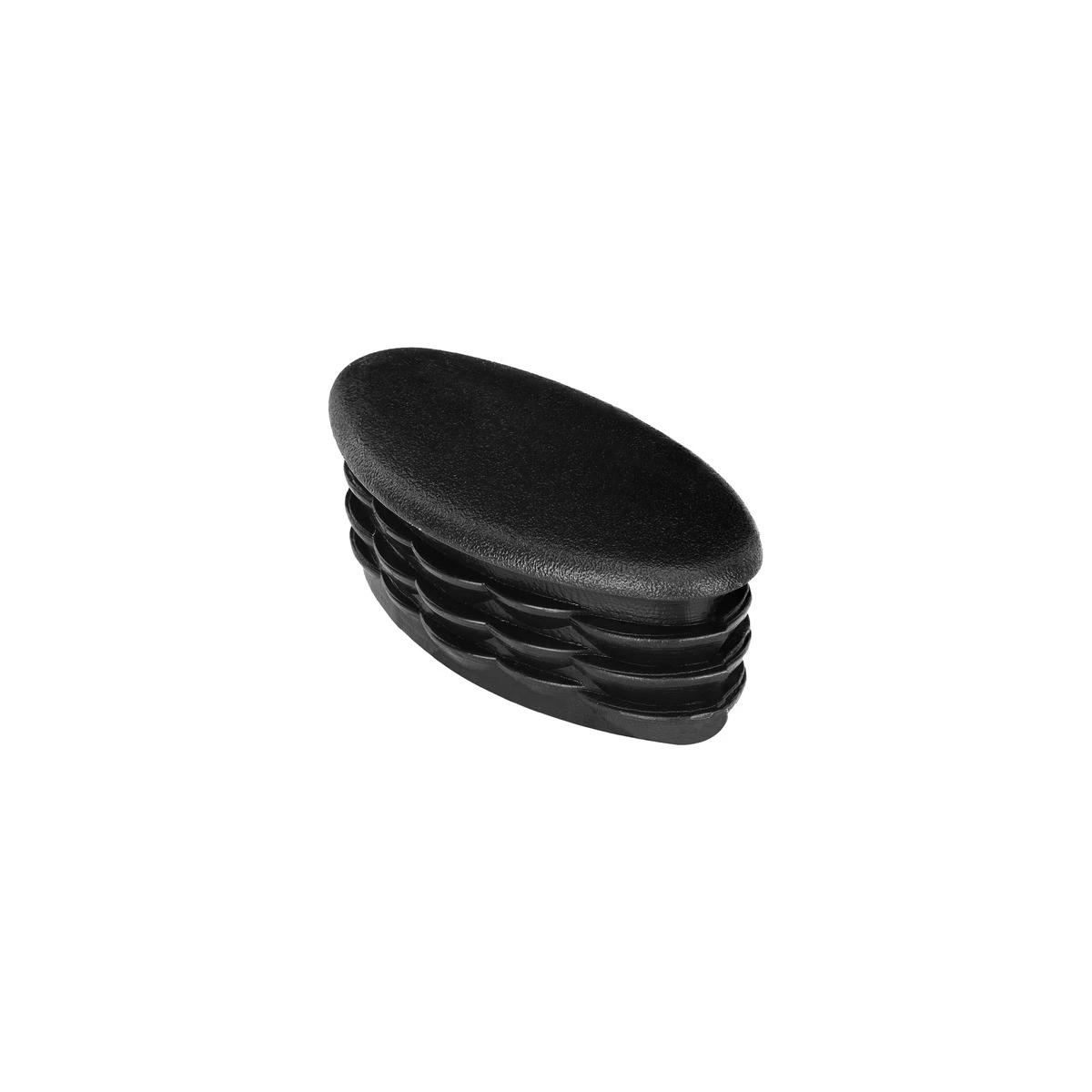 Thin Head Ellipse Tube Plugs
Outfitting a hotel, restaurant, school, healthcare facility, or large furniture build? Superior Glide supports volume orders with bulk pricing tiers, free physical samples, and dedicated quote pricing for accounts placing larger orders.
Bulk pricing tiers, net terms for qualified buyers, and dedicated support for facility managers and procurement teams.
Hold the product, test the fit, check the finish. We ship samples free so you can evaluate before committing to a full order.
For orders above standard volume tiers, we’ll prepare a custom quote with consolidated shipping and your account’s tier pricing.

Reviews
There are no reviews yet