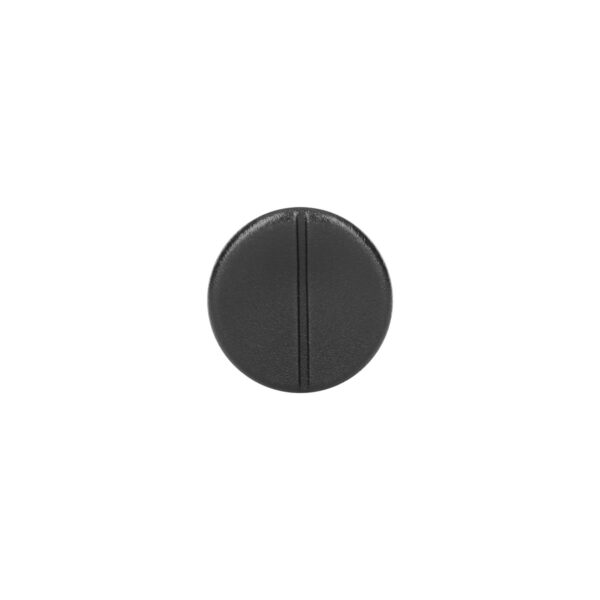
Angled round tube plugs solve the problem that standard flat head plugs cannot: furniture legs that meet the floor at an angle instead of straight down. The plug body press-fits inside the tube at the same angle as the leg, so the base sits flat and level on the floor. No wobble, no edge contact, no uneven wear. Tube plugs for angled legs on chairs, stools, and tables with splayed or raked designs. 2 diameters (Ø 20 and 22 mm), 2 angles (9° and 22°), wall thickness 1.5 to 2 mm. Black and grey. Sold in multiples of 4.
Not sure what size? See the size chart ↓
📦 Sold in packs of 4 — quantity adjustable at checkout
Standard flat head plugs assume the leg meets the floor straight down. Many chairs, stools, and tables do not. When furniture legs splay outward or rake backward, a flat plug sits at an angle to the floor: one edge digs in, the other lifts off, and the plug wears unevenly, wobbles, and scratches. Angled round tube plugs solve this by building the angle correction into the plug itself. The body press-fits inside the tube at the same angle as the leg, so the flat base sits level on the floor. Full base contact. No wobble. No edge digging. No uneven wear.
Same PE construction and flexible ribbed body as the flat head range. Same press-fit installation. The only difference is the geometry: the head is cut at a fixed angle (9° or 22°) relative to the tube axis. Angled round tube plugs are tube plugs for angled legs on any furniture with splayed, raked, or tilted hollow round legs. 2 diameters: Ø 20 and Ø 22 mm. Wall thickness 1.5 to 2 mm. Black and grey. Sold in multiples of 4.
Angled round tube plugs come in 3 size-and-angle combinations across 2 diameters and 2 angles. Each combination covers a specific leg tilt range. The right angled round tube plug matches your tube’s outside diameter (OD), wall thickness, and the angle at which the leg meets the floor.
Wall: 1.5 to 2 mm. For aggressively splayed legs on stools, side tables, and design-forward seating. Black (RAL 9005) and grey (RAL 7040).
Wall: 1.5 to 2 mm. For slightly tilted legs on dining chairs, side chairs, and standard seating with a gentle splay. The most common angled round tube plug specification. Black (RAL 9005) and grey (RAL 7040).
Wall: 1.5 to 2 mm. For aggressively tilted legs on the same Ø 22 mm tubing. When the gentle 9° correction is not enough and the leg splays at a steeper pitch. Black (RAL 9005) and grey (RAL 7040).
For straight legs (0° angle), flat head round tube plugs come in 26 sizes from Ø 10 to Ø 80 mm. For decorative heads on non-floor-contact tube ends, see conical, domed, or half-sphere head styles. For custom angles or diameters, contact Business Solutions.
Three measurements instead of two. Angled round tube plugs require the standard outside diameter and wall thickness, plus the angle at which the leg meets the floor.
Use calipers or a ruler across the widest point of the tube opening. Outside edge to outside edge. Angled round tube plugs are available in Ø 20 and Ø 22 mm.
Use calipers at the tube end, or calculate: (OD minus ID) / 2. Both sizes require 1.5 to 2 mm wall for the ribs to grip properly.
Place a digital angle finder on the leg and read the tilt from vertical. A leg that tilts 9° from vertical needs the 9° plug. A leg that tilts 20° to 24° from vertical needs the 22° plug. If your reading falls between 9° and 22°, choose the closer value.
Same press-fit mechanism as all our tube plugs, with one extra step: rotational alignment. The angled base must face the correct direction relative to the leg’s tilt. Angled round tube plugs press in by hand at 1.5 to 2 mm wall thickness. A rubber mallet provides extra seating force if needed.
The specific problem of angled legs meeting flat floors. The National Wood Flooring Association (NWFA) recommends protective contact surfaces on all furniture legs, and angled round tube plugs ensure that the entire base contacts the floor evenly instead of concentrating pressure at one edge.
The primary function. When a standard flat plug goes on a tilted leg, only one edge touches the floor. That single line of contact concentrates all the weight, digs into the floor finish, and creates a pivot point. Angled round tube plugs correct the tilt so the entire flat base meets the floor. Weight distributes evenly. No edge digging. No pivot. These are the tilted leg tube plugs that eliminate the geometry problem at the source. Angled furniture leg plugs that match the leg to the floor.
A flat plug on a tilted leg creates a sharp line of contact that scratches hardwood, gouges vinyl, and wears through laminate. Angled round tube plugs spread that contact across the full base diameter. Less pressure per square millimeter means less damage. Unlike leaving metal edges unprotected, the flat PE base provides a smooth, broad contact surface. For additional scratch protection on sensitive floors, apply a round self-adhesive furniture pad to the flat base.
A plug that only contacts the floor at one edge creates a pivot. The chair rocks. It tips. It makes noise every time someone shifts their weight. Angled round tube plugs eliminate the pivot by providing full base contact. The chair sits stable and flat. No rocking, no tipping, no metallic scraping at the pivot edge. Splayed leg tube end plugs that turn unstable seating into stable seating.
Same sealed end as every other plug in the range. The angled geometry does not compromise the seal. Moisture, debris, and insects are kept out of the tube interior. Angled round tube plugs protect the tube and correct the floor contact angle at the same time.
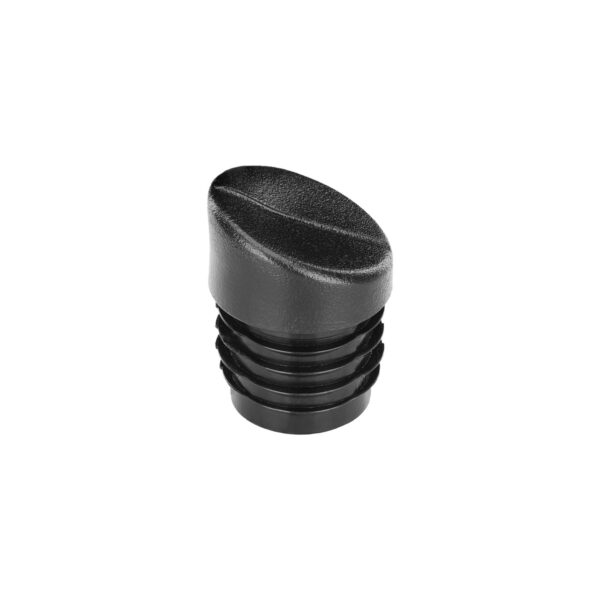
Same PE (polyethylene) body and flexible ribbed grip as every tube plug in the range. The only difference is the head geometry: the base is cut at a fixed angle relative to the tube axis. Angled round tube plugs are molded from a single piece of PE with no joints, seams, or separate components.
The base is a flat disc identical in material to a standard flat head plug. The angle is in the relationship between the base and the tube axis, not in the base itself. At 9°, the correction is subtle and handles the gentle splay found on most dining and side chairs. At 22°, the correction is aggressive and handles the steep tilt found on design-forward stools, loungers, and architectural seating. Angled round tube plugs use the same PE compound that resists UV, chemicals, moisture, and impact across all our plug products.
Identical rib structure to the flat head range. The ribs compress during insertion and expand against the inner tube wall. At the 1.5 to 2 mm wall thickness specified for all angled sizes, the ribs engage firmly. No adhesive, no screws, no tools beyond an optional rubber mallet. Angled round tube plugs hold securely even under the asymmetric load distribution created by angled legs.
If your furniture has legs that meet the floor at an angle, here is how angled round tube plugs compare to the alternatives.
A flat head plug on a tilted leg sits at the leg angle, not flat on the floor. One edge digs in, the other lifts. Angled round tube plugs correct this so the base sits level. If your legs are straight, use flat head. If your legs are tilted, use angled.
A self-adhesive pad on the bottom of an angled tube still contacts the floor at an angle. The pad compresses unevenly and wears on one side. Angled round tube plugs correct the angle first, then you can add a self-adhesive pad to the flat base for PA6 floor protection with full, even contact.
Some installers file or cut the tube end at an angle to create flat floor contact. This exposes raw metal, creates sharp edges, voids any powder-coat finish, and cannot be undone. Angled round tube plugs achieve the same result without modifying the tube. Removable, replaceable, non-destructive.
Anti-slip round tube plugs grip the floor but assume a straight leg. On an angled leg, the TPE head contacts at an angle and grip is uneven. Angled round tube plugs establish flat contact first. For angled legs that also need grip, install the angled plug and add a TPE pad to the flat base.
Angled round tube plugs are designed for any hollow round furniture leg that meets the floor at an angle instead of straight down. The angle correction is the entire purpose of this product.
Every variant uses the same internal ribbed PE body. The head determines floor behavior, appearance, and specialized function.
9° and 22° angle correction for splayed and tilted legs. Ø 20 and 22 mm.
Anywhere Ø 20 or Ø 22 mm hollow round furniture legs meet the floor at an angle. Angled round tube plugs correct the tilt so the full base contacts the floor, turning an unstable, floor-damaging geometry into stable, protected floor contact.
Dining chairs and side chairs with gently splayed legs are the most common residential application for angled round tube plugs. Mid-century modern chairs, Scandinavian-style seating, and contemporary accent chairs frequently use splayed leg geometry in the Ø 20 to 22 mm tubing range. The 9° plug handles most of these designs. For the same furniture, use flat head plugs on any straight legs and angled plugs only on the tilted ones.
Restaurant chairs, cafe stools, hotel lounge seating, and bar stools with raked legs. In commercial environments where hundreds of chairs sit on finished hard floors, the angle correction matters: one edge digging into hardwood or tile across an entire dining room adds up quickly. Angled round tube plugs are available in bulk for commercial fit-outs. For commercial pricing, visit Business Solutions. For floor-contact legs that also need PA6 scratch protection, pair with round self-adhesive furniture glides.
Angled round tube plugs require the same minimal maintenance as flat head plugs. Check periodically that the plug remains seated and that the base still sits flat on the floor. Over time, if the plug rotates slightly inside the tube (unusual but possible under heavy use), the base will no longer sit level. Pull the plug, realign, and reseat it. The PE surface does not stain, discolor, or absorb cleaning products.
Inspect the flat base for wear. Because the base contacts the floor evenly (unlike a flat plug on a tilted leg, which wears on one edge), angled round tube plugs wear more slowly and more uniformly than misapplied flat plugs. On commercial furniture, inspect every 3 to 6 months. On residential furniture, an annual check is enough. Angled round tube plugs are sold in multiples of 4, so keeping spares on hand for commercial environments is practical.
Round Tube Plugs (Flat Head): for legs that meet the floor at 0°. 26 sizes from Ø 10 to Ø 80 mm. Use flat on straight legs and angled round tube plugs on tilted legs on the same piece of furniture.
Round Self-Adhesive Furniture Pads: apply a PA6 pad to the flat base of the angled plug for dedicated scratch protection on hardwood and finished floors.
| Specification | Details |
|---|---|
Product Type |
Tube Plug – Inner with Angle (9° / 22°) |
Shape |
Round Tube |
Materials |
PE (Polyethylene) or PA (Polyamide – Ø20 mm only) |
Fit Style |
Friction-fit ribbed compression |
Floor Compatibility |
All hard and soft flooring |
Furniture Compatibility |
Chairs, tables, stools, racks, shelving, institutional and commercial furniture |
Leg Compatibility |
Metal and plastic round tubing with angled legs |
Sizes Available |
Ø20 mm (1.5–2 mm wall), Ø22 mm (1.5–2 mm wall) |
Color Options |
Black, Grey |
Installation Type |
Press-fit (hand or rubber mallet) |
Key Benefits |
Angled face correction, anti-rocking stability, scratch protection, durable hold |
Indoor/Outdoor Use |
Indoor | Covered Outdoor | Uncovered Outdoor |
Recyclable |
Yes |
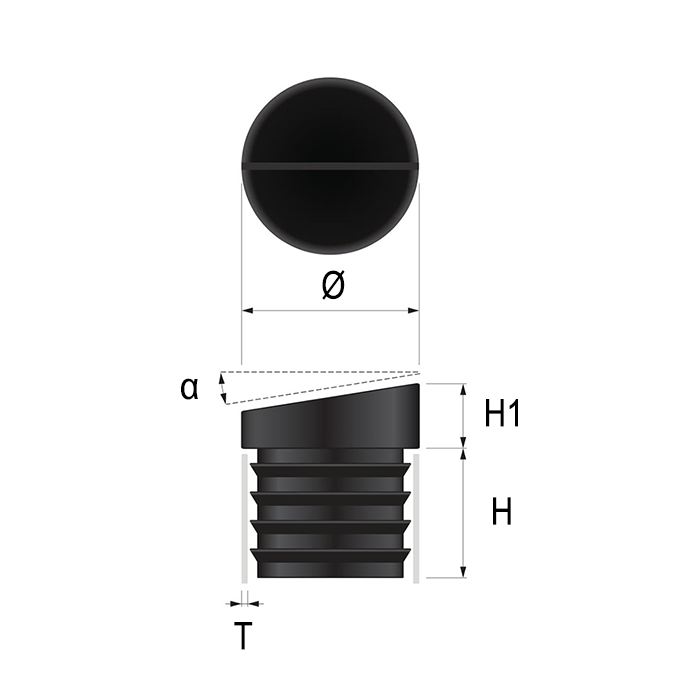
| Outer Tube Diameter (Ø) | Tube Wall Thickness (T) | (H) Insert Depth | Head Height (H1) | Angle (α) |
|---|---|---|---|---|
20 mm (0.79") |
1 – 1.5 mm (0.04" – 0.06") |
11.5 mm (0.45") |
10 mm (0.39") |
22 |
22 mm (0.87") |
1 – 1.5 mm (0.04" – 0.06") |
16 mm (0.63") |
8 mm (0.31") |
9 |
22 mm (0.87") |
1.5 – 2 mm (0.06" – 0.08") |
16 mm (0.63") |
12.5 mm (0.49") |
22 |
The angle depends on how far the leg tilts from vertical. A chair with slightly splayed legs typically needs 9°. A stool or table with aggressively raked legs typically needs 22°. Measure by placing a digital angle finder on the leg and reading the tilt from vertical. If you are between the two values, choose the closer angle. A 9° plug on a 22° leg will leave one edge lifted. A 22° plug on a 9° leg will rock the opposite direction.
The angled base is flat PE, the same material as standard flat head plugs. It provides basic floor contact but not dedicated scratch protection. For angled legs on scratch-sensitive floors, install angled round tube plugs and apply a round self-adhesive furniture pad to the flat base for PA6 floor protection.
Almost. Ø 22 mm is available in both 9° and 22°. Ø 20 mm is available in 22° only. All sizes come in black and grey.
You can, but the plug will sit at the leg angle instead of flat on the floor. Only one edge of the plug contacts the floor, which creates a pivot point, concentrates wear, and can scratch floors. Angled round tube plugs eliminate this problem by compensating for the leg tilt so the full base contacts the floor.
For custom angles, contact us through Business Solutions. Custom molds are possible with minimum order quantities. For angles close to 9° or 22°, the standard plugs often work well enough because the PE base has slight flex that accommodates minor deviations.
Only logged in customers who have purchased this product may leave a review.


Reviews
There are no reviews yet