
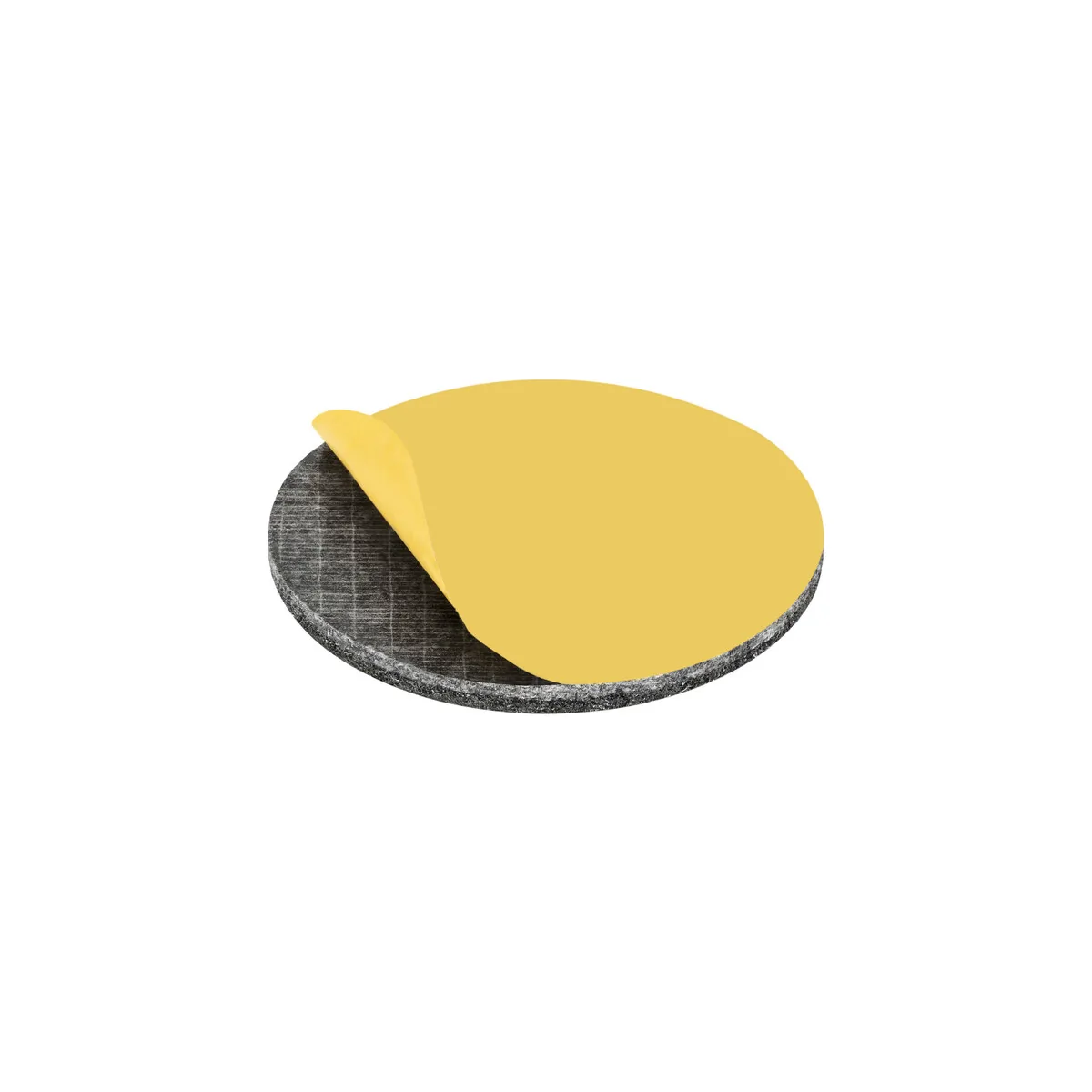
Stick-on pads are the easiest floor protection there is. Peel, press, done. They are also the product people most often get wrong, and it is always the same mistake: the pad is bigger than the leg. Knowing how to measure furniture legs for pads is the whole difference between one that stays on and one that peels.
How to measure furniture legs for pads takes two minutes. Here is where to measure, and what to do with the number.
Pads cover more sizes than anything else we make
Worth knowing before you start, because it changes what you are shopping for. Round pads run from 12 mm (0.47″) up to 300 mm (11.81″). Glides stop at 75 mm.
So a pad is not just the easy option. It is the only option at both ends of the range. A leg under 23 mm is too small for any glide. A leg over 95 mm is too wide for any glide. Sideboards, bed frames, sofa feet, wide table pedestals and small metal café legs all live outside the glide range, and a pad covers all of them, because a pad only has to cover the base and stick to it.
Why the size matters more on a pad than anything else
A pad has no rivet. The adhesive does all the work, so anything that stresses the bond shortens its life.
An oversized pad overhangs the leg. Every time somebody sits down or the furniture shifts, that overhang flexes, and the flexing works the adhesive loose from the edges in. The overhang also catches on doorways and rug edges, which speeds it up.
An undersized pad leaves a sliver of leg bare. You lose a little coverage, but the pad stays on.
So the rule only bends one way: flush with the bottom of the leg, or slightly smaller. Between two sizes, take the smaller one.
How to measure furniture legs for pads, by leg shape
Tip the piece over so the bottom of the leg faces you. Measure the flat surface that actually touches the floor.
Round legs: straight across. That is the diameter.
Square legs: one side.
Rectangular legs: length and width. Write both down.
Tapered legs: at the very bottom, not partway up. A leg 30 mm in the middle and 25 mm at the floor takes a pad sized for 25 mm.
Legs with a ring or flare at the foot: the flat surface below the decoration, not the widest point of it.
That is how to measure furniture legs for pads, one leg at a time. Then check two or three legs from the same set. If they differ, size the whole set to the smaller number.
Match the shape first, then the size
Shape comes before size in how to measure furniture legs for pads. A round leg takes a round pad. A square leg takes a square pad. A rectangular leg takes a rectangular pad sized on both dimensions, because a round or square pad on a rectangular leg overhangs the narrow side, and that is exactly the overhang that peels.
Every size is listed on the product pages for round, square and rectangular pads. Find your measurement, take the size that is flush or one step smaller.
Long runners and rails
Bench legs, sled-base chair runners and long rails need coverage a round pad cannot give, so the rectangular line includes a 19 x 510 mm (0.75″ x 20.08″) strip you cut to length with a utility knife.
Measure the flat part of the runner that actually sits on the floor, not the total length including the curved ends, then trim to that measurement or a touch under. Press it on in sections from one end to the other. The sizing rule holds when you trim: do not leave any hanging past the contact surface.
Standard, heavy-duty or foam
All three have the same needle-punched PA6 fiber face, the upright, glue-free pile our glides use, so the floor protection is identical. They differ in what is behind the fiber.
Standard suits everyday furniture: dining chairs that move a little, side tables, desk chairs without casters.
Heavy-duty is built for weight and for pieces that get dragged rather than lifted: sofas, dressers, sideboards, dining tables.
Foam adds a foam layer between the fiber and the leg, which lets the pad seat properly on a leg whose bottom is not perfectly flat or smooth.
How to measure furniture legs for pads works the same across all three.
Pads are for hard floors, including furniture that never moves
This comes up a lot, so here is the straight answer.
On a hard floor, stationary furniture is what pads are best at. A bookcase, a sideboard, a bed frame, a wardrobe. Nothing drags, so nothing needs a rivet, and the pad quietly does two jobs: it keeps the raw leg off the finish, and it means the piece can be nudged into place when you clean without gouging anything. The National Wood Flooring Association lists abrasive traffic among the leading causes of finish wear, and a pad is the simplest way to keep a raw leg from adding to it.
On carpet, a pad is not the answer, even on furniture that never moves. Carpet does not scratch, so there is nothing for a fiber face to protect against, and the fiber and the carpet pile catch on each other the moment anything does shift. If the furniture on your carpet never moves, it does not need a pad at all. If it moves, it needs a slide, which has a hard ABS face made to skim across pile. Heavy furniture crushing carpet is a different problem again, solved by spreading the load rather than by anything you stick on.
The same goes for rough floors. Slate, brick, textured tile and tile with deep grout lines will catch and tear a soft fiber face. Those want slides too.
Fitting
- Clean the bottom of the leg with 70% isopropyl alcohol. Dust, wax and factory oils are what make adhesive fail.
- Let it dry completely.
- Peel the backing and press the pad on firmly, centered on the leg.
- Give the adhesive 48 hours to reach full strength before any heavy sliding.
On plastic legs, fit one pad and test it before doing the set. Some plastics have a low-energy surface that any adhesive struggles with.
A useful shortcut: on furniture that stays put, you do not need to guard the 48 hours at all. The adhesive cures while the furniture sits there.
Common mistakes
Buying one size up for extra coverage. The overhang peels.
Measuring the widest part of a tapered leg instead of the bottom.
Putting a round pad on a rectangular leg.
Skipping the alcohol wipe. This is the single most common cause of a pad that will not stay on.
Sliding the furniture hard an hour after fitting. You are testing a bond that is not finished.
Still not sure how to measure furniture legs for pads
That is the whole of how to measure furniture legs for pads: measure the leg, write down the number, and check the size list on the pads page. Between sizes, or an unusual leg? Email a photo of the bottom of the leg with a ruler beside it to support@superiorglide.com, or use the chat, and we will match it for you.
Browse all furniture pads for hard floors. If the furniture moves every day, the glides and slides sizing guide is the one you want instead.
Fitting out a restaurant, hotel, school or office? Business Solutions covers free samples so you can test on your own furniture, plus volume pricing and a quote for the whole job.