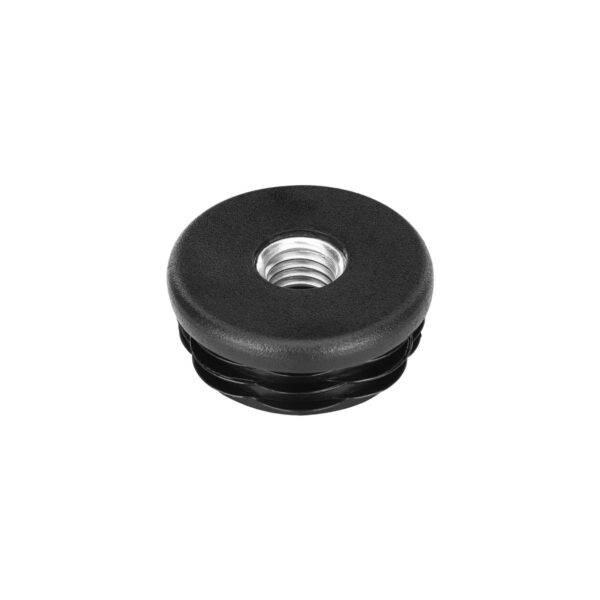
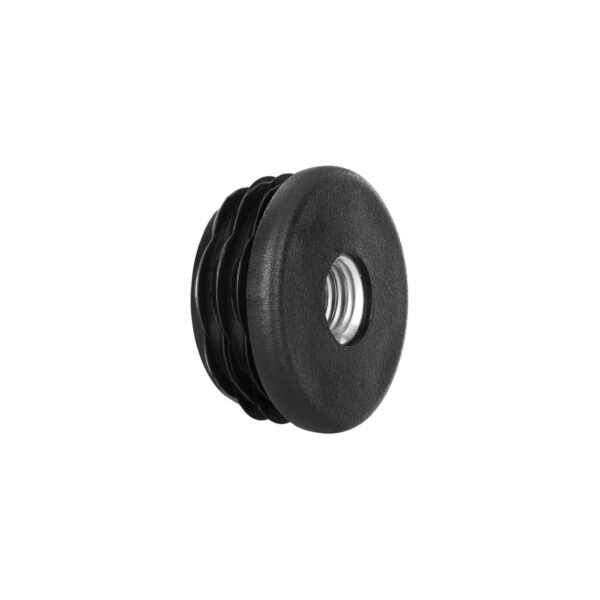
Round threaded inserts press inside hollow round furniture legs and provide a built-in threaded nut for adjustable leveling feet. The PA body grips the tube interior with flexible ribs. The zinc-plated steel nut accepts M6, M8, M10, or M12 leveling feet. Match the insert to the tube diameter and wall thickness, then screw in any leveling foot with the corresponding thread. Threaded inserts for round tube legs on tables, desks, workbenches, and commercial furniture that needs height adjustment. 3 diameters: Ø 28, 40, and 50 mm. Wall 1 to 2 mm. Black, grey, and white. Sold in multiples of 4.
Not sure what size? See the size chart ↓
📦 Sold in packs of 4 — quantity adjustable at checkout
Standard tube plugs seal and finish hollow round legs. Round threaded inserts do that and add something standard plugs cannot: a built-in threaded metal nut that accepts adjustable leveling feet. The PA body press-fits inside the tube the same way a plug does. But instead of a flat PE head, a zinc-plated steel nut sits centered in the insert, ready to receive any leveling foot with a matching M thread. Tables, desks, workbenches, and commercial furniture that needs height adjustment on uneven floors start with round threaded inserts.
PA (polyamide) body for structural rigidity under load. Zinc-plated steel (Fe HDG) threaded nut for corrosion-resistant thread engagement. Flexible internal ribs grip the tube wall without adhesive. Round threaded inserts are threaded inserts for round tube legs that bridge the gap between the hollow tube and the leveling foot. 3 tube diameters: Ø 28, 40, and 50 mm. 4 thread sizes: M6, M8, M10, and M12. Wall thickness 1 to 2 mm. Black, grey, and white. Sold in multiples of 4.
Round threaded inserts are organized by tube diameter, then by thread size within each diameter. The tube diameter must match your round tube. The thread size must match the leveling foot you plan to use. Both must be correct for the system to work.
M6 (black, white) and M8 (black). Wall 1 to 2 mm. The smallest diameter for lightweight tables, side tables, and compact furniture frames. M6 handles the lightest loads. M8 provides a step up for moderate furniture weight.
M8 (black), M10 (black), and M12 (black, grey). Wall 1 to 2 mm. The most versatile diameter with the widest thread range. M8 for light to medium duty. M10 for standard commercial furniture. M12 for heavy tables, workbenches, and industrial equipment.
M8 (black) and M10 (black). Wall 1 to 2 mm. The largest diameter for heavy commercial table legs, conference tables, and industrial workbench frames. The larger tube provides more structural support for the heavier loads that M8 and M10 feet carry at this scale.
For extended insertion depth on Ø 35 mm tubes, see extended round threaded inserts. For square tube legs, see square threaded inserts. For rectangular tube legs, see rectangular threaded inserts. For leveling feet to screw into these inserts, browse adjustable leveling feet. For custom sizes or threads, contact Business Solutions.
Two components in one product. The PA body handles the tube connection. The steel nut handles the leveling foot connection. Together they create a threaded interface inside a hollow round tube that was never designed to accept a screw.
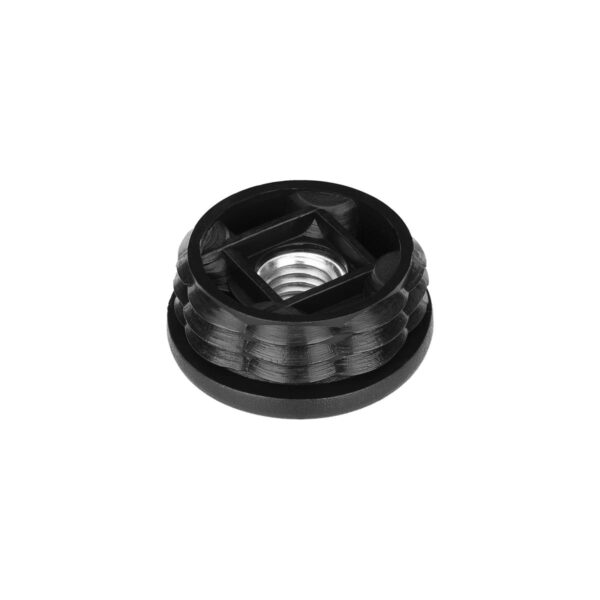
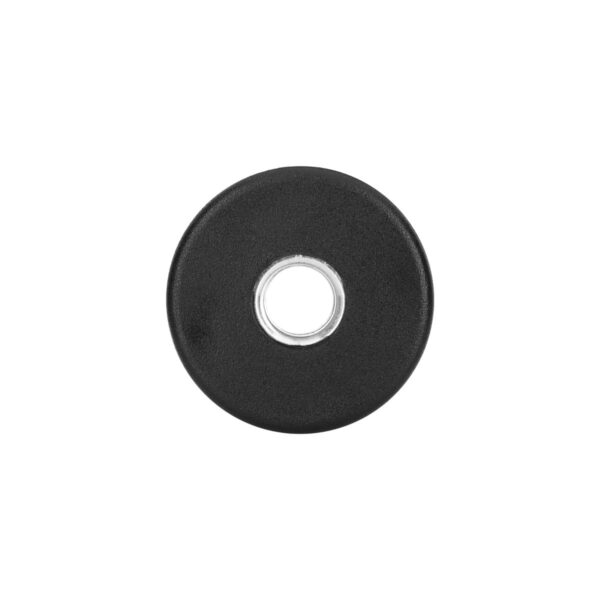
The PA body with flexible ribs press-fits into the hollow round tube, the same way a standard tube plug does. The ribs compress during insertion and expand against the tube interior. No adhesive, no screws. The insert body grips the tube wall through friction. The threaded nut is centered and exposed at the bottom of the insert, facing the floor.
Any leveling foot with the matching M thread screws into the nut. Turn the foot clockwise until it engages the threads, then continue turning to adjust the height. The leveling foot extends below the insert, creating an adjustable contact point between the furniture and the floor. Turn to raise. Reverse to lower. Round tube threaded inserts leveling that adjusts in seconds.
Two measurements for the insert: tube outside diameter and wall thickness. One decision for the system: which M thread size matches your leveling foot or your load requirements.
Use calipers across the outside of the round tube. Round threaded inserts are available for Ø 28, 40, and 50 mm. The insert must match the tube diameter exactly.
Use calipers at the tube end. All round threaded inserts require 1 to 2 mm wall thickness. If your tube has thicker walls, the insert body will not seat fully.
M6 for the lightest loads (small side tables, display stands). M8 for light to medium (dining tables, desks). M10 for medium to heavy (conference tables, commercial furniture). M12 for heavy duty (workbenches, industrial tables). If you already have leveling feet, match the thread to them.
Same press-fit installation as standard round tube plugs. The PA body with ribs slides into the tube and grips the interior wall. A rubber mallet is recommended for the PA body, which is more rigid than PE and requires a firmer push to seat fully.
The fundamental problem: hollow round tubes have no threads. Without round threaded inserts, there is no way to screw a leveling foot into a hollow tube leg. The National Wood Flooring Association (NWFA) recommends protective contact on all furniture legs, and leveling feet installed through round threaded inserts provide adjustable, floor-friendly contact that standard plugs cannot.
The primary function. Tables, desks, and workbenches wobble on uneven floors. Leveling feet screw into round threaded inserts and extend or retract to compensate for floor irregularities. Each leg adjusts independently, so one low corner can be raised without affecting the other three. Furniture leg threaded inserts round profiles need for stable, wobble-free contact on any floor surface.
Leveling feet have broad, flat bases (often with anti-slip or PA6 pads) that distribute weight and protect floors. Unlike bare metal tube ends that scratch and gouge, a leveling foot base provides controlled, designed floor contact. Round threaded inserts are the bridge that connects the hollow tube to that leveling foot. Round threaded inserts M8 M10 options that match the most common leveling foot specifications.
The threaded nut transfers the full furniture load from the leveling foot through the insert body into the tube wall. PA handles this concentrated compressive and shear stress. The zinc-plated steel nut handles the thread engagement and rotational forces from height adjustment. Together, the PA body and steel nut create a load path that a standard PE tube plug cannot provide.
Like every other press-fit product in the range, round threaded inserts seal the tube opening. Moisture, debris, and insects are kept out. The PA body fills the tube opening around the nut, providing the same moisture barrier as a standard plug. The insert seals the tube whether or not a leveling foot is installed, though the exposed nut threads should be protected from debris if the foot is removed.
Two materials engineered for different roles. The PA body handles tube grip and structural support. The steel nut handles thread engagement and load transfer. Round threaded inserts are the only products in the tube plug range that combine plastic and metal in one assembly.
PA provides higher tensile strength and rigidity than PE. Under the concentrated load of a leveling foot, the body must resist compression, shear, and creep. PA handles all three. The flexible ribs grip the tube interior, and the rigid body around the nut transfers load to the tube wall.
Hot-dip galvanized steel. The zinc coating protects against corrosion in normal indoor environments. The nut is pre-installed in the PA body during manufacturing. M6, M8, M10, and M12 threads are precision-formed to accept standard metric leveling feet.
If your furniture needs leveling capability on hollow round tube legs, here is how round threaded inserts compare to the alternatives.
Standard round tube plugs seal and finish the tube but do not accept leveling feet. If you do not need height adjustment, standard plugs are simpler and less expensive. If you need leveling, round threaded inserts are the only press-fit option that provides a threaded interface inside a hollow tube.
Extended round threaded inserts have a deeper insertion body for extra grip in thin-walled Ø 35 mm tubes. If your tube is Ø 35 mm and the standard-depth insert does not hold, the extended version provides more retention. For Ø 28, 40, and 50 mm tubes, standard depth round threaded inserts are the correct choice.
Welding a nut inside a round tube provides a permanent threaded interface but requires welding equipment, proper alignment, and refinishing of any damaged coating. Round threaded inserts push in by hand with a mallet. Removable. No heat. No refinishing. No welding skill required.
T-nuts and pronged inserts are designed for wood or solid material, not hollow metal tubes. They require a solid surface to grip their prongs. Round threaded inserts are designed specifically for hollow round metal tubing with 1 to 2 mm walls.
Round threaded inserts are designed for any hollow round furniture tube that needs to accept an adjustable leveling foot. The insert bridges the gap between the hollow tube and the threaded foot.
Choosing the right thread size depends on the load the furniture carries and the leveling foot you plan to use. Here is a general guide for round threaded inserts across the three available tube diameters.
The smallest thread. For lightweight furniture: small side tables, display stands, accent tables. Low load capacity. Available only in the Ø 28 mm tube diameter.
The most versatile thread. Available across all three tube diameters. Handles light to medium furniture loads: dining tables, home office desks, light commercial tables. The most commonly specified thread for general furniture leveling.
Medium to heavy duty. For conference tables, commercial dining tables, institutional furniture, and equipment with moderate to substantial loads. Available in the two larger tube diameters where heavier furniture is most common.
Heavy duty. For workbenches, industrial tables, heavy commercial equipment, and any furniture where the per-leg load is substantial. Available only in Ø 40 mm. Black and grey.
Anywhere hollow round furniture legs need adjustable leveling feet. Round threaded inserts are the standard method for adding threaded leveling capability to hollow round tubing.
Restaurant tables, hotel dining tables, office desks, conference tables, and institutional workstations. In commercial environments, uneven floors are common and leveling is not optional. Round threaded inserts with adjustable leveling feet provide the height compensation that prevents wobbling, rocking, and the customer complaints that follow. Available in bulk for manufacturing runs and facility fit-outs. For commercial pricing, visit Business Solutions.
Workbenches, assembly stations, testing fixtures, and industrial equipment with round tube frames. Precise leveling is critical when the work surface must be flat and stable. M10 and M12 threads handle the heavier loads typical in industrial applications. For environments where the steel nut would corrode (wet floors, chemical exposure), stainless steel threaded inserts are available in square profiles.
Check that the insert remains firmly seated in the tube. Under heavy load or repeated height adjustment, the insert can shift if the ribs have worn. Tighten or retighten the leveling foot periodically. Over time, vibration and floor contact can loosen the foot. A quick check every 3 to 6 months on commercial furniture keeps the leveling system stable.
Inspect the zinc plating on the nut for corrosion. In normal indoor environments, the zinc coating provides adequate protection. If the plating shows rust spots, the environment may be too humid or chemically aggressive for zinc-plated steel. Consider upgrading to stainless steel inserts for those conditions. Round threaded inserts are sold in multiples of 4. Keep spares on hand for commercial environments where a damaged insert needs quick replacement.
Adjustable Leveling Feet: standard base, low-profile, anti-slip, ball-joint, tilt, and stainless steel rod options in M6 through M12 threads.
Square Threaded Inserts: for square tube legs. 6 sizes from 20 × 20 to 50 × 50 mm.
Extended Square Threaded Inserts: deeper grip for thin-walled square tubes.
Rectangular Threaded Inserts: for rectangular tube legs.
Stainless Steel Square Threaded Inserts: for corrosive environments.
| Specification | Details |
|---|---|
Product Type |
Tube Plug with Threaded Insert (Inner) |
Shape |
Round Tube |
Materials |
PA (Polyamide) body + Fe HDG (Galvanized Steel) thread insert |
Fit Style |
Ribbed friction-fit compression with internal threads |
Furniture Compatibility |
Furniture legs, shelving, railings, office fixtures |
Leg Compatibility |
Metal and plastic round tubing |
Tube Outer Diameters |
Ø28 mm (1.10"), Ø35 mm (1.38"), Ø40 mm (1.57"), Ø50 mm (1.97") |
Wall Thickness Range |
1–2 mm (0.04"–0.08") |
Weight Capacity |
60–150 kg (132–330 lbs) static load per plug, depending on size |
Color Options |
Black, White (Ø28 mm only), Grey (Ø40 mm / M12 only) |
Installation Type |
Press-fit by hand or rubber mallet |
Key Benefits |
Adds internal threads, secure fit, corrosion resistance, fast installation |
Indoor/Outdoor Use |
Indoor | Covered Outdoor | Uncovered Outdoor |
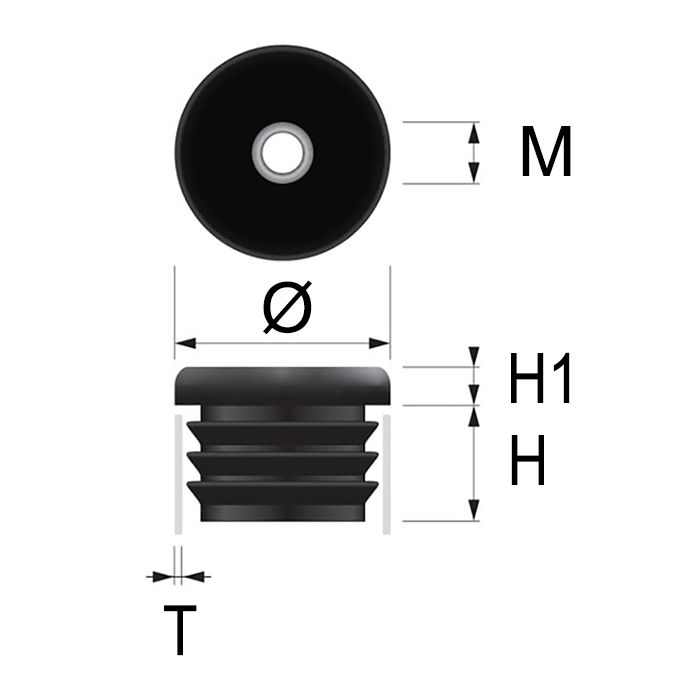
| Tube Diameter (Ø) | Tube Wall Thickness (T) | Threaded Insert (M) | Head Height (H1) | Insert Depth (H) | Static Load Capacity (SL) |
|---|---|---|---|---|---|
28 mm (1.10") |
1 – 2 mm (0.04" – 0.08") |
M6 (6 mm (0.24")) |
5 mm (0.19") |
15 mm (0.59") |
60 kg (132 lbs) / pc. |
28 mm (1.10") |
1 – 2 mm (0.04" – 0.08") |
M8 (8 mm (0.24")) |
5 mm (0.19") |
15 mm (0.59") |
80 kg (176 lbs) / pc. |
40 mm (1.57") |
1 – 2 mm (0.04" – 0.08") |
M8 (8 mm (0.24")) |
5 mm (0.19") |
13 mm (0.51") |
80 kg (176 lbs) / pc. |
40 mm (1.57") |
1 – 2 mm (0.04" – 0.08") |
M10 (10 mm (0.39")) |
5 mm (0.19") |
13 mm (0.51") |
120 kg (264 lbs) / pc. |
40 mm (1.57") |
1 – 2 mm (0.04" – 0.08") |
M12 (12 mm (0.47")) |
5 mm (0.19") |
12 mm (0.47") |
150 kg (330 lbs) / pc. |
50 mm (1.97") |
1 – 2 mm (0.04" – 0.08") |
M8 (8 mm (0.24")) |
5 mm (0.19") |
14 mm (0.55") |
80 kg (176 lbs) / pc. |
50 mm (1.97") |
1 – 2 mm (0.04" – 0.08") |
M10 (10 mm (0.39")) |
5 mm (0.19") |
14 mm (0.55") |
120 kg (264 lbs) / pc. |
Any leveling foot with a matching M thread. An M8 insert accepts any M8 leveling foot. An M10 insert accepts any M10 foot. Browse our adjustable leveling feet range for standard base, low-profile, anti-slip, ball-joint, tilt, and stainless steel rod options. The thread interface is universal, so third-party leveling feet with the same thread also work.
PA (polyamide) has higher tensile strength and rigidity than PE. The threaded nut transfers the full weight of the furniture and its load through the insert body into the tube wall. PA handles this concentrated stress without deforming. PE would compress under the same load and lose grip over time.
Fe HDG stands for iron (steel) hot-dip galvanized. The steel nut is coated with zinc for corrosion resistance. This protects the threads from rust in normal indoor environments. For wet or chemically aggressive environments like commercial kitchens, stainless steel threaded inserts are available in square profiles.
Load capacity depends on the thread size and tube diameter. Larger threads and larger tube diameters handle heavier loads. As a general guideline, M8 supports light to medium furniture, M10 handles medium to heavy furniture, and M12 is for heavy commercial and industrial applications. Distribute the total furniture weight plus expected load across all four inserts when calculating per-insert capacity.
Technically yes, but it is not the intended use. The insert seals the tube and the threaded nut is recessed, so the PA body contacts the floor. However, the insert costs more than a standard round tube plug and the exposed thread opening collects debris. Use standard plugs for tube finishing and threaded inserts only when you need leveling feet.
Only logged in customers who have purchased this product may leave a review.


Reviews
There are no reviews yet