
Vinyl plank is a tough floor. It is why people put it in kitchens, entryways and laundry rooms in the first place. What it does not shrug off is the dining chair, and the damage is slow enough that nobody notices until it is done. To protect vinyl plank flooring properly you only need to get two things right: what is under the leg, and what is on the floor.
Here is what actually causes it, and how to protect vinyl plank flooring against it.
What actually scratches a vinyl plank floor
Grit does. Sand and dust come in on shoes and settle where people walk, which is exactly where the chairs are. The top of a plank is a clear wear layer, usually around 12 mils thick on floors sold for family homes, sometimes 20. Weight alone does not bother it, and a chair can sit in one spot indefinitely and do nothing.
What the wear layer cannot take is a hard particle dragged across it under load. So the chair leg is rarely the thing doing the cutting, and neither is the floor. The question is what sits between them, because that is what decides whether grit gets caught, held, and dragged back and forth in the same few inches.
Once you know that, working out how to protect vinyl plank flooring stops being complicated.
The cheapest way to protect vinyl plank flooring
Sweeping is not glamorous, but it costs nothing and matters more than anything you can buy. If the grit is not under the leg, the leg has nothing to cut with. A quick sweep around the table a couple of times a week is the cheapest protection vinyl plank flooring will ever get.
Then match the fitting to the leg
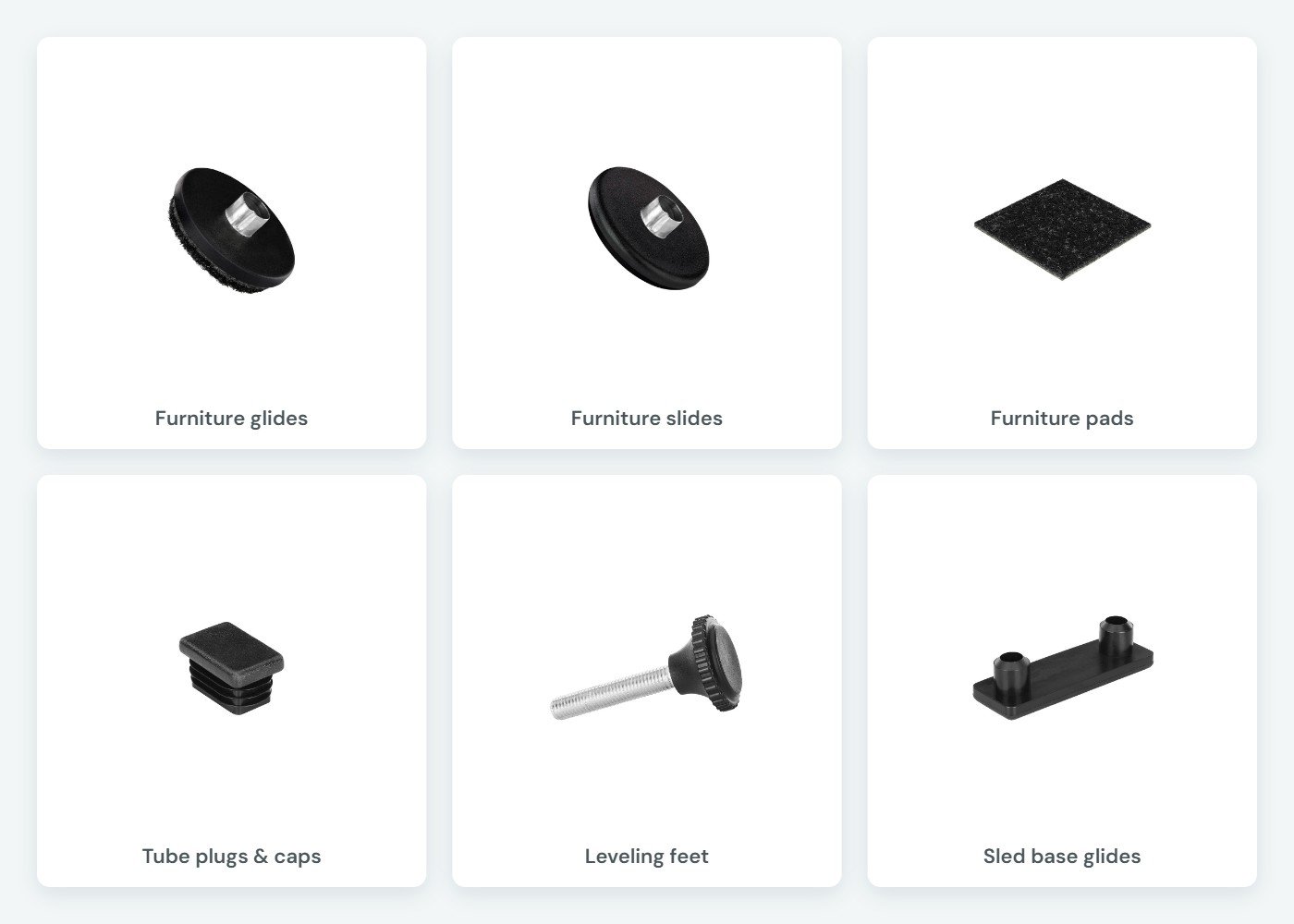
This is the part that does most of the work to protect vinyl plank flooring. Tip the chair back and look at the bottom of the leg. There are four things you might see.
Solid wood. Most dining chairs and most older furniture. Use a nail-on glide. A hollow zinc-plated tubular rivet taps into the wood with a rubber mallet, no drilling, and a small anti-rotation notch on the rivet keeps the glide from turning in the leg once it is seated.
A flat, closed bottom in metal, laminate or veneer. Bar stools, office chairs, patio sets, and most furniture made in the last ten years. A rivet has nothing to bite into there, or it splits the thin skin. Use a self-adhesive glide. Clean the bottom of the leg with 70% isopropyl alcohol, let it dry, press firmly, and give it 48 hours to reach full strength. This is also the answer if you rent and would rather not put rivets in someone else’s furniture.
An open tube you can look up into gives adhesive nothing to hold. That leg takes a push-in tube plug.
Furniture that stays where it is, or a base wider than any glide. A sideboard, a bed frame, a wide table pedestal. Use a self-adhesive pad. Same fiber face on a thin backing, same alcohol wipe, same 48 hours, and pads go on legs far wider than a glide will fit.
If you are not sure what you are looking at, send us a photo of the bottom of the leg. We answer those every day.
Get the size right
Measure the bottom of the leg at its widest point: the diameter on a round leg, both sides on a square or rectangular one. If the leg tapers, measure at the very bottom, because that is the part that touches the floor.
Then take that size or the next one down. Never bigger: an oversized glide does not protect vinyl plank flooring, it snags on it. A glide that sticks out past the leg catches on rug edges and thresholds, and vinyl plank gives it a seam to snag on every few inches. Slightly smaller is invisible.
Glides run 23 mm, 28 mm, 38 mm, 50 mm and 75 mm (0.91″ to 2.95″), plus a 33 x 19 mm rectangle for narrow legs, and each size covers a range upward from its own measurement. A 32 mm leg takes the 28. A 55 mm leg takes the 50. The largest glide covers legs up to 95 mm; anything wider takes a pad. The full chart is in the guide on how to measure furniture legs.
Why felt keeps failing on this floor in particular
Felt is the most common thing people fit to protect vinyl plank flooring, and the one that disappoints them. An ordinary felt pad is fibers laid flat in layers and glued together. Think about the direction you push a chair: sideways, which is the same direction those layers are stacked. They shear apart, one layer at a time, and the pad gets thinner and shaggier. As it opens up it starts catching grit and holding on to it, and now the pad is carrying the abrasive around under the leg instead of keeping it out. If yours keep wearing out in a few months, that is why. It is not you.
Ours are built the other way around. The fibers are needle-punched standing upright, like bristles in a brush, and held mechanically with no glue in the pile. Push sideways and you are pushing against the ends of the fibers rather than sliding one layer off another, so the surface stays closed as it wears. The pile is packed to 1,450 grams of fiber per square meter.
The no-glue part matters more on vinyl plank than anywhere else, for a boring reason. People choose this floor for kitchens and entryways because it copes with water, so it gets mopped more, and walked on in wet shoes more, than the hardwood it replaced. Damp is hard on the glue holding a felt pad together. There is no glue in our pile for it to work on. That is not the same as waterproof and we would not claim it is, but a mopped floor is a normal day for it rather than the thing that finishes it off.
Look at them from time to time
A glide is meant to be the thing that wears out instead of your floor, which only works if you replace it when it does.
A hotel we work with went through four kinds of glide on their lobby stools. The Teflon ones wore down. The soft plastic ones cracked. The nail-on ones broke off and left bare nails sticking out of the legs, which is about the worst thing you can drag across a floor: the plastic head had only been pressed against a narrow nail, so when the plastic gave up, the nail stayed behind and became the lowest point on the stool. On ours the wide rivet head is molded inside the ABS body, one piece, so there is no seam for it to break at. ABS is the plastic Lego bricks are made of, for what it is worth.
So every so often, tip the chairs and look at what has been riding between them and your floor, because that is the part protecting vinyl plank flooring day to day. Swap the tired ones. Because the rivet parts the wood fibers rather than removing them, a nail-on glide can be tapped into the same spot again.
If you only remember four things
- Grit does the scratching. To protect vinyl plank flooring, sweep where the chairs sit.
- Wood leg, nail-on. Flat metal or rented, self-adhesive. Open tube, tube plug. Stays put, pad.
- Measure the leg. Same size or one down, never bigger.
- Check the glides now and then, before one of them checks your floor.
For background on resilient floors as a category, the Resilient Floor Covering Institute publishes technical and maintenance guidance.
Browse furniture glides for hard floors, or read the Furniture Glides Guide for fitting steps and the full size chart. Not sure which suits your chairs? Send a photo of the bottom of a leg to support@superiorglide.com, or use the chat, and we will come back with the size and the part.
Fitting out a restaurant, hotel, school or office with vinyl plank throughout? Business Solutions covers free samples, volume pricing and a quote for the whole job.