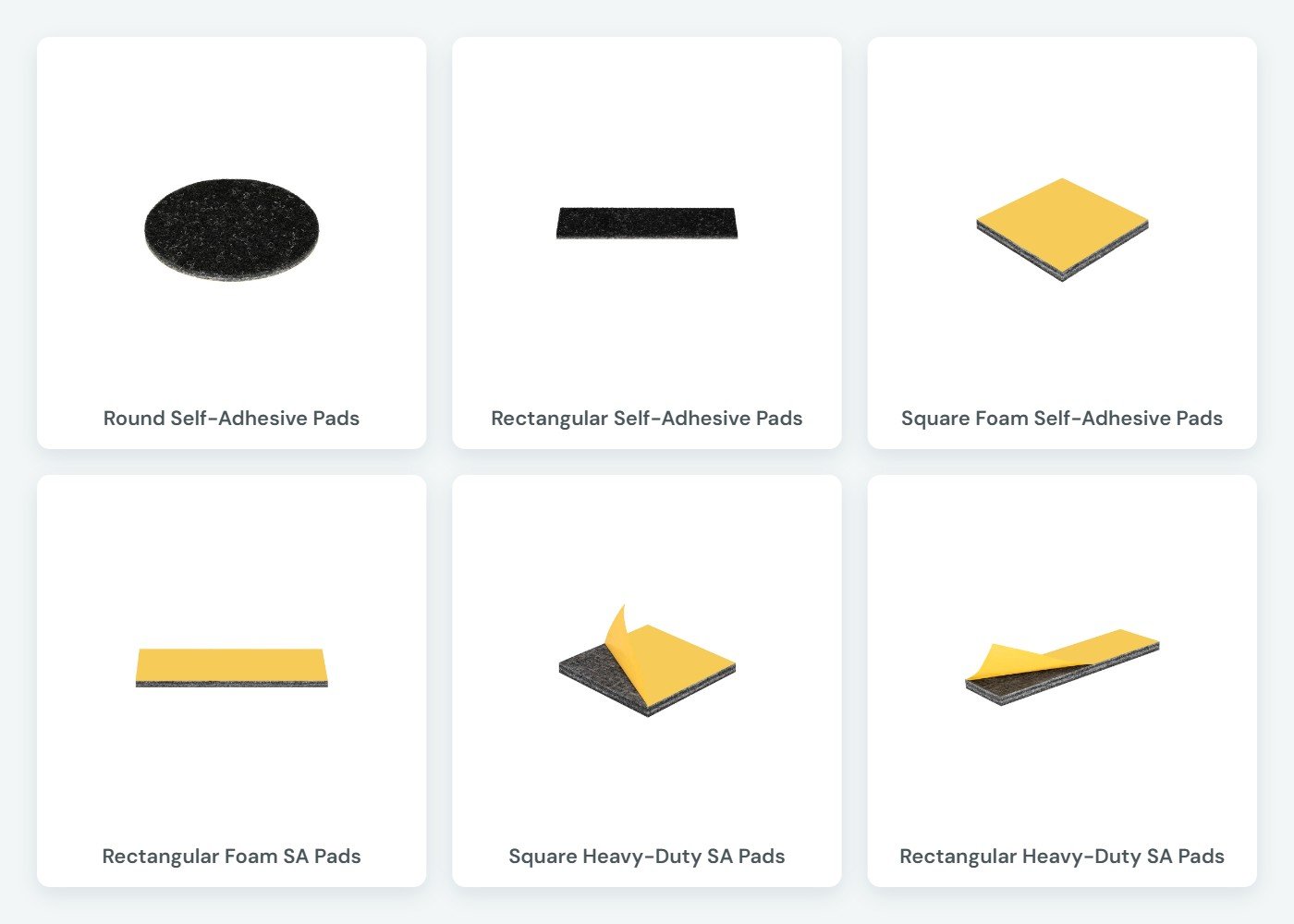

A sofa does not scratch a floor. It presses one. This guide covers the whole job for furniture pads on hardwood, laminate, tile and vinyl: choosing between the three tiers, dealing with a floor or a leg that is not flat, sizing the pad, and bonding it so the face stays put.

On this page:
Start here
Furniture pads come in three tiers. Thickness answers how hard the leg presses. The base answers whether anything under it is flat. Nothing else changes between the three tiers.
Question 1. How hard does the leg press?
PA6 fiber at 5.5 mm (0.22″). Dining tables, sofas, dressers, cabinets, bed frames. This is the tier most furniture wants and the one most orders are for.
PA6 fiber at 11 mm (0.43″), double the thickness. Pianos, pool tables, safes, server racks, marble tops. Anything where a lot of weight arrives through a small foot.
Question 2. Is everything flat?
The pad bonds face to face and stays put. Pick the thickness from the first question and stop there. Most rooms and most furniture fall here.
A closed-cell foam core compresses to take up the gap, so the pad meets the floor across its whole face instead of on one edge. Old boards that have moved, tile lippage, threshold transitions, or a leg base that is no longer true.
Where most orders go wrong
Furniture pads carry load across the whole face, so the size you order is the size doing the work. The direction is the same as every other line here: under the leg edge, never past it.
01
Tip a sofa back onto two legs, or lay a chair on its side. Cabinets and wardrobes usually need a second person. You are looking for the flat face the pad will bond to, and whether it is actually flat.
02
Plenty of legs flare into a wider foot or sit on a plinth. Measure the part that touches the floor. Round: diameter. Square: one side. Rectangular: both, width first.
03
Discrete feet take discs or squares. A plinth, a sled runner, or a long unbroken base wants a rectangular strip rather than four pads in a row, which leaves gaps that catch.

Where to measure the leg base
Order the largest pad that does not exceed your measurement. Sizes step in bands, so a 27 mm base takes a 23 mm pad and the next size up is 30 mm. A few millimeters of leg showing round the edge is normal and costs you nothing, because the pad still lifts the leg clear of the floor. A pad that overhangs catches a vacuum head and peels from the corner, which does cost you something.
Before anything else
Furniture pads use the same PA6 fiber face as the glides line, so the floor list is the same. What changes is that a pad sits still, which makes the finish underneath it matter more, not less.
Hardwood in any species, engineered wood, parquet, bamboo, sealed cork. Laminate at any AC rating, luxury vinyl plank and tile, sheet vinyl. Glazed porcelain, polished ceramic, marble, granite, polished travertine. Sealed and polished concrete, epoxy.
Wall-to-wall carpet, carpet tile, area rugs, indoor-outdoor carpet. Unsealed concrete, textured tile, natural cleft slate, stamped concrete, brick, rough terrazzo. A fiber face has nothing to sit against on any of these.
Fitting protectors under furniture legs appears in the National Wood Flooring Association’s consumer advice as a basic step for keeping a wood floor intact. Their notes on caring for a finished floor are at woodfloors.org.
Ten minutes, and then leave it alone
One method covers all three tiers of furniture pads, and the whole job lives or dies on the first step. They go on furniture that stays put, so the bond cures on its own once the piece is back down.
01
Isopropyl alcohol at 70% or higher, then let it evaporate fully. Old furniture carries wax, polish and oily residue that a dry cloth will not shift, and every one of those sits between the adhesive and the wood.
02
Take the film off and keep your fingers off the adhesive. Skin oil is enough to weaken a bond over a face this size. Discard the backing straight away so it cannot find its way back on.
03
Fiber side down, leg centered on the pad. Thirty seconds of firm even pressure, right out to the corners. Then lower the furniture gently and leave it. Full strength arrives over 48 hours and the weight of the piece helps it get there.
Foam pads have two backings, and only one comes off. A foam pad is built with EHBT mesh on one face and EHBF acrylic foam on the other, so there is a film on each side. Remove the bottom one only and leave the inner layer where it is. Because both adhesives are curing at once, keep the furniture still for the full 48 hours rather than nudging it into place afterwards.
What you are buying
Furniture pads are a stack rather than a molded part, and the order of the layers is what separates the three tiers. Switch views and tap a number to see what each one does.
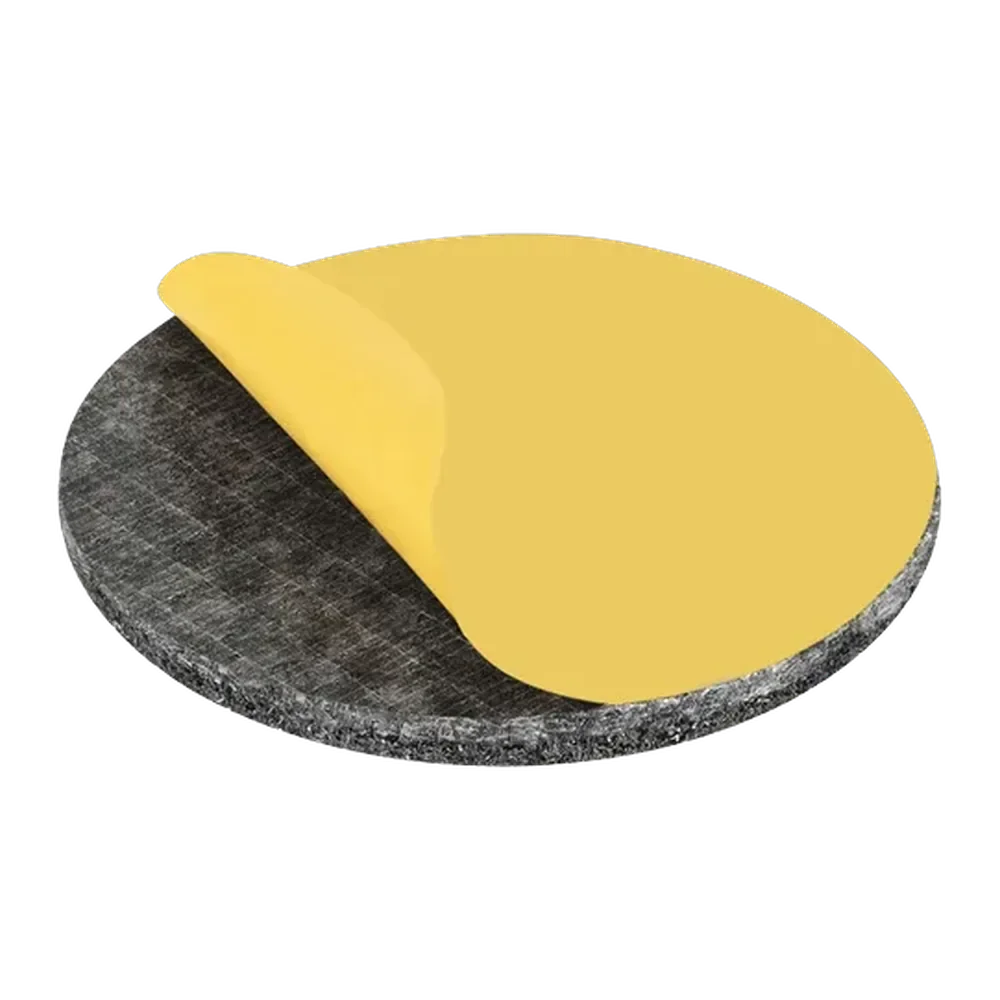
Two precision-engineered components protect your floors from the weight of everyday furniture. The PA6 fiber surface sits against the floor while the EHBT adhesive bonds to the furniture leg base.
PA6 (Polyamide 6) needle-punched fiber, 5.5 mm thick. The fiber face sits against the floor and spreads the load of the leg across its whole area rather than a point, which is what keeps a static piece from pressing a mark into hardwood, tile, or laminate.
EHBT fiberglass mesh tape that bonds to the furniture leg base. Clean the leg with isopropyl alcohol, peel, then press firmly for 30 seconds. Full bond strength comes over 48 hours, which happens on its own on stationary furniture.
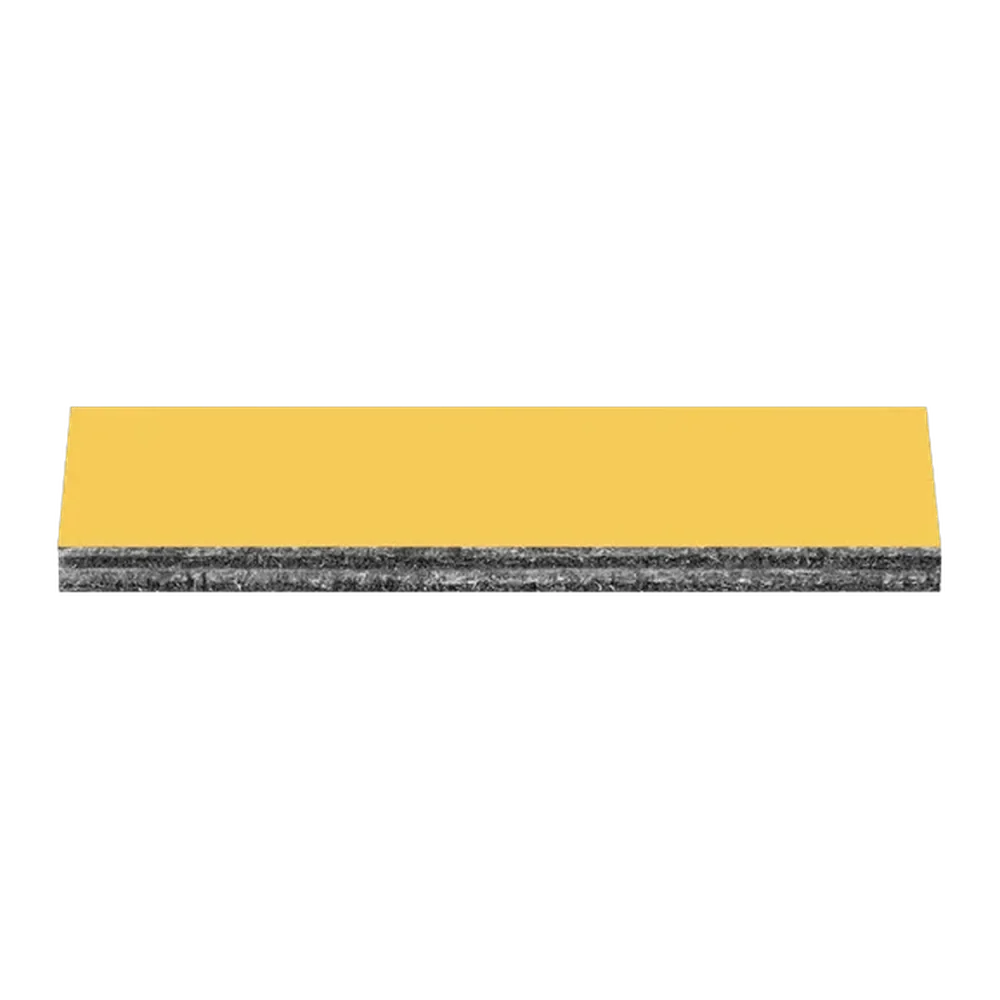
Two precision-engineered components handle extreme weight loads from pianos, safes, marble furniture, and commercial equipment. Same construction as Standard pads, but with doubled thickness for maximum compression resistance.
The same PA6 needle-punched fiber as Standard pads, at 11 mm thick (double the 5.5 mm Standard). The extra depth resists compression under pianos, safes, and other heavy loads, so the fiber keeps its cushion instead of flattening.
The same EHBT fiberglass mesh tape used on Standard pads. Clean the leg with isopropyl alcohol, peel, then press firmly for 30 seconds. Full strength comes over 48 hours.
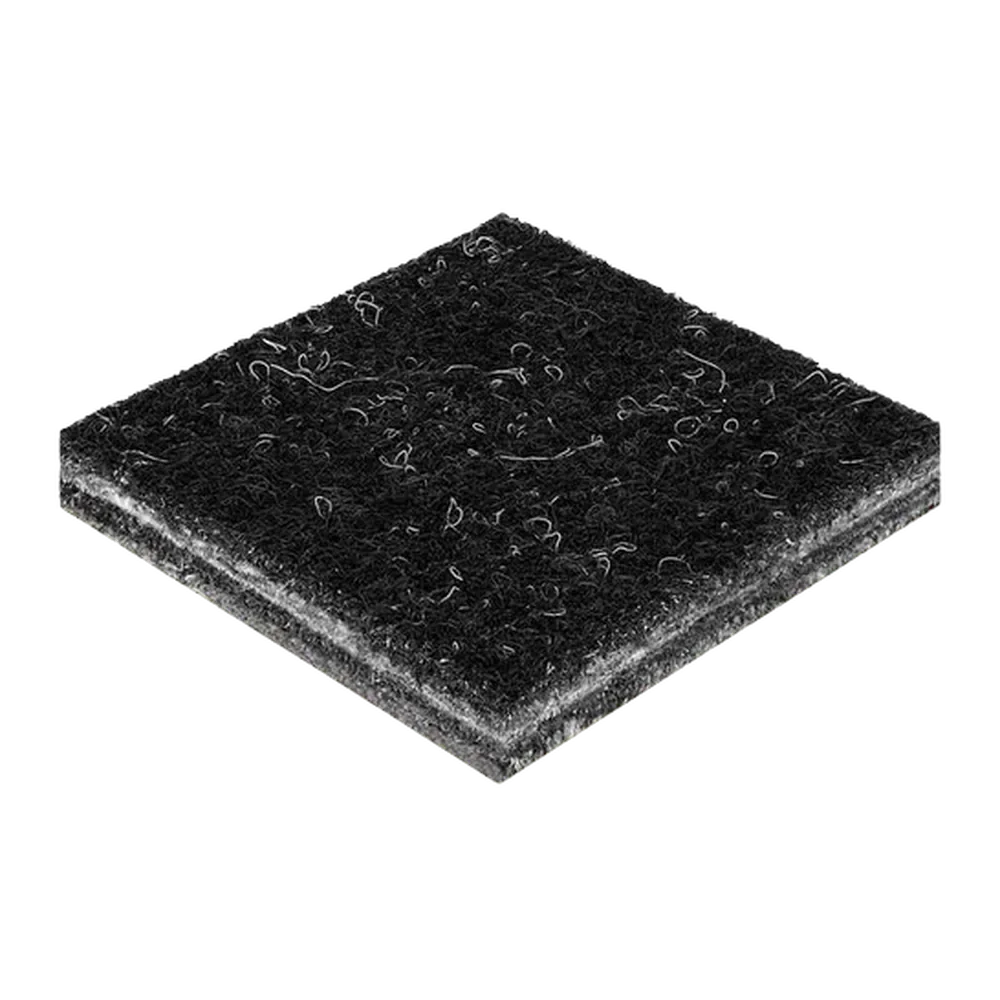
Three layers solve the uneven-floor problem, and uneven leg bases too. The PA6 fiber surface protects the floor, the closed-cell foam core conforms to surface irregularities, and a dual adhesive backing bonds the pad to the leg.
The same PA6 needle-punched fiber face that protects the floor from scratches and traffic marks.
A closed-cell foam core that conforms to surface irregularities, on the floor or the leg base. It lets the pad sit flat on uneven surfaces and warped leg bottoms where a rigid pad would rock.
Foam pads use two adhesives: an EHBT fiberglass mesh in the middle of the stack and an EHBF acrylic foam tape that bonds to the leg. Only the bottom backing peels off, so leave the inner layer in place. Both reach full strength over 48 hours, so avoid moving the furniture during the cure.
The decision behind the decision
Furniture pads and glides carry the same PA6 fiber face and suit the same floors. What separates them is whether there is a rigid platform behind that face, and that is a question about movement rather than about the floor. The furniture glides guide covers the moving side in full.
Fiber bonded straight onto EHBT adhesive, with nothing rigid behind it. It conforms to the leg base and spreads a static load over a wide area. Self-adhesive only, in three thicknesses, up to Ø 300 mm (11.81″) and in strips to 510 mm (20.08″).
The same fiber face on a rigid ABS carrier, which is what lets it take the sideways load of a leg being dragged without the face shearing off the body. Nail-on into wood or self-adhesive onto anything flat.
If you would rather skip the theory
Almost every pad order is one of the six below. Read down to whichever describes your piece and take the tier named there.
Wide feet, heavy, and moved twice a year at most. Standard thickness, sized as close to the foot edge as you can get.
Often a small square foot under a lot of weight, which is exactly the load that dents a board. Heavy-Duty earns its place here more than anywhere else in the house.
Usually a plinth rather than legs, so a continuous strip beats a row of discs. Measure the plinth depth and cut the strip to the run.
Small castors or feet carrying several hundred kilograms. Heavy-Duty, and get as much face under each foot as the base allows.
Boards that have moved, tile with lippage, a threshold running under one leg. Foam takes up the difference so the piece stops rocking and the pad meets the floor flat.
Hundreds of static legs, one floor, and a handover inspection at the end of it. Worth pricing as a job rather than a basket.
Still open
Tiers, sizing and ordering all live on the pads category page. Below are the situations that do not fit a neat leg: plinths, castors, freshly refinished boards, and pads that have flattened out.
A plinth wants a strip rather than pads. Run rectangular strip along the load-bearing edge and cut it to the length of the run. Four discs under a plinth put all the weight through four points on a base designed to spread it, which is the opposite of what you are trying to achieve.
No, and it will not stay on. A castor rolls, and a pad is bonded to something that is supposed to stay still. If the castors are marking the floor, either swap them for soft-tread castors rated for hard floors or remove them and pad the socket face, provided that face is flat and wide enough to bond to.
Follow the finish manufacturer, not us. Most waterborne and oil-modified finishes want furniture kept off for several days and full cure takes considerably longer. Putting a pad onto a floor is not the risk; putting weight onto a finish that has not hardened is. Ask whoever laid it.
That is compression, and it means the fiber has done its work. A pad that has flattened to a thin glazed film is no longer spreading load, it is just a layer between two hard things. Peel it off, clean the residue with isopropyl alcohol, and fit a fresh one. On heavy pieces this is worth checking annually.
Match the thickness, not necessarily the shape. Four legs at different heights will rock, so if one leg gets an 11 mm heavy-duty pad they all should. Shape and size can vary leg to leg where the feet differ, and often have to.
On a sealed or finished leg, usually not. Warm the pad with a hairdryer, lift a corner, and pull slowly back on itself rather than straight down. Residue comes away with isopropyl alcohol. On bare or waxed wood, test a foot you cannot see first, because those finishes can lift.
People use them under appliances, speaker stands, planters and instrument cases, and that works as long as the base is flat, clean and dry. Where it stops working is anything hot, anything that vibrates hard, or anything outdoors, none of which suit an adhesive bond.
Only partially, and partial bonds fail from the edge. A domed or heavily chamfered foot needs either a foam pad, which compresses into the shape, or a flat face created first. If the leg is a hollow tube, a plug gives you that flat face and then any pad will bond properly.
Turn the chair over and measure the leg base at its widest point — the surface that actually touches the floor, not the leg above it. Pick a pad the same size or two to three millimeters smaller, so it sits flush without overhanging the edge.
Full steps with photos: how to measure furniture legs for pads.
Yes. Concentrated loads compress a standard pad and shorten its life. For heavy chairs, barstools and furniture that gets dragged, choose the heavy-duty construction in furniture pads for hard floors — same footprint, denser build.
Browse other furniture guides: Slides Guide · Glides Guide · Tube Plugs Guide · Leveling Feet Guide · Sled Base Guide · Tile Floors Guide · Nail-On Glides How-To
Related reading: why felt furniture pads scratch hardwood floors · how to measure furniture legs for pads
Product categories: Furniture Glides · Furniture Slides · Furniture Pads · Tube Plugs & End Caps · Leveling Feet · Sled Base Glides
Business orders: Business pricing for volume pricing, project quotes, and commercial orders.
That is the guide
Plinths, castors and domed feet catch more furniture pads orders out than anything else, and all three are quicker to solve from a photograph than a paragraph. Send one of the base and one of the floor.
Every size, in one place
Dimensions, materials, load ratings and part numbers for the whole range: glides, slides, pads, tube plugs, threaded inserts, leveling feet and sled base glides. Millimeters and inches side by side, with a drawing for every part.